How does a foreign buyer verify a Brazilian artist's legal and business standing?
A foreign buyer verifies a Brazilian seller's legal standing by matching the CNPJ on the contract and invoice against the Receita Federal's free public lookup, which shows the registered name and whether the registration is active, and optionally a federal tax-clearance certificate. These checks confirm a registered business exists, not that a painting is authentic.
What the CNPJ is and where a buyer can look it up
In Brazil, a business is identified by a CNPJ, the federal registry number for legal entities. The tax authority, the Receita Federal, runs a public service called the Comprovante de Inscrição e de Situação Cadastral: the buyer types the 14-digit number, completes a captcha and receives a certificate. According to a Brazilian accounting publication, the basic lookup is free and open to anyone, and no login is needed. The Receita's own CNPJ page also points to a separate open-data portal for public CNPJ data.
The certificate lists the CNPJ, the registered business name (razão social), the trade name when there is one, the opening date, the company size, the legal nature, the main and secondary activity codes (CNAE), the registered address, and the registration status with its date. That gives a foreign buyer something concrete to compare against what the seller has put on the contract and the invoice.
How to read the result
The field that matters most is the situação cadastral, the registration status. The same source lists five values: active (ativa), suspended (suspensa), unfit (inapta), closed (baixada) and void (nula). A buyer is looking for an active registration whose registered name matches the name that appears on the agreement and on the invoice.
The limits of the check matter just as much. An active CNPJ proves that a legal entity is registered with the federal tax authority. It does not prove that a painting is original, that the artist is who the listing says, or that the seller delivers. Those questions are covered in how to verify an artist's authenticity before buying internationally, where the checks are direct ones: a live video call, detail photographs and a documented body of work.
A second, optional check: the federal tax-clearance certificate
Brazil also issues a joint Receita Federal and PGFN certificate on federal tax debts, the Certidão de Regularidade Fiscal. The official government service page says it covers federal tax debts and the federal Active Debt registry, including social security contributions, that it can come back negative, positive with negative effects, or positive, and that it is valid for 180 days from issue. The same page states that any person can consult and issue these certificates, and that the service is free.
Nothing requires a buyer to ask for it. It is a way to see whether the registered business has outstanding federal tax debts, which is a statement about the business's tax position and nothing more. A seller can also simply be asked to send a current copy.
Matching the paperwork to the registration
The lookup is only useful when it is compared with documents. Three comparisons cover most of it. First, the name and CNPJ on the sale agreement should match the Receita result. At Perfeito Studio, the master Acquisition Agreement is issued with the studio's CNPJ already filled in, and the studio's own registered address is deliberately not published on the site, so the agreement is where a buyer finds the registration number to check. Second, the name on the fiscal invoice or official receipt should be the same entity. Third, the name on the payment instructions should match as well: a transfer account held by an unrelated third party is a reason to stop and ask.
If the document issued is an electronic invoice (NF-e), it carries a 44-digit access key that identifies it. According to a Brazilian tax-software publisher, entering that key in the national NF-e portal gives a summary view with the issuer, the recipient, the amount and the status, while the full view needs a digital certificate. Which type of fiscal document applies to a given sale is something to confirm with the studio, because the answer depends on how the sale is classified. For how the invoice and the certificate of authenticity divide the work at customs, see invoice vs. certificate of authenticity for customs.
From the studio
From the studio
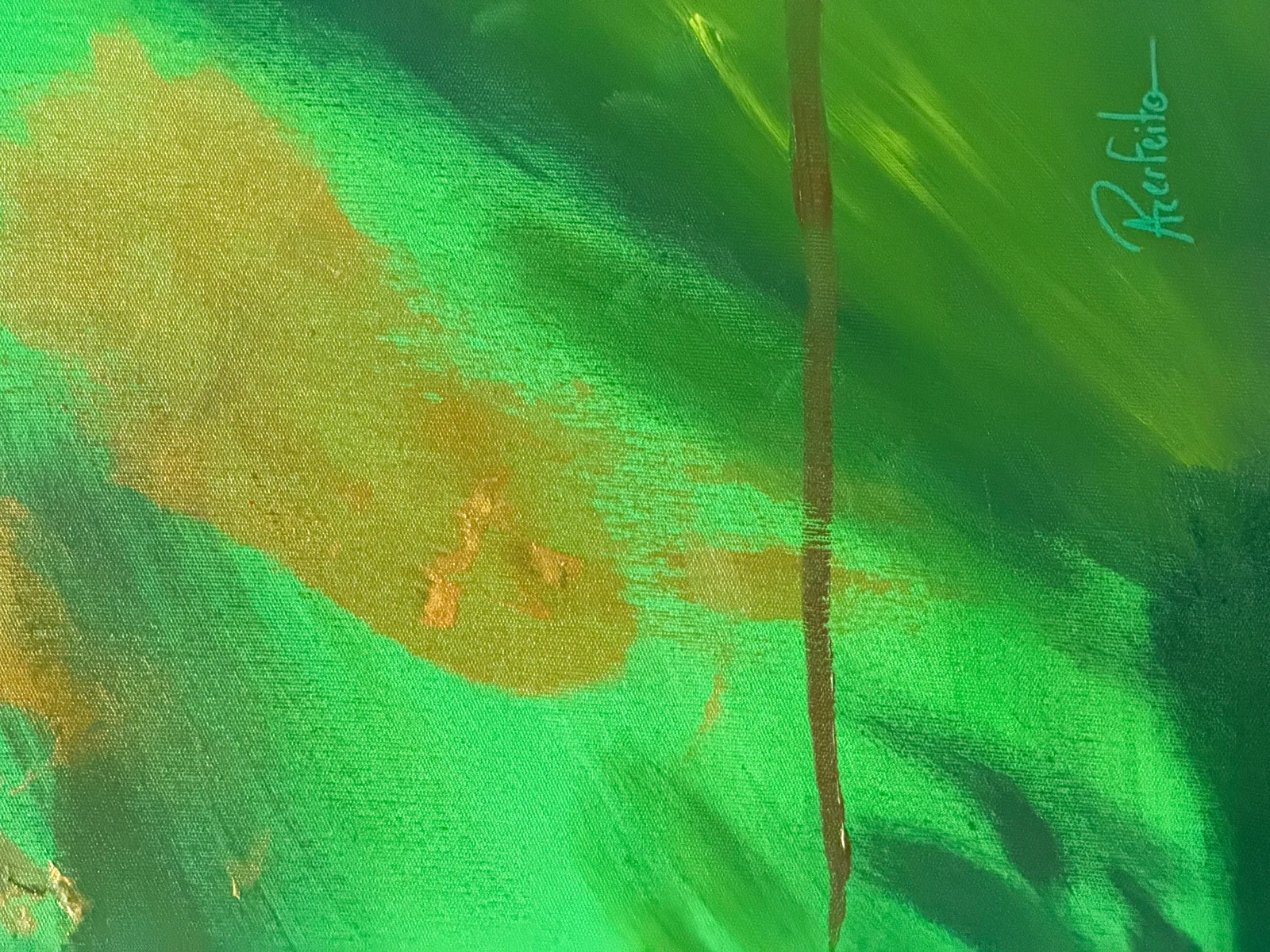
Vegetal Dawn, from Terra & Ether, is 80 x 120 cm and dated 2026, and its detail photograph above shows the signature on the canvas. A signature and a business registration are two different kinds of evidence. The signature belongs to the work, together with its Archive ID, AP-TAE-2026-003, and the signed Certificate of Authenticity that carries a QR code to the work's own page. The registration belongs to the seller, and it sits in the Acquisition Agreement and the fiscal document, where it can be compared with the public record. Because every sale is direct from the artist, without a gallery in between, we would rather a buyer run the lookup than take either document on trust. Anything about our own paperwork that this page does not state, such as which fiscal document applies to a particular sale, is best confirmed with us directly.
Frequently asked
How does a foreign buyer verify a Brazilian artist's legal and business standing?
Ask the seller for the CNPJ, the federal business registration number, and look it up on the Receita Federal's public service, which issues a certificate showing the registered name and the registration status. Then check that the same name appears on the sale agreement and the invoice. If the seller is an individual rather than a company, ask which it is and request the equivalent identifying documents.
What should a foreign buyer know before acting on this?
A CNPJ lookup confirms that a legal entity is registered and whether the registration is active, suspended, unfit, closed or void. It says nothing about whether a painting is authentic or whether the seller will deliver. Treat it as one check among several, alongside a live video call, detail photographs and the certificate of authenticity.
Does this differ for a US buyer versus a European buyer?
The Brazilian side of the check is the same whatever the buyer's country, because the registration and the tax certificate are Brazilian records. What differs is what happens when the work arrives: import duty or VAT rules depend on the destination, and they are covered separately for the United States, the European Union and the United Kingdom on this site.
Who handles this in practice: the artist, a shipper, or the buyer?
The buyer. The lookups are public and free, so no intermediary is needed, and the buyer only needs the seller's registration number and, if wanted, a current copy of the certificate, which the seller can be asked to send. A shipper or customs broker deals with the shipment, not with whether the seller is properly registered, so the standing check is best done before payment.
What could go wrong if this step is skipped?
A buyer could pay an entity whose registration is closed or suspended, or whose name does not match the name on the invoice or the payment account. The step costs a few minutes. It also gives a buyer a clean record of who the counterparty was if a question comes up later about the invoice or the shipment.
Ask for the paperwork before you pay
Message the studio to request the business registration details, the fiscal document type and a live look at the work you are considering.
Sources
- Receita Federal (gov.br) — 2026-10-02
- Receita Federal — 2026-10-02
- Contabilidade.com — 2026-10-02
- Portal gov.br — 2026-10-02
- NFE.io — 2026-10-02
Published on