How to pack paintings for a house move: wrapping, corners and the moving truck
The Canadian Conservation Institute wraps a painting in layers: stiff cardboard over the face, kept off the paint, then clear polyethylene or Mylar taped at the back, then bubble wrap or foam on the outside. Mark front and back. In the truck, strap the package so it cannot shift, and keep it away from cold and heat.

Works cited in this text


Before you wrap anything
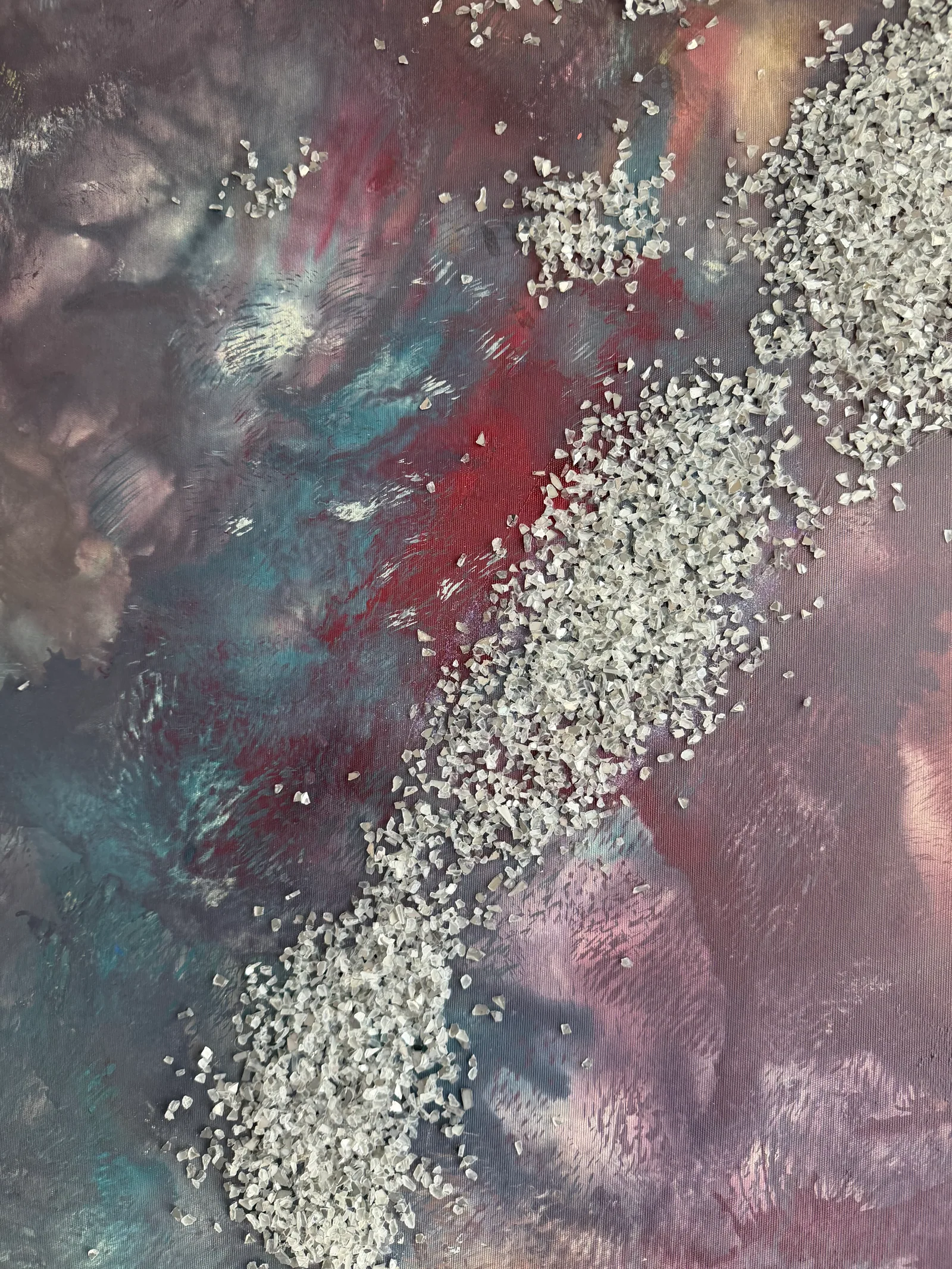
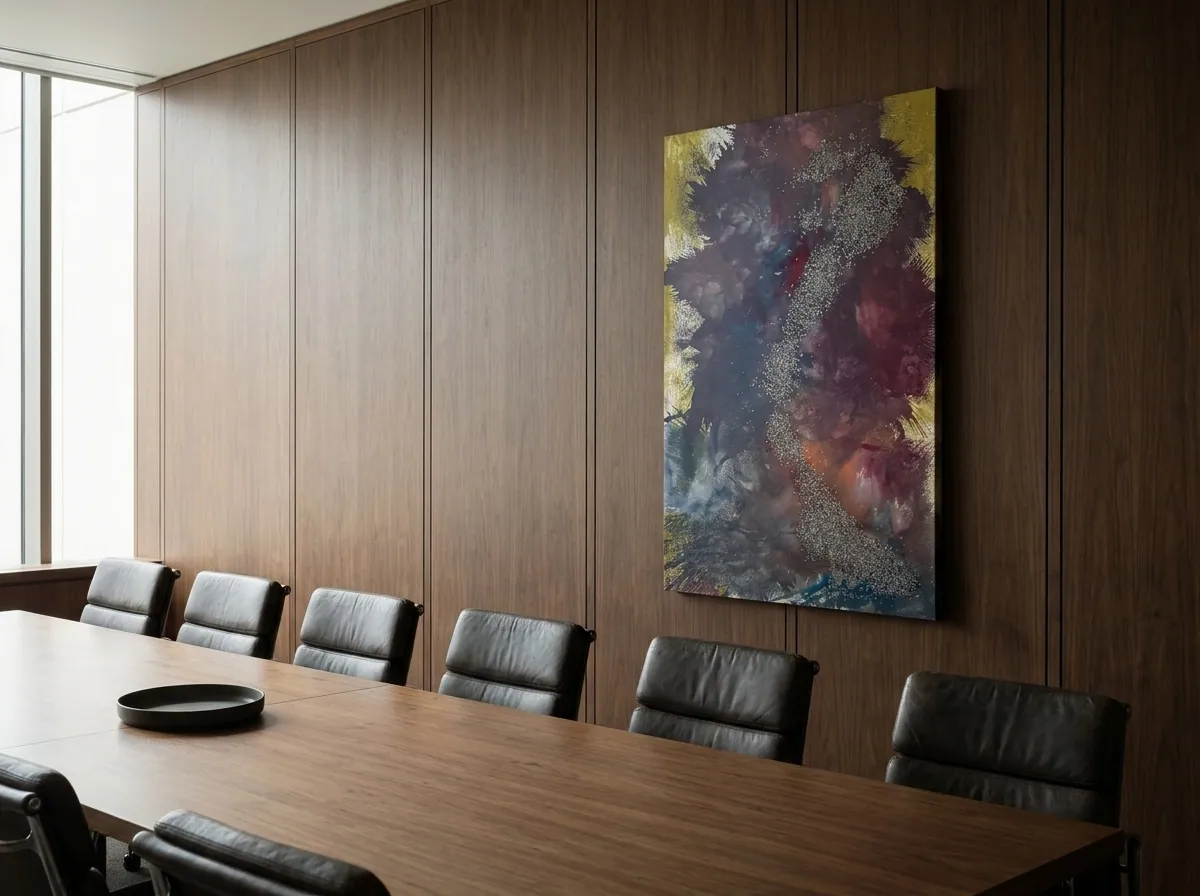
Elemental Veins is a 90 × 140 cm canvas in mixed media, with acrylic and metallic fragments. In the close-up below, the fragments sit in a raised band over the paint. Cardboard or plastic would press there first. Check your own paintings for parts of the surface that stand proud.
The Canadian Conservation Institute (CCI) publishes a short guide, CCI Notes 10/16, Wrapping a Painting, and it opens with checks. Is the painting in good condition? If it is framed behind glass, a spacer should hold the glass off the paint. If it is large, heavy, fragile or in unusual condition, the CCI says it may need special preparation, and that a conservator can advise when in doubt. Keep the cardboard in the room where you will pack for at least a day before you use it; the CCI lists it among materials that take up moisture from the air. Photograph the front and back of each work.
What to buy
The CCI materials list fits on a shopping note:
- rigid cardboard, stiff enough that it will not sag onto the paint (multiwall board for big paintings);
- a clear plastic sheet, either Mylar or clean uncoated polyethylene, 2 to 4 mil thick;
- bubble wrap or a thin sheet of closed-cell foam;
- packing tape that peels off easily, and low-tack tape if a frame has glass;
- cushioned corner covers for fragile frame corners;
- a utility knife, scissors, a steel ruler and a marker.
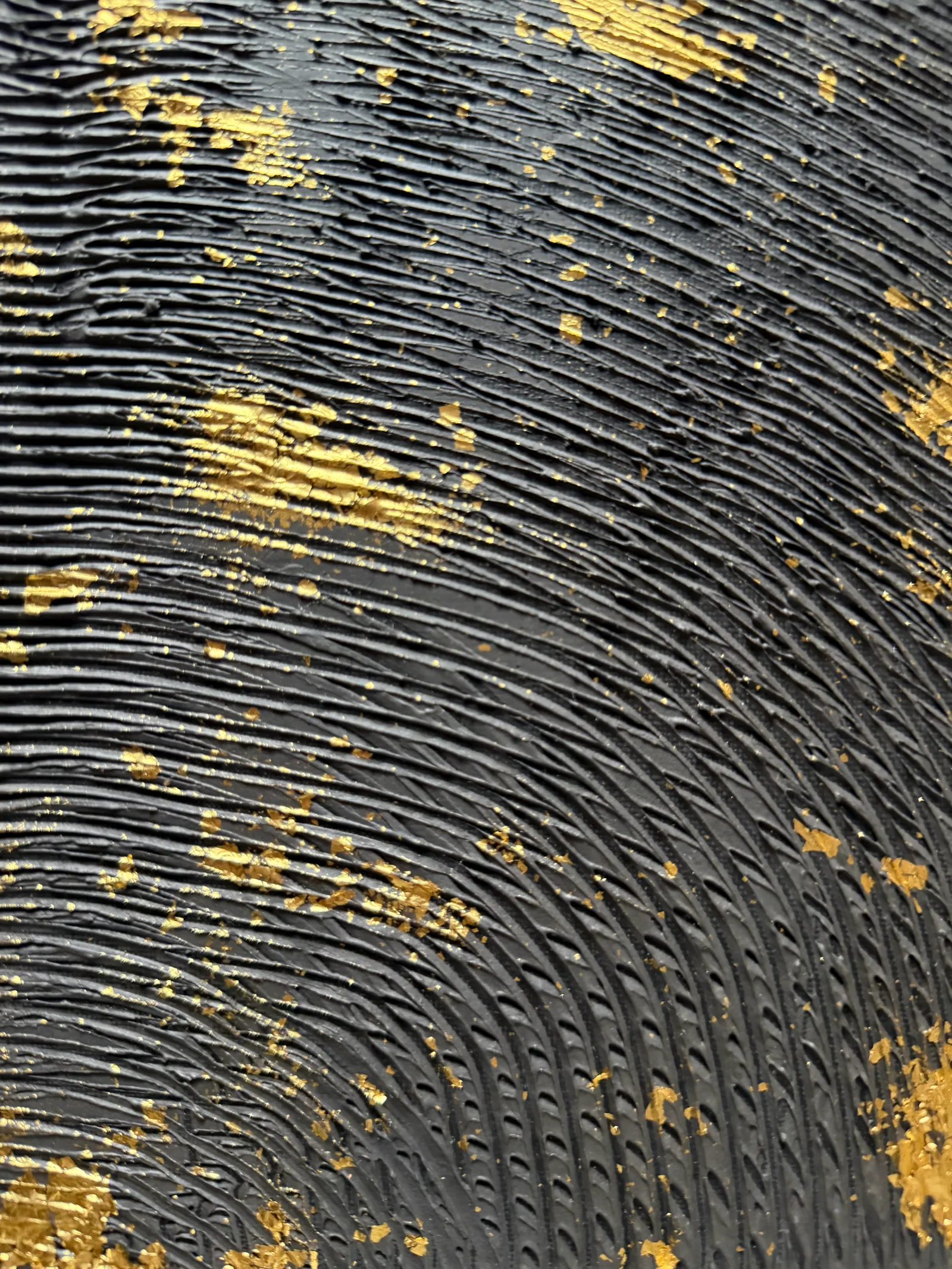
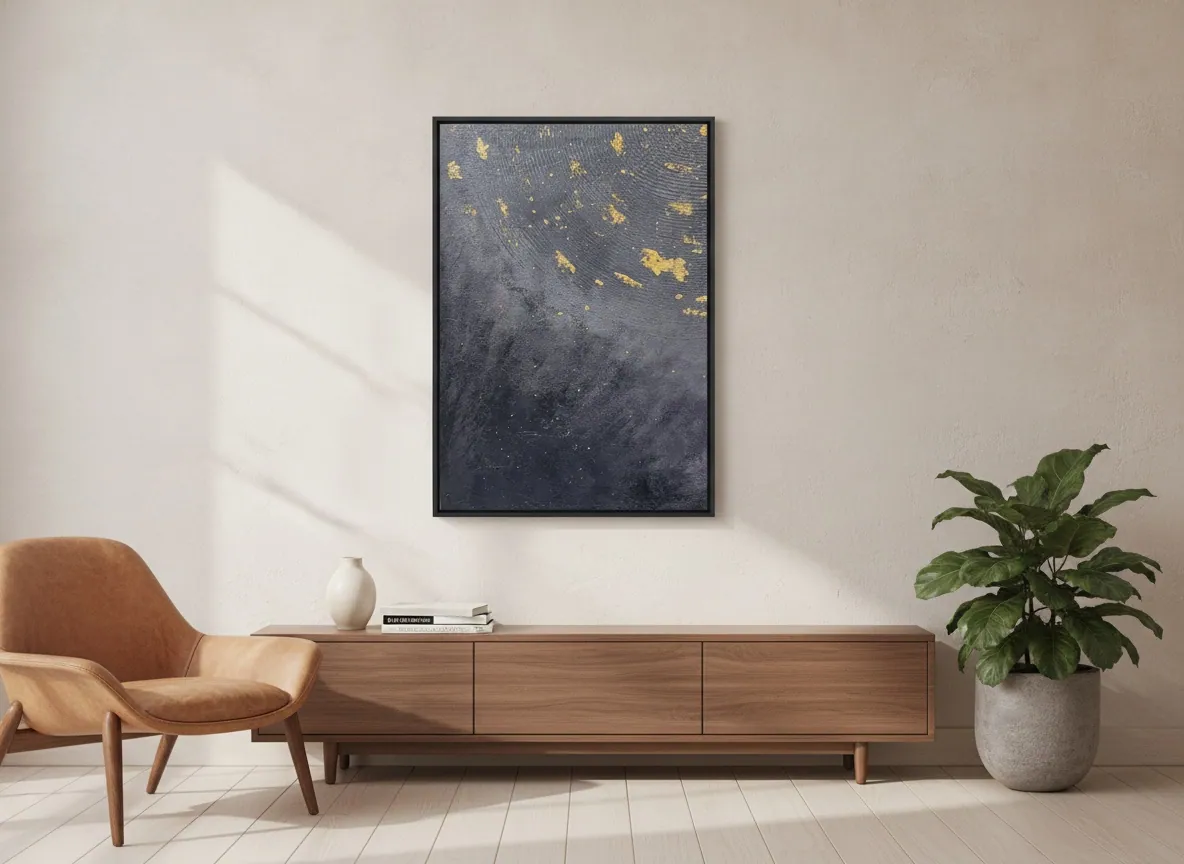
Celestial Plan (Black & Gold, 2025) is a 50 × 70 cm canvas of mixed media, texture paste and imitation gold leaf (metallic leaf). The paste is combed into ridges across a black ground, and the metallic leaf, sealed with a spray sealant, sits on top of them. In the CCI sequence the bubble wrap goes on last, on the outside of the package, so the ridges face a sheet of cardboard that never touches them.
Wrapping a canvas, step by step
- Lay the bubble wrap or foam on a clean table, bubbles up, big enough to wrap the painting with overlap.
- Put the plastic sheet on top. Cut it so about 8 cm (3 in) overlaps at the back.
- Cut the cardboard to the outer size of the front, or a little larger so it folds over the sides, and lay it on the plastic.
- Set the painting face down on the cardboard, with the paint kept clear of it. An unframed canvas first goes into a travel frame whose sides are deep enough that the wrapping touches only the frame.
- Add a back board if you have one, tape its folds and fill gaps with soft, non-abrasive material so the painting cannot slide.
- Pull the plastic snug and tape the overlap at the back, folding over one end of each strip so it lifts off later without a blade.
- Wrap the bubble or foam around everything, tape the edges, and write FRONT and BACK on the outside with a short note on how to unpack.
A canvas of 100 × 150 cm, like Vibrant Awakening (acrylic, Luminous Rebirth, 2025), is where the CCI's advice on large paintings applies: ask a conservator, or a packer who works with art, before wrapping it at home.
Framed works on paper and glass
Golden Frond is watercolour and acrylic on paper, framed, and its 45 × 45 cm includes the frame. With a framed work, the CCI looks at the glazing first. If the frame holds ordinary glass, cover its outer face with low-tack tape so the pieces stay put if it breaks, then peel the tape off slowly and soon after the move. For paintings over 1 m², the CCI suggests replacing non-laminated glass with laminated anti-reflective glass, or with museum-quality acrylic, which scratches easily.
Fit cushioned covers on the frame corners if they are fragile, then wrap the frame as in the steps above. The choice between glass and acrylic is covered in glass or acrylic glazing for a framed watercolour.

In the moving truck
The CCI checklist for a finished package is about what happens on the road. It should resist punctures and dents, be sealed against water and be cushioned against knocks. It also has to be restrained, so the painting cannot move inside the wrapping and the package cannot move in the vehicle. In a moving truck, strap each wrapped painting in place with nothing heavy leaning on its face.
Temperature is the second risk. The CCI wants the package insulated and carried in an air-conditioned vehicle, away from cold, heat and fast swings. Its page on humidity gives one reason: condensation forms when an uninsulated package sits against a cold wall, "whether in a room, truck, or airplane". For a short move across town, the CCI describes another option, the wrapped painting hand-carried by a trained person, with thermal insulation if the temperature will change. Moving in winter? Read can an acrylic painting be shipped in freezing weather.
For those acquiring a work
Vibrant Awakening (100 × 150 cm, R$ 5,900) and Elemental Veins (90 × 140 cm, R$ 6,400) are large canvases from 2025. Celestial Plan (50 × 70 cm, R$ 2,700) is a smaller canvas, and Golden Frond (45 × 45 cm with frame, R$ 2,400) is a framed work on paper from Water & Bloom, 2026. Each is unique, with no editions or reproductions. Ask the studio for the details of a specific work before you plan the hanging. Any conversion from BRL is approximate.
Every acquisition comes directly from the artist with a signed Certificate of Authenticity carrying the Archive ID, a fiscal invoice or receipt, an Artwork Acquisition Agreement, an artist dossier and care guidance. Shipping is quoted per destination and paid by the buyer; professional packaging is included and transit insurance is available. See shipping.
Available works
-
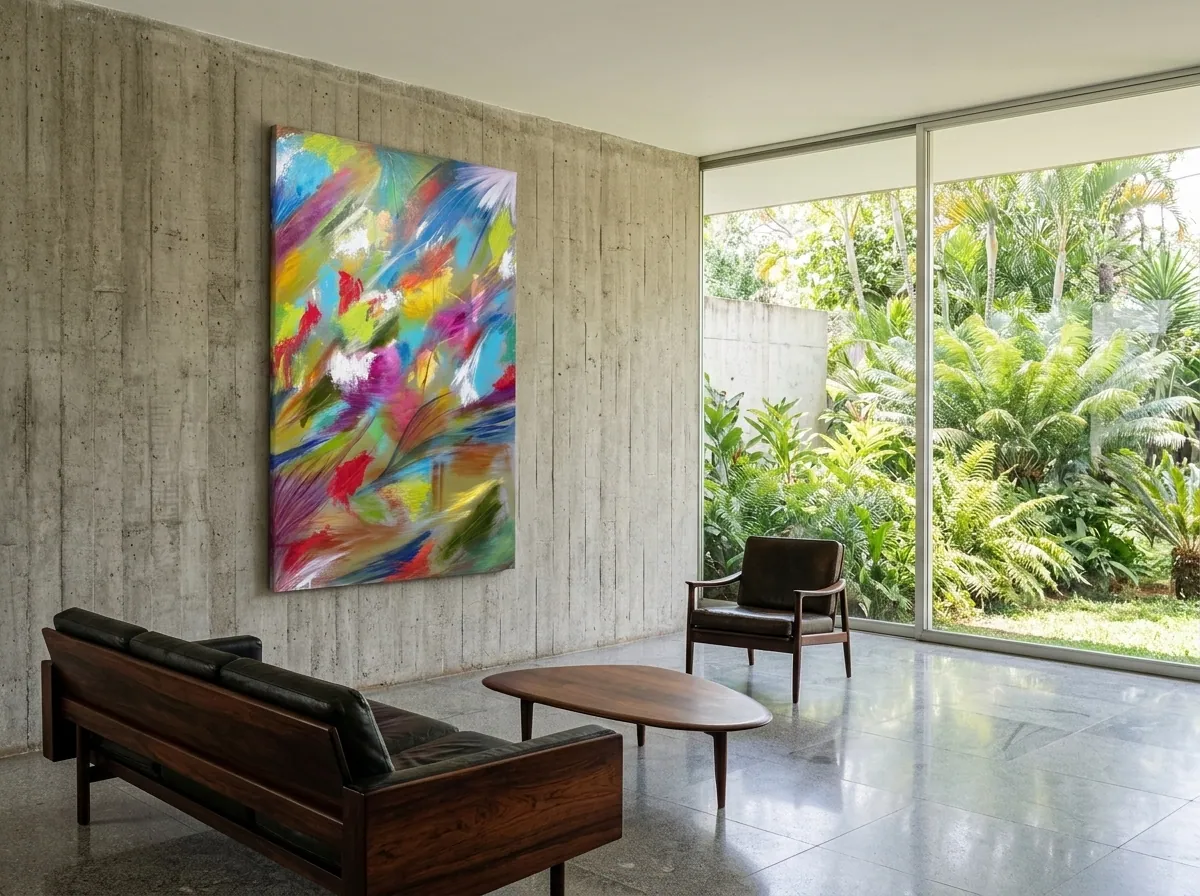 Vibrant Awakening
100 x 150 cm (39 x 59 in) · R$ 5.900
-
 Vibrant Awakening
100 x 150 cm (39 x 59 in) · R$ 5.900
-
 Elemental Veins
90 x 140 cm (35 x 55 in) · R$ 6.400
-
 Elemental Veins
90 x 140 cm (35 x 55 in) · R$ 6.400
-
 Celestial Plan
50 x 70 cm (19.7 x 27.6 in) · R$ 2.700
-
 Celestial Plan
50 x 70 cm (19.7 x 27.6 in) · R$ 2.700
From the studio
From the studio
Alyne Perfeito is a Brazilian visual artist, trained as an architect, based in Brasília. Celestial Plan and Elemental Veins both carry raised material, combed texture paste with metallic leaf on one and metallic fragments on the other, so the gap between cardboard and paint in step 4 matters on both. On moving day, keep the certificate and the artist dossier in your own bag. They hold the technical record of medium, dimensions and year, with the Archive ID, which a conservator or an insurer will ask for if anything goes wrong.
Frequently asked
Should the painting face touch the bubble wrap?
No. In CCI Notes 10/16 the face rests on rigid cardboard that is kept off the paint, a clear plastic sheet is sealed around that, and the bubble wrap or foam goes on the outside of the package.
How do I protect the glass on a framed work on paper?
If the frame has ordinary glass, the CCI suggests covering the outer face with low-tack tape so pieces stay in place if it breaks, and peeling it off slowly soon after the move. A spacer should keep the glass off the artwork. For works over 1 m², it suggests laminated anti-reflective glass or museum-quality acrylic.
Can paintings ride in the moving truck with the furniture?
Yes, if each package is strapped so it cannot shift in the vehicle. The CCI also asks for insulation and an air-conditioned vehicle, because cold, heat and fast temperature changes are risks, and an uninsulated package against a cold truck wall can gather condensation. For a short local move, it describes hand-carrying the wrapped painting with a trained person.
When is it worth hiring a fine art handler instead?
The CCI says a painting that is large, heavy, fragile or in unusual condition may need special preparation before wrapping, and to consult a conservator when unsure. An unframed canvas also needs a travel frame deep enough that the wrapping touches only the frame. If either applies, ask a conservator or a packer who works with art.
Planning a move with new work?
Ask the studio for detail photographs of Vibrant Awakening, Elemental Veins, Celestial Plan or Golden Frond and a shipping quote to your new address.
Sources
- Canadian Conservation Institute, CCI Notes 10/16, Wrapping a Painting — 2026-11-22
- Canadian Conservation Institute, Agent of deterioration: incorrect relative humidity — 2026-11-22
- Perfeito Studio — 2026-11-22
- Perfeito Studio — 2026-11-22
- Perfeito Studio (src/data/obras.json and studio-facts.json) — 2026-11-22
Published on
Edited and reviewed by: Alyne Perfeito, architect and visual artist · CAU A1023098
Alyne Perfeito is a trained architect and visual artist with a studio in Brasília, Brazil. She edits and reviews the Journal from her painting practice. See Alyne's works →