Pairing two abstract paintings as a diptych: spacing, scale and color
Two separate abstract paintings tend to read as a pair when they share one decision: a common color field, a similar weight of texture, and a gap that looks small next to either canvas. Scale can differ. What the eye needs is a deliberate alignment line, and a tape test on the wall before anything is drilled.
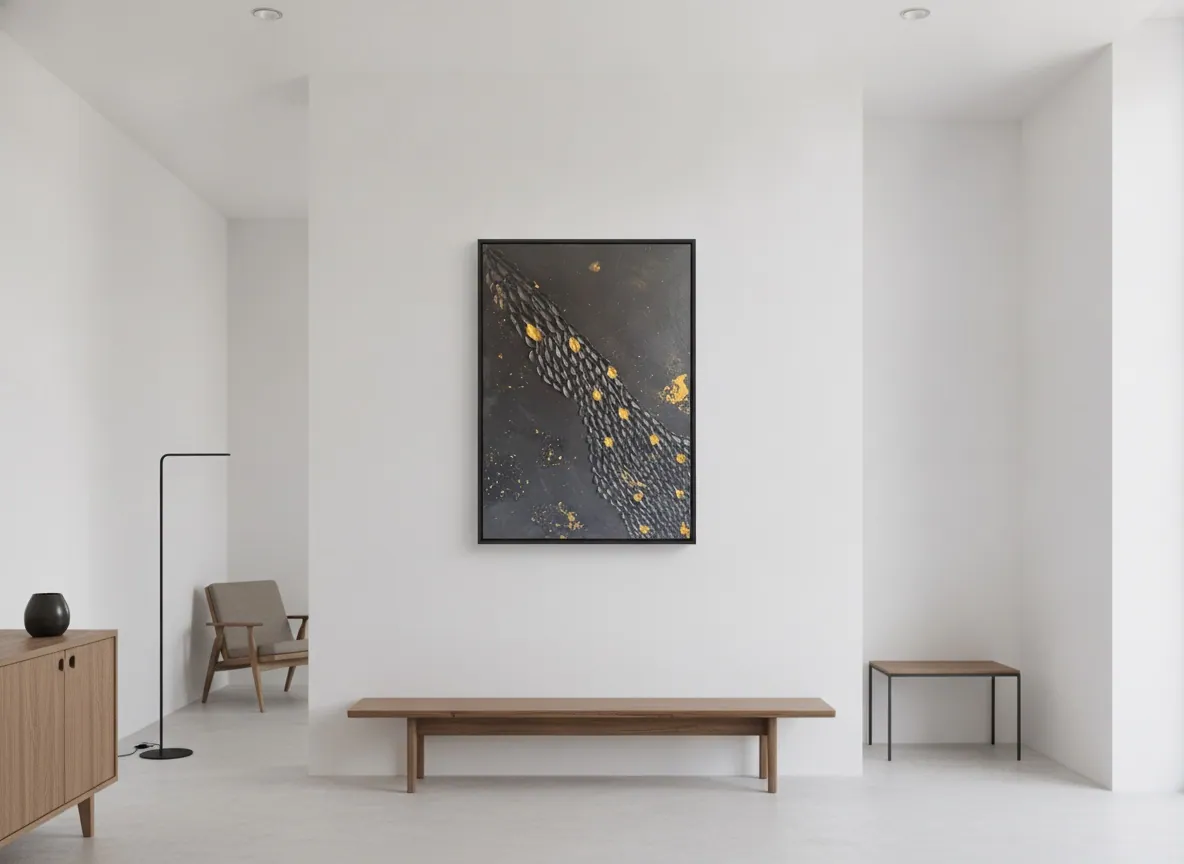
A diptych made from two originals is a composition you build
A traditional diptych is conceived as two panels from the start. Two paintings that were made separately are different: each one is complete, and the pair exists only once you hang them together. That is not a weakness. It means the pairing is yours to design, and it can be changed later if the room changes.
It also means the two works are bought as two objects. At Perfeito Studio each original is unique and sold individually, so a pair is something a collector assembles, not a pre-made set. The questions below are the ones that decide whether the assembly works. If you are new to buying from the studio, how to buy a painting from Perfeito Studio explains the steps.
Color: share one field, vary the rest
The simplest way to make two different paintings look intentional is to give them one dominant color field in common. Two works on a black ground with gold accents will tend to sit together even if their composition is entirely different. Two works with different grounds and different accents rarely do, however good each one is alone.
Texture can work the same way. In the studio's experience, a heavily sculpted surface beside a flat, smooth one tends to read as a contrast of two voices rather than a pair. If you want the contrast, make the color common; if you want a calm pair, keep the surface weight close.
A practical check: photograph both works side by side at small size, on your phone. If one jumps out and the other disappears, the pair may be unbalanced in value (light against dark), not necessarily in subject.
Scale: unequal sizes can work if one line is shared
Two canvases of the same size are the safe route, but they are not required. When sizes differ, choose one shared line and let everything else follow it. There are three honest options: align the centers horizontally, align the tops, or align the bottoms. As a rule of thumb, aligning centers tends to be the most forgiving, because the eye can read the pair as one centered group.
A worked example from the collection: Golden Passage measures 60 x 80 cm and Celestial Plan measures 50 x 70 cm (width by height, both vertical, both Black & Gold, both 2025). The heights differ by 10 cm. Aligned on their centers, each canvas sits 5 cm lower or higher at the edges, which looks like a deliberate step. Aligned on the tops, the larger one would hang 10 cm lower at the bottom edge, which reads more like a mistake in measuring. As an illustration of the arithmetic only: with a gap of 8 cm, the pair would span 60 + 8 + 50 = 118 cm of wall.
Both are separate originals, priced individually in the catalog, and they are not presented as a set. The example only shows how two close sizes behave.
The gap: a proportion, tested with tape
Published spacing numbers for multi-panel hanging vary from one source to another, so treat them as habits rather than rules. A method holds up better: as a rule of thumb, the gap should look small next to the width of either painting, so the two read as one group, and it should be constant, the same distance at top and bottom. Too wide, and each canvas can start to demand its own wall. Too tight, and the edges may seem to touch without meaning to.
To find yours, cut two pieces of paper to the exact size of each canvas, tape them to the wall, and move one in small steps from the distance where the pair will normally be seen. For the full spacing question, including wide walls and testing before drilling, see how much space to leave between paintings on a wall.
Height and the wall around the pair
It helps to treat the pair as a single object when you set the height: measuring to the center of the whole group, rather than to the top of one canvas, tends to give the steadier result. Over a sofa or console, leave a visible margin above the furniture, and consider keeping the group no wider than the furniture so it does not overhang. The wider the pair, the more clear wall it tends to need on each side.
If you are still deciding which wall suits large works at all, see the guide on choosing a large abstract painting for a living room. If the pair is for a seated room, you may prefer to hang a little lower than you would standing, since you read it from a chair.
From the studio
From the studio
I trained as an architect before I painted, so I think of a pair as a plan in two parts: where the line is, where the gap is, where the eye enters. Golden Passage and Celestial Plan are both mixed media on canvas, with texture paste, imitation gold leaf and a black ground. Golden Passage carries a diagonal flow of sculpted forms; Celestial Plan has fine concentric textures across the black surface, with scattered imitation gold leaf. The texture is different, but the black and the gold are shared, and that is the kind of common ground I look for in a pair.
If you send a wall photo and measurements, I can tell you how I would read the pair.
Frequently asked
How far apart should a diptych hang?
There is no single figure that holds for every room. Published numbers vary, and most come from canvas retailers. Use a method instead: keep the gap clearly smaller than either painting's width, keep it identical at the top and bottom, and judge it with paper templates taped to the wall from the distance where you will normally look. The right gap is usually the one you stop noticing.
Can two different paintings work as a pair?
Yes, if they share one clear decision. A common dominant color is the strongest link, followed by a similar weight of surface texture, and then a shared alignment line such as the centers. Subject, size and composition can differ. Two works with different grounds, different textures and no common line will usually read as two separate pictures that happen to be near each other.
Can I buy two originals as a pair from Perfeito Studio?
Yes, as two separate acquisitions. Each painting is a unique original sold individually, and the studio does not present any two works as a set. Each one comes with its own Certificate of Authenticity and Archive ID, so every work in your pair is documented on its own. You choose the two works, and the pairing is yours to design on your wall.
How does Perfeito Studio ship an original painting?
The studio ships within Brazil and internationally. Shipping is quoted per destination and paid by the buyer, as are any import duties or taxes in the destination country. Professional packaging is included, and transit insurance is available. Domestic delivery takes up to 15 business days depending on destination, and international shipping is quoted on request.
What comes with an original from Perfeito Studio?
Every acquisition is direct from the artist and includes the original painting, a Certificate of Authenticity with the full technical record and Archive ID, a fiscal invoice or official receipt, an Artwork Acquisition Agreement, an artist dossier, conservation and care guidance, and professional packaging. The certificate carries a QR code linking to the work's official page.
Thinking of two works for one wall?
Send a photo of the wall and the measurements, and we can talk through which works might sit together.
Sources
- Perfeito Studio (src/data/obras.json) — 2026-10-11
- Perfeito Studio (src/data/studio-facts.json) — 2026-10-11
Published on · Updated on