How to store a painting you are not hanging
Store a stretched painting upright, raised off the floor, away from exterior walls, attics and basements, with nothing touching the paint. The Canadian Conservation Institute (CCI) and US National Park Service (NPS) also ask for a stable room, humidity of 40 to 60 per cent (CCI) or 40 to 55 per cent (NPS), and a cover against dust.
Upright, flat or leaning: which position is safest
The Canadian Conservation Institute (CCI) states that its storage guidance refers primarily to framed paintings and paintings on stretchers or strainers, and that these suit vertical storage, in slotted shelves or on sliding screens. Unframed work on card or panel is the exception: CCI says it should be stored horizontally, in boxes or drawers, and canvas that is not tacked to a stretcher can lie flat on shelving or in drawers.
Leaning a painting against a wall is the weakest of the options. The US National Park Service (NPS) Museum Handbook lists three main methods, which are hanging from storage screens, placing on storage shelves, and stacking vertically against an interior wall, and says not to stack paintings against a wall unless there is no other option. Its handbook calls stacking a temporary measure, only for paintings in good condition, and says never to lean paintings against exterior walls.
If a stack is unavoidable, both institutions describe the same set-up. The paintings rest on skid-proof padded blocks, with rigid board between each one, slightly larger than the paintings it separates (CCI) or larger than the largest painting it touches (NPS). NPS says to keep paintings of similar size together and never stack more than a few on each set of blocks; CCI sets the ceiling at four to five paintings. A painting in poor condition, especially with flaking paint, should not stand upright at all: NPS advises laying it flat on a shelf.
What to put between the painting and the room
Two kinds of material matter: what separates one painting from another, and what covers the painting itself. For separation, both sources ask for rigid board. NPS specifies heavy-duty acid-free cardboard, larger than the largest painting it touches.
For covering, the two institutions are not identical, which is worth knowing before you buy anything. CCI says that dirt, dust and water can be addressed by wrapping and sealing a painting in polyethylene or Mylar sheeting, and adds that where wrapping is not an option, for reasons of condition or fragile impasto, a smaller work can go into a container instead. NPS describes dust covers of washed cotton muslin over the paintings, with the fabric never allowed to touch the painted surface. The shared principle is a barrier against dust and drips that is held clear of, or at least does not abrade, the paint.
Before any of this, NPS asks that hanging wires, hooks and other hanging hardware be removed from the painting, because they can pierce the canvas and scratch varnished surfaces or frames. It also recommends fitting canvas paintings with a rigid backing board, which protects the reverse from knocks and buffers the canvas against changes in humidity and temperature, and advises asking a conservator when attaching one is in question. A heavily textured or fragile surface is a case for a conservator's advice rather than a home experiment.
Which rooms are wrong, and how high the humidity can go
The shortlist of places to avoid is consistent across both sources. CCI advises against attics and basements: attics can reach extremes of heat and dryness, and basements can be damp and exposed to flooding from ground water or overhead pipes. NPS lists the same two, and adds exterior walls, spaces near furnaces or heating and air-conditioning vents, spaces below water pipes, and areas of strong vibration such as busy walkways. Both ask that paintings sit off the floor: CCI gives 7 to 10 cm, NPS at least four inches (about 10 cm).
On humidity, CCI states that the safest relative humidity for paintings on canvas or wood is a stable level between 40 and 60 per cent, with 50 per cent as the central value favoured by consensus for uniformity between lending institutions, and that levels above 70 to 75 per cent encourage mould growth (the NPS puts the line lower, at over 65 per cent). It notes that such readings can occur in the cooler spots of a room, such as an exterior wall or near water pipes, even when the middle of the room is fine. CCI recommends a temperature anywhere from 16 to 25 degrees Celsius. NPS gives a narrower range, 40 to 55 per cent humidity, and says the key is stability: sudden changes, such as moving a painting from a cool area to a warm one, can cause moisture to condense on the surface.
A spare room that is climate-controlled with the rest of the home matches that description far better than a loft or a lower floor with a damp history. A garage is not named in either document, but it shares the exposures they warn about, so it is worth treating with the same caution. That is an inference, not a quotation.
Checking on a painting you are not looking at
Neither source gives a fixed inspection schedule, so no number of weeks is offered here. NPS asks for stable conditions and for covers on paintings in storage. Our own habit, which is not a rule from either institution, is to look at a stored painting from time to time for signs of damp, flaking paint or a shifted stack. When the painting comes out of a cold or damp room, NPS advises that any change to a painting's environment be made gradually, so give it time rather than moving it straight into a heated room.
To plan the return to a wall, our guide on how to rotate artwork at home covers swapping works in and out, and the guide on protecting a painting from sunlight covers the room it will return to. If you keep records of what is in storage, a condition report gives you a baseline to compare against.
From the studio
A note from the studio on surface
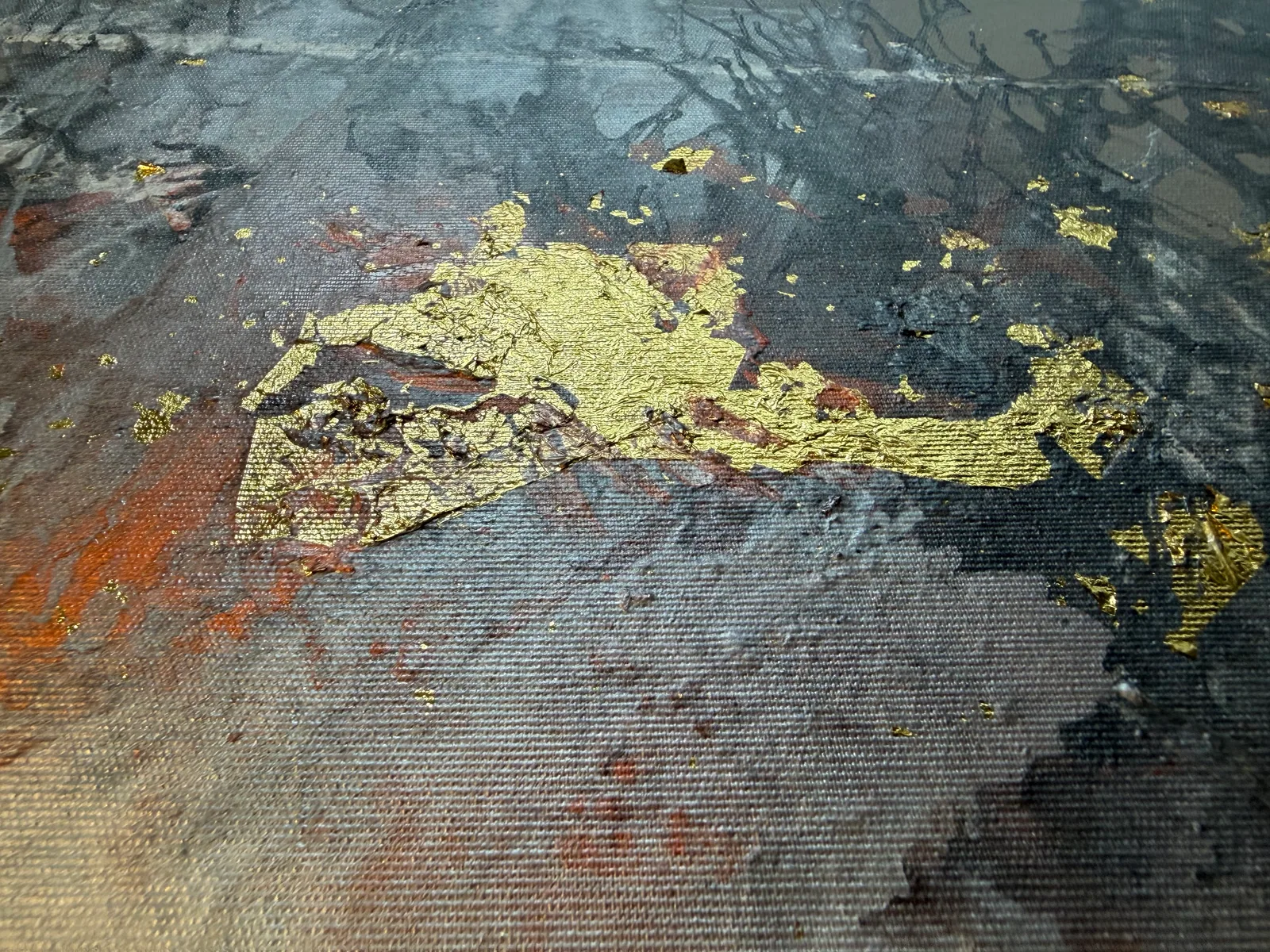
On a work like Origin of Light (60 × 80 cm, Heart of Chaos, 2025, mixed media with acrylic and gold leaf on canvas), the surface is the picture: layered pigment and fragments of gold leaf sit on the canvas rather than disappearing into it. From the studio's point of view, that is the practical reason to read the two institutions' advice on covers closely. A cover is there to keep dust off, not to touch the painting, and with a built-up surface the difference between a cover held clear and one resting on the paint is not small. For a work like this, we would hold a cover clear of the surface, and ask a conservator before anything that presses against it.
Frequently asked
Should it stand upright or lie flat?
For framed paintings and canvases on stretchers, the Canadian Conservation Institute describes vertical storage, in slotted shelves or on screens, as suitable. Unframed work on card or panel should be stored horizontally, and a painting in poor condition, especially with flaking paint, is better laid flat according to the US National Park Service. Whichever position is used, the painting should be raised off the floor and kept away from exterior walls.
What to wrap it in?
The sources differ slightly. The Canadian Conservation Institute describes wrapping and sealing in polyethylene or Mylar sheeting against dust, dirt and water, and notes that fragile impasto may rule wrapping out. The US National Park Service describes dust covers of washed cotton muslin that never touch the paint. For a textured or fragile surface, ask a conservator, and take off hanging wires and hooks first.
What humidity is too high?
The Canadian Conservation Institute gives 40 to 60 per cent relative humidity as the safest stable range for paintings on canvas or wood, and says levels over 70 to 75 per cent encourage mould growth. The US National Park Service recommends 40 to 55 per cent and stresses stability. Cooler spots, such as exterior walls or the area near water pipes, can run damper than the middle of a room. The National Park Service says levels over 65 per cent encourage mould.
Can I store it in a garage?
Neither conservation document mentions garages by name. They do advise against attics and basements, exterior walls, spaces near vents or below water pipes, because of swings in heat, dryness and damp. A garage usually shares several of those exposures, so treat it with caution. This is an inference from the sources, not a rule they state, and a climate-controlled interior room is the safer choice.
How often should I check it?
Neither the Canadian Conservation Institute nor the National Park Service handbook gives a fixed interval, so we do not offer one. A sensible habit, and this is our suggestion rather than a rule from either source, is to look at a stored painting from time to time for signs of damp, flaking paint or a shifted stack, and to look more closely after a leak or a long spell of unusually damp weather.
Planning where a painting will live, and where it will rest
Ask the studio about a specific work, its surface and how it is best kept. Replies come directly from the artist's studio on WhatsApp.
Published on