Old money art: what kind of painting actually hangs in an old-money interior
Style guides describe an old-money interior as hung with portraits, landscapes, equestrian scenes and botanical prints in restrained or gilded frames, added gradually over time. A restrained abstract original fits when it follows the same discipline: tonal, material, hung with intent and chosen for its own worth, never to fill a gap on the wall.
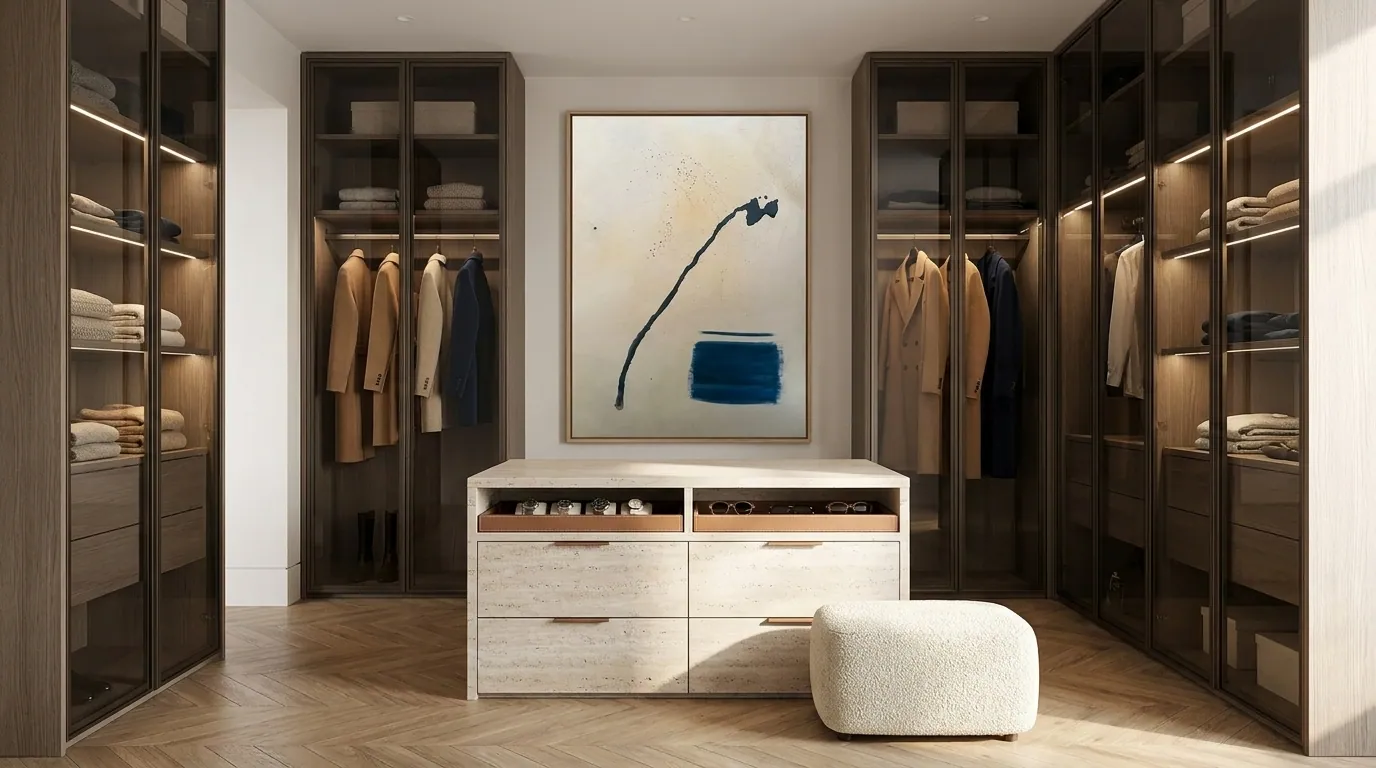
What old money means, and what style guides say hangs on its walls
Wikipedia describes old money as a social class of the rich who have kept their wealth across generations, in contrast to new money, whose wealth was acquired within a single generation. The same article notes that in the late 19th and early 20th centuries nouveau riche families built Gilded Age mansions that emulated European royal palaces, while old money was more conservative. That is a contrast in display, not a defined decorating style.
The "old money" interior is a design-media label built on that idea, and its sources are style guides, not authorities. A June 2026 guide on lovemoney.com recommends traditional art: landscapes, equestrian scenes, portraits, botanical prints or black-and-white photography. It suggests simple, understated frames when several pieces hang together, more ornate gilded frames for a single large piece, and centred artwork in formal rooms. A second guide, on The City Wood's blog, describes a family library with portraits of ancestors on the walls and recommends dark wood or antique gold frames.
The reference vocabulary, in other words, is figurative and inherited: faces, horses, fields, plants. The two guides we read say nothing about abstraction either way. What they do describe is the discipline around the art: the frame, the placement and the patience.
Works cited in this text


The principle underneath: art that accumulates, not art that fills a gap
The lovemoney guide contains one line that matters more than any list of subjects: artworks are added gradually, and each piece should offer individual value rather than fill a gap. That is a buying rule, not a style rule, and an abstract painting can obey it as well as a portrait can.
It also complicates the assumption that established wealth collects only the traditional. The Museum of Modern Art in New York was conceived in 1929 by Abby Aldrich Rockefeller, Lillie P. Bliss and Mary Quinn Sullivan, and opened to the public on 7 November 1929. The Rockefeller family appears in Wikipedia's article on old money as an example of family wealth growing across generations. This is historical context, not a decorating prescription: it shows only that a family associated with generational wealth helped found a museum of modern art.
As for abstraction itself, Wikipedia describes abstract art as composing with shape, form, colour and line with some independence from visual references in the world, and says the departure from reality can be slight, partial or complete. That range is useful here. In the studio's experience, an abstraction rooted in landscape or sediment can hang where a traditional landscape would, and a more complete abstraction can hang where nothing else competes with it.
How an abstract painting meets the same standard
The City Wood guide lists a neutral foundation (ivory, cream, taupe, soft grey), rich earth tones (deep green, navy, chocolate brown, burgundy) and metallic accents such as antique gold, bronze and brass, used sparingly. Read for a canvas, that palette gives three practical tests. They are the studio's reading of the guides, not a rule from them.
Tone before colour. A field built from one family (bone, stone, umber) with at most one rationed accent sits inside that vocabulary. Silent Interval is a warm bone-white field with one dark line descending through it and a single block of blue near the lower edge.
Material where the carved frame used to carry the history. Relief and layered pigment give a surface age and weight without a figure. Echo of Silence is monochrome sculpted texture on canvas. Patina Field is built by applying pigment, scraping it back and applying it again, so that the surface reads as wear, the way an old façade does.
Gold as an accent, not a field. In Golden Passage the imitation gold leaf appears as fragments set into a black textured ground, which is the "used sparingly" principle applied to a painting.
Two further decisions belong to the room, not the canvas. Frame: the guides point to dark wood or antique gold; on a contemporary canvas the same logic suggests a frame that belongs to the wood tones already in the room. Placement: a single large work hung on the central axis of a formal wall follows the symmetry the guides describe.

Four works from the studio that follow that logic
Four originals from the collection show different ways of meeting the standard above. Prices are in Brazilian real and are set by the studio.
- Silent Interval, Matter & Silence, 2026. 120 × 160 cm, mixed media with acrylic on canvas. BRL 7,900. The large single-wall piece: one gesture, one accent, a worked and scored ground.
- Echo of Silence, Matter & Silence, 2025. 50 × 70 cm, sculpted texture on canvas. BRL 2,400. The smallest and most monochrome of the four, where the relief is the whole subject.
- Golden Passage, Black & Gold, 2025. 60 × 80 cm, mixed media, texture paste and imitation gold leaf (metallic leaf) on canvas. BRL 3,500. Fragments of gold-coloured leaf on a black field.
- Patina Field, Terra & Ether, 2026. 100 × 100 cm, acrylic on canvas. BRL 5,200. Slate blue, iron brown and one passage of ochre, tonal and mineral.
Each is a unique original, signed and catalogued under an Archive ID. The full catalogue is on the gallery page.

Before you buy: the artist, the wall and the shipping
Alyne Perfeito is an emerging Brazilian visual artist and trained architect based in Brasília. Her first documented body of work, painted between 2025 and 2026, is organised in six series. Every acquisition is made directly from the artist and includes a signed Certificate of Authenticity with the technical record and Archive ID, a fiscal invoice or official receipt, an acquisition agreement, an artist dossier, care guidance and professional packaging.
Before choosing, measure the free width of the wall, photograph it at the hours the room is used, and note where the daylight comes from. A restrained painting depends on its surroundings more than a loud one does.
The studio ships within Brazil and internationally. Shipping is quoted per destination and paid by the buyer, as are any import duties or taxes in the destination country; transit insurance is available. Domestic delivery takes up to 15 business days depending on destination, and international shipping is quoted on request. Details are on the shipping page. The work can also be seen in person in Brasília by appointment, where part of the collection is on view at INTI in Lago Sul; for buyers elsewhere, the studio sends additional detail photographs and video of a specific work on request through WhatsApp.
From the studio
From the studio
I am an architect by training, and I read a wall before I read a painting: its proportion, its axis, what stands beside it. An old-money room, as the guides describe it, is organised that way, with matching pieces set on axes and one wall that gathers the eye. A painting there has to carry weight without raising its voice.
Silent Interval (120 × 160 cm, 2026) was composed for interiors that value calm: a black line falls through a warm bone-white field and a single block of blue anchors the lower edge, so the weight is placed with intent and the rest is left as breathing room. In Golden Passage (60 × 80 cm, 2025) I use imitation gold leaf the way the guides ask metal to be used in a room, in small fragments on a black textured ground, found rather than announced. And in Patina Field the pigment is applied and scraped back until the surface reports wear, because a canvas that looks as if it has kept its own record sits comfortably beside furniture that has kept its own.
Frequently asked
What kind of art hangs in an old-money home?
Style guides describe traditional art: landscapes, equestrian scenes, portraits, botanical prints and black-and-white photography, often framed in dark wood or antique gold and added gradually. These are design-media conventions rather than rules, and the guides we read do not address abstraction either way. What they stress is restraint, symmetry in formal rooms and pieces chosen for their individual worth.
Can an abstract painting work in an old-money interior?
Yes, if it behaves like the rest of the room. In the studio's reading, that means a tonal field with at most one rationed accent, a surface with material weight, gold only in small amounts, and a frame and position that suit the existing wood tones and axis of the wall. In the studio's experience, a single large original usually works better there than several small pieces competing.
Which colours fit the old-money look?
One style guide lists a neutral foundation of ivory, cream, taupe and soft grey, with earth tones such as deep green, navy, chocolate brown and burgundy, and antique gold, bronze or brass used sparingly. On a canvas, that translates into a palette from one tonal family. In the studio's reading, saturated colour is not forbidden, but it works best kept to a single accent.
Is old money art the same as quiet luxury art?
Not exactly. Wikipedia defines quiet luxury as an aesthetic of dress and consumption marked by understated elegance, high-quality materials and timeless styling, with no visible logos. Old money refers to wealth held across generations. The two labels overlap in their restraint, so they often appear together in interior guides, but they come from different ideas. The studio has a separate guide on quiet luxury and abstract art.
Does the frame need to be gilded or antique?
The guides we read suggest ornate gilded frames for a single large piece and simple, understated frames when several works hang together, with dark wood or antique gold as the usual finishes. These are style suggestions. For a contemporary canvas, the practical test is whether the frame belongs to the wood tones and proportions already in the room.
Does Perfeito Studio ship originals internationally?
Yes. The studio ships within Brazil and internationally. Shipping is quoted per destination and paid by the buyer, as are any import duties or taxes in the destination country. Professional packaging is included and transit insurance is available. Domestic delivery takes up to 15 business days depending on destination; international shipping is quoted on request.
Hanging one restrained piece in a formal room?
Send a photo of the wall, the furniture beside it and the light it receives, and the studio will tell you which works suit it.
Sources
- Wikipedia — 2026-10-23
- lovemoney.com (Alexandra Upton, 10 June 2026) — 2026-10-23
- The City Wood (blog, undated) — 2026-10-23
- Wikipedia — 2026-10-23
- Wikipedia — 2026-10-23
- Wikipedia — 2026-10-23
Published on · Updated on