Wabi-sabi and abstract art: choosing imperfect, textured work for a calm room
Wabi-sabi is the Japanese aesthetic of finding beauty in imperfection, simplicity and the marks of age. In a calm room, abstract art that fits it shows the hand: a worked, matte surface, a muted earth or stone palette, and an uneven rhythm instead of a polished finish.
What wabi-sabi actually means
The term joins two older ideas. Wabi points to deliberate simplicity; sabi to an appreciation of what is old, weathered and faded. Britannica traces both to the Japanese tea ceremony, where the sixteenth-century tea master Sen no Rikyū established them as its aesthetic ideals.
The Metropolitan Museum of Art's essay on the tea ceremony describes the same shift toward rustic, simple wares, with vessels valued even when they carried visible flaws. Wikipedia lists the characteristics of the aesthetic as asymmetry, roughness, simplicity, economy, austerity, modesty, intimacy and an appreciation of natural objects. So the idea is older and more specific than a decorating label: it values a made object that shows how it was made and does not hide that it will age.
What it asks of a painting on the wall
Translating a philosophy into a purchase is a design judgement, not a rule set by any institution. These are the studio's working questions for a calm, wabi-sabi-leaning room:
- Does the surface show the hand? Ridges, scoring, uneven passages and small irregularities read as made. A flat, perfectly even field reads as manufactured.
- Is the palette from earth or stone? Warm whites, bone, ochre and umber sit quietly beside plaster, timber and linen. One deep accent is enough.
- Is the composition at rest? Asymmetry and a lot of open ground tend to suit the idea better than strict symmetry or a busy pattern.
- Is the finish matte? A mirror-like gloss pulls toward polish, which is the opposite register.
- Is there room around it? One piece with air usually reads better than a crowded wall.
The related Japandi style draws on the same Japanese tradition; the Japandi guide covers where the two overlap.
Three originals read against those questions
To be clear, Perfeito Studio does not present these works as wabi-sabi art. The point is which visible properties, as shown in the photographs, line up with the questions above.
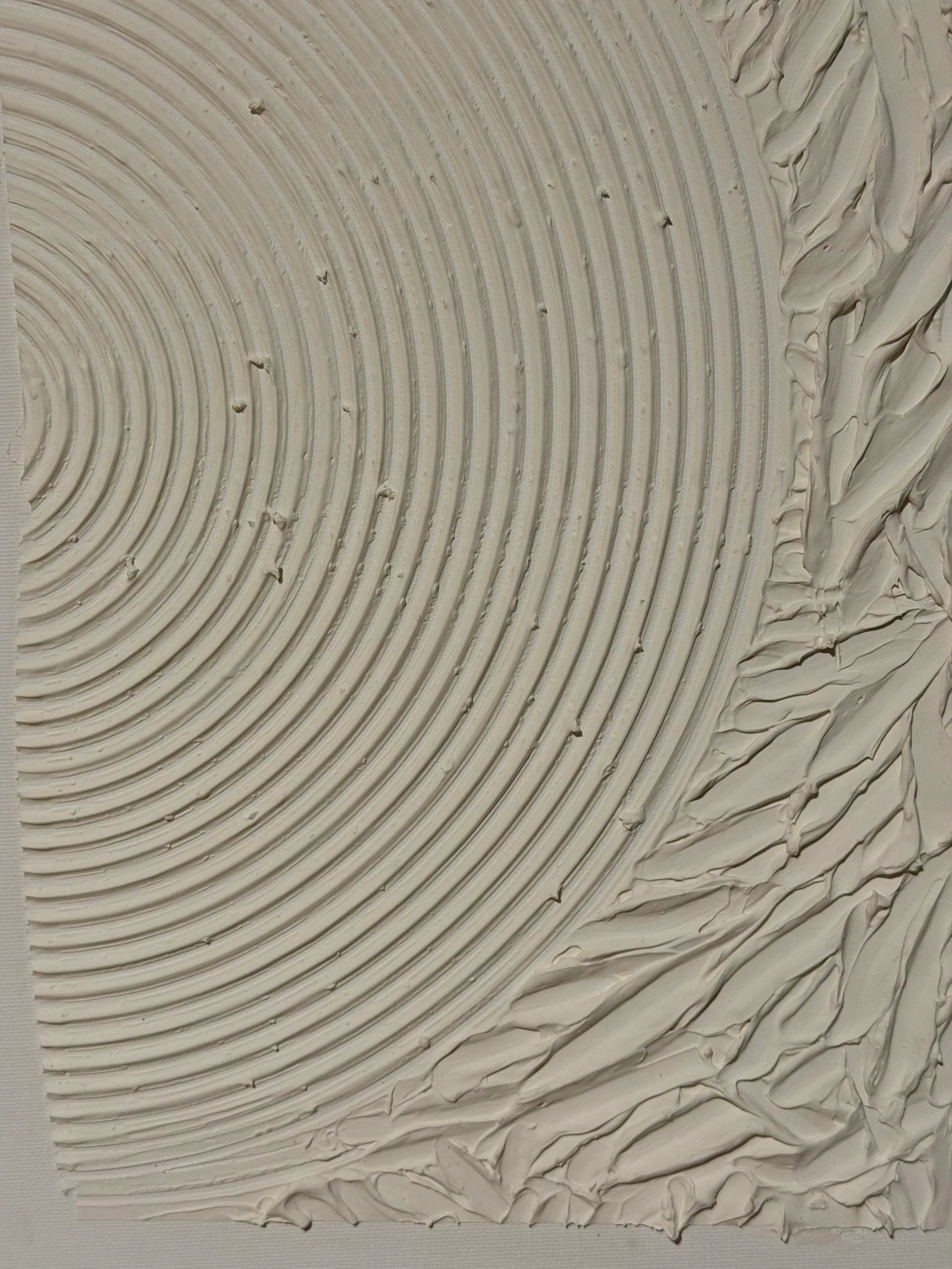
- Echo of Silence (2025, Matter & Silence, sculpted texture on canvas, 50 × 70 cm, BRL 2,400, Archive ID AP-MAS-2025-002) is a single pale tone worked into concentric reliefs and organic folds. Up close the ridges carry small pits and irregularities. It is the quietest of the three, and its size suits a sideboard, a narrow wall or a reading corner.
- Amber Strata (2026, Terra & Ether, mixed media with acrylic on canvas, 150 × 100 cm, BRL 6,700, Archive ID AP-TAE-2026-004) is built in horizontal passages of ochre, bone and oxidized umber, with dark marks settling like mineral debris and flecks of warm gold at irregular intervals. It is the earthiest of the three. The gold flecks are small; a room that wants no metal at all should look at the other two first.
- Silent Interval (2026, Matter & Silence, mixed media with acrylic on canvas, 120 × 160 cm, BRL 7,900, Archive ID AP-MAS-2026-003) is a warm bone-white field crossed by one dark gesture, with a single block of blue near the lower edge. Its textured, scored ground and its open space suit a main wall.
Each of these is physically built: what you see in the photograph is relief and layering, not a printed image of one. For how to read that kind of surface, see what textured abstract art is and how to read it; for warm earth palettes in particular, earth-tone and terracotta abstract art.
Before you choose: a short checklist
- Look at detail photographs, not only the full image: texture is invisible at thumbnail size. Detail photographs and video of a specific work are available on request.
- Check the stated size against your wall. The guide to a large abstract painting for a living room sets out the proportions.
- Think about the light: a relief changes with the direction it is lit, so see how to light a textured painting.
- Give the work time. Quiet pieces reward a longer look; how to look at an abstract painting explains how.
Original, not print
An aesthetic built on visible making is a poor fit for a reproduction, which carries an image but not a built surface. Perfeito Studio sells originals only. Every acquisition is direct from the artist and includes the unique painting, a signed Certificate of Authenticity with the technical record and Archive ID, a fiscal invoice or official receipt, an Artwork Acquisition Agreement, an artist dossier, care guidance and professional packaging. The full catalogue is on the gallery page.
From the studio
What I look for in a surface
I trained as an architect, so I think about a painting in relation to the wall it will live on and the light that crosses it. In Echo of Silence the relief is built in a single pale tone, so the work is entirely ridge and shadow. In Amber Strata ochre, bone and oxidized umber are laid in horizontal passages, with dark marks and flecks of warm gold across the field. Both are built in layers of texture, which is why a detail photograph tells you more than the full image.
Frequently asked
What is wabi-sabi in art and decor?
Wabi-sabi is a Japanese aesthetic that finds beauty in imperfection, simplicity and the marks of age. Wabi points to deliberate simplicity and sabi to appreciation of the old and weathered; both are tied to the Japanese tea ceremony. In a room it usually means natural materials, muted colour, and objects that visibly show how they were made.
Does a textured canvas fit a wabi-sabi room?
It can. A worked, matte surface in a muted earth or stone palette shares the visible-making quality the aesthetic values, while a flat glossy field or a loud multi-colour composition does not. Texture is a surface trait, not a claim about philosophy: the studio does not describe its paintings as wabi-sabi, only notes which visible traits line up.
What is the difference between buying an original and a print for this?
An original is a single physical object whose relief and layering are really there; a print reproduces an image of a surface on a flat sheet. For an aesthetic centred on visible making, that difference matters. Perfeito Studio sells originals only. Each is unique, signed and catalogued with an Archive ID, and sold directly by the artist.
How does Perfeito Studio ship an original painting?
The studio ships within Brazil and internationally. Shipping is quoted per destination, by postcode within Brazil, and is paid by the buyer, as are any import duties or taxes in the destination country. Professional packaging is included and transit insurance is available. Domestic delivery takes up to 15 business days depending on destination; international shipping is quoted on request.
What comes with an original from Perfeito Studio?
Every acquisition is direct from the artist and includes the original painting, a signed Certificate of Authenticity with the technical record and Archive ID, a fiscal invoice or official receipt, an Artwork Acquisition Agreement covering ownership, copyright and image use, an artist dossier, conservation and care guidance, and professional packaging. The certificate carries a QR code linking to the work's official page.
Ask about a textured original
Tell the studio your wall size and light, and ask for detail photographs of the work you have in mind.
Sources
- Encyclopaedia Britannica — 2026-10-09
- Encyclopaedia Britannica — 2026-10-09
- The Metropolitan Museum of Art — 2026-10-09
- Wikipedia — 2026-10-09
- Perfeito Studio — 2026-10-09
- Perfeito Studio — 2026-10-09
Published on