Wall art for a car garage: what an original painting needs to survive next to the cars
An original painting can hang in a garage if the room behaves like any other room: dry, within a stable temperature range, out of direct sun and away from engine exhaust. The Canadian Conservation Institute's low-energy range is below 25 °C in summer and above 5 °C in winter. CCI does not discuss garages; in our reading, a closed, insulated car gallery is the kind of room that can meet it.

What the painting is made of, and why a garage wall tests it
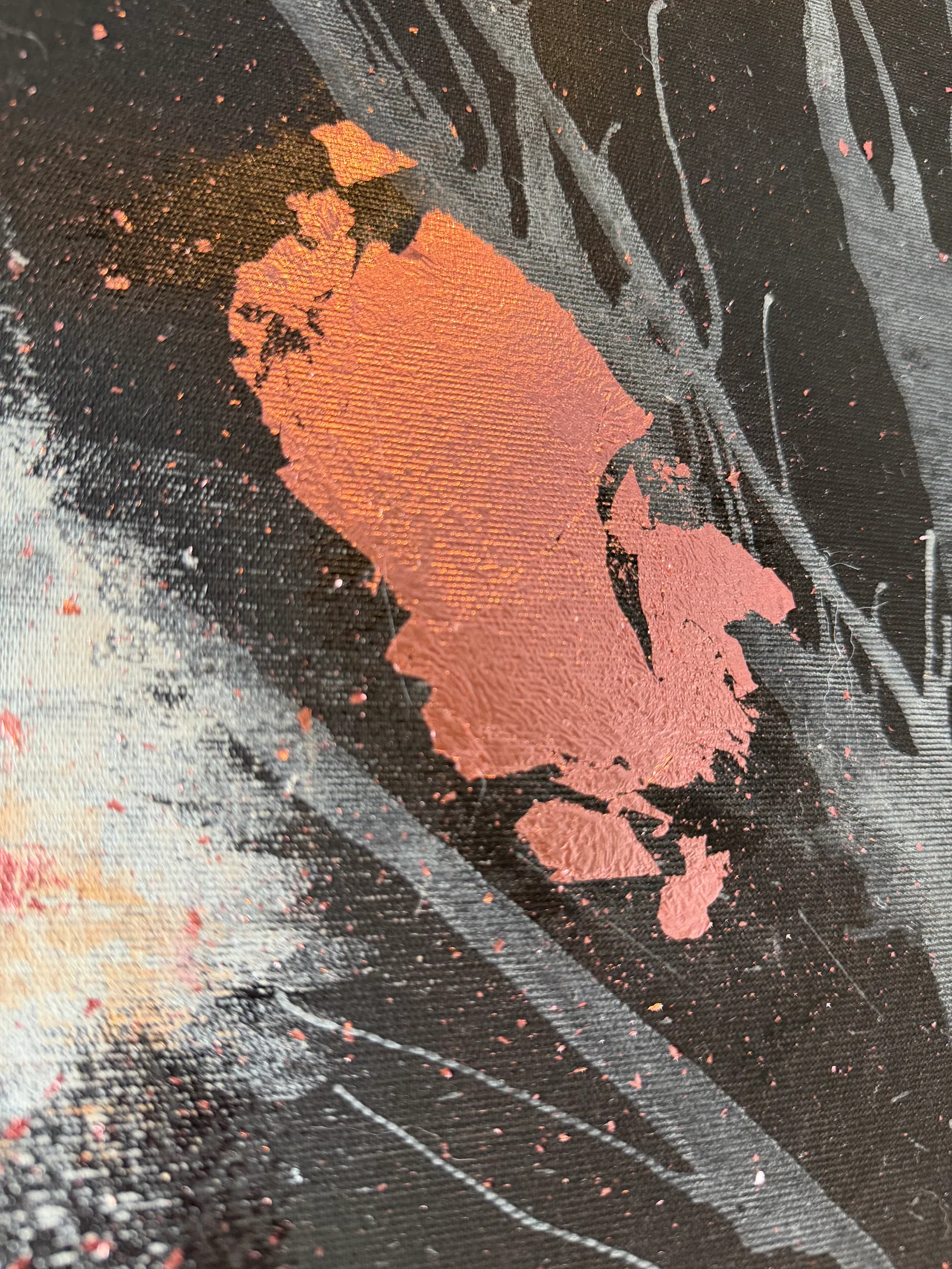
Genesis of Flame (Heart of Chaos, 2025) is mixed media on canvas, built with acrylic, metallic pigment and a finish that is both high-gloss and matte. It measures 120 × 200 cm (width × height). In the detail photograph below, a patch of copper-toned metallic colour sits on a black ground, with grey drips running across it and the weave of the canvas still visible through the thinner passages.
That surface, paint over a woven support, is what a room has to leave alone. Alyne Perfeito is an emerging Brazilian visual artist, trained as an architect, and the works in this body of work were painted between 2025 and 2026. The Canadian Conservation Institute (CCI) reads a room through four conditions: temperature, humidity, pollutants and light. The sections below apply those four to a garage wall.
Works cited in this text


Temperature and damp: what CCI measures, and what to check in a garage
CCI gives a low-energy range for collections: keep summer below 25 °C and winter above 5 °C. On the cold side the institute describes the risk as mostly one of brittleness, which becomes a handling risk; it notes that acrylic paints enter a glassy phase below 5 °C. In practice, a painting that has sat in a cold room is hung and moved with care, and not knocked or flexed. CCI adds that fluctuation is usually a smaller risk in itself, but that it is linked to humidity problems, and that uneven temperatures from place to place in a building are generally a bigger problem than fluctuations over time.
Humidity is the larger question. CCI defines damp as relative humidity above 75% and says a stable level inside the mould danger zone is worse than swings that dip back into the safe zone every few days. For paintings, it warns that a fluctuation to lower humidity is a much higher risk than one to higher humidity, and that heating without humidifying can push indoor humidity very low. For walls, its temperature guidance advises insulation, or at least an air space of 10 cm or more, between objects and external walls, cold floors and hot ceilings, and its humidity guidance advises backing boards on paintings.
CCI does not measure garages, so the next step is our reading: a garage whose door opens to the street exchanges air with outdoors every time it lifts, and follows outdoor conditions more closely than a bedroom does. In the studio's practice, that is the reason to choose an interior wall, not the one shared with the outside, and to check the wall for damp before anything is hung.
Exhaust, dust and the air in a car gallery
On pollutants, CCI names the sources and the effects. CCI describes nitric oxide as the major nitrogen oxide emitted by combustion in vehicles (about 50% of emissions), with nitrogen dioxide forming from it in the atmosphere, and says nitrogen dioxide causes artists' colourants to fade. Fine particles are described as particularly damaging because they discolour or soil surfaces; indoors, most come from soil and fibres, apart from cooking and the burning of candles and lamps. The institute lists avoid, block, dilute and filter as strategies, and treats avoiding the source as the best option where it is feasible.
Applying that to a garage is our inference, not a CCI measurement: an engine that runs indoors puts a combustion source in the same room as the painting. The practical rule that follows is to start and warm cars outside, to keep the painting in a room separated from the parking bays by a door, and to keep dust down. A closed car gallery, with the cars parked and the engines off, is a different air from a working garage.
Light in a car gallery: sun, spotlights and angle
CCI defines the dose of light as intensity multiplied by time, and calls fading "utterly irreversible". Its figures: a museum benchmark of 50 lux, about 30,000 lux for average daylight and almost 100,000 lux for direct noon sunlight. Its basic strategy is to avoid areas of direct sunlight and intense spot lamps at close distances on organic artefacts, and to block windows with screens, louvres or blinds. For display lighting, the only way to reduce fading is to reduce exposure.
For a garage, that means the painting stays off any wall that the sun reaches through the door glazing or a window, and the lamps are not mounted close to the surface. In the visualisation above, the track heads are fixed to the ceiling and wash the wall from a distance. In the studio's practice, a high-gloss passage throws back a lamp aimed straight at it, so the light is better aimed from the side; the angle and colour temperature that bring out texture are covered in our guide to lighting a textured painting, and the wider question of fading in how to protect a painting from sunlight.
For those acquiring: scale, light, distance, documents and shipping
Scale. A garage has no sofa to size against, so the references are the vehicle, the door line and the floor-to-ceiling height. Genesis of Flame is 120 × 200 cm (width × height), R$ 8,800. Fire of Devotion (Heart of Chaos, 2026, acrylic on canvas) is 100 × 150 cm, R$ 5,700. Elemental Veins (Terra & Ether, 2025, mixed media with acrylic and metallic fragments on canvas) is 90 × 140 cm, R$ 6,400. Celestial Plan (Black & Gold, 2025, mixed media, texture paste and imitation gold leaf (metallic leaf) on canvas) is 50 × 70 cm, R$ 2,700, a size that suits a narrow stretch of wall between two bays or beside a door. Genesis of Flame has no fixed top or bottom: it can be hung either way up, at the buyer's choice.
Distance and light. Leave clear floor in front so the work can be seen whole, and keep it out of the reach of an opening car door. In the visualisation the car is parked close to the right-hand edge of the painting; in a real room we would leave more room than that. Keep the wall out of direct sun, as above.
Documents. Every acquisition is direct from the artist and includes the original, unique painting, a Certificate of Authenticity signed by hand with the Archive ID and a QR code to the work's page, a fiscal invoice or official receipt, an Artwork Acquisition Agreement, an artist dossier, conservation and care guidance, and professional packaging. See what an acquisition includes. Most works ship unframed and ready to hang, with the gallery edges finished; framing or a float-mount can be arranged on request, and the frame in the visualisation is part of the image.
Shipping. The studio ships within Brazil and internationally. Shipping is quoted per destination and paid by the buyer, as are any import duties or taxes at the destination; professional packaging is included and transit insurance is available. International shipping is quoted on request, and the details are on the shipping page. Detail photographs and video of a specific work are available on request.

From the studio
A note from the studio
I am an architect by training, so I read a garage wall as I read any wall on a plan: where the doors swing, where daylight comes in, and which wall faces the outside and which faces another room. Genesis of Flame is a red core opening out of black, with gloss and matte passages and metallic pigment, and it is the work I would first put on a wall like the one in the visualisation, a dark wall with the lamps set apart from it. It has no fixed top or bottom, so the flame can be turned toward the cars or away from them. Before suggesting any work, I would ask for the wall's dimensions, a photograph of it and the position of the lights. Detail photographs or a short video of the surface can be sent on request.
Frequently asked
Can an original painting hang in a garage?
It can, if the room is treated like any other room that holds art: dry, within a stable temperature range, out of direct sun and away from combustion. The Canadian Conservation Institute's low-energy range is below 25 °C in summer and above 5 °C in winter. The institute does not discuss garages; in our reading, an open, uninsulated garage is a different matter from a closed car gallery, and an interior wall is a safer choice than one shared with the outside.
Do exhaust fumes and temperature swings damage paintings?
The Canadian Conservation Institute describes nitric oxide as the major nitrogen oxide emitted by vehicle combustion, with nitrogen dioxide forming from it, and says nitrogen dioxide fades artists' colourants. On temperature, it describes fluctuation as usually a smaller risk in itself, but one linked to humidity problems. It does not measure garages; our reading is to start engines outside and to keep the painting in a room separated from the parking bays.
What kind of garage is safe for original art?
One that is closed, dry and stable: damp is defined by the Canadian Conservation Institute as relative humidity above 75%, and its temperature guidance advises insulation, or at least an air space of 10 cm or more, between objects and external walls. In our reading that favours an interior wall, away from sun and from a running engine. A heated room needs care too, because heating without humidifying can push humidity very low. Check the wall for damp before hanging.
How should art be lit in a car gallery?
Keep the wall out of direct sun and the lamps away from the surface: the Canadian Conservation Institute advises avoiding direct sunlight and intense spot lamps at close distances on organic artefacts. Ceiling track heads that wash the wall from a distance fit that advice. In the studio's practice, light from the side suits textured and high-gloss surfaces better than a lamp aimed straight at them.
Which painting sizes suit a collector's garage wall?
Measure the floor-to-ceiling height and the clear stretch of wall outside the door-swing line. Genesis of Flame is 120 × 200 cm (width × height) and Fire of Devotion is 100 × 150 cm, both for a main wall; Elemental Veins is 90 × 140 cm, and Celestial Plan is 50 × 70 cm for a narrow wall beside a door. Prices are in BRL on each work's page.
Does the studio ship original paintings internationally?
Yes. The studio ships within Brazil and internationally. Shipping is quoted per destination and paid by the buyer, as are any import duties or taxes in the destination country. Professional packaging is included and transit insurance is available. International shipping is quoted on request, so send the destination and the work you have in mind over WhatsApp.
Send the wall, the light and the position of the door
Message the studio on WhatsApp for detail photographs or a short video of a work for your garage wall, or for a shipping quote to your country.
Sources
- Canadian Conservation Institute (Government of Canada) — 2026-10-24
- Canadian Conservation Institute (Government of Canada) — 2026-10-24
- Canadian Conservation Institute (Government of Canada) — 2026-10-24
- Canadian Conservation Institute (Government of Canada) — 2026-10-24
- Perfeito Studio, catalogue record (src/data/obras.json, studio-facts.json) — 2026-10-24
- Perfeito Studio, studio facts (src/data/studio-facts.json) — 2026-10-24
Published on