What is a gallery-wrapped canvas? Bar depth, edges and what to check
A gallery-wrapped canvas is stretched so the fabric folds around the sides of the stretcher bars and is fixed at the back. No staples show on the edges, so the painting can hang without a frame. The bars are usually deeper than on a standard canvas, and the sides may be painted solid, continued, or mirrored.
What gallery wrap actually describes
Gallery wrap is a method of stretching, not a type of painting. The canvas is pulled around the sides of the stretcher bars (or strainer bars) and secured to the back of the wooden frame, rather than stapled into the sides. Wikipedia describes the result as a frameless presentation of a finished painting or photograph (Gallery wrap).
The point of the method is the edge. In a gallery wrap the fasteners are on the back and the hardware is not visible, so the side of the canvas is a finished surface and the painting can stand on its own on a wall. The Wikipedia entry on stretcher bars makes the same point for printed canvas photographs: wrapping the canvas all the way around the frame lets the picture be hung already framed (Stretcher bar).
How deep the bars are, and why it matters
Depth is the practical difference between a standard canvas and a gallery wrap. Wikipedia gives a typical gallery-wrap frame thickness of about 1.25 inches (about 3.2 cm), thick enough to conceal the fastening hardware. A framing and canvas guide from Montcarta puts standard stretcher bars at 0.75 to 1.5 inches (about 1.9 to 3.8 cm) and gallery-wrap bars at 1.5 to 2.5 inches (about 3.8 to 6.4 cm) (Montcarta).
The sources do not agree on one figure: the 1.25 inches Wikipedia gives for a typical gallery wrap falls inside Montcarta's range for standard bars, so depth alone does not tell you whether a canvas is a true gallery wrap. What the deeper bar gives you is a side wide enough to read as a finished edge. Montcarta describes standard bars as the ones designed for decorative framing, which is why gallery wrap and framing are usually presented as two separate routes to the same wall.
What the sides can look like
Once the fabric is on the back, the side of the canvas still has to be treated. There are four common approaches: painted a solid colour, usually white; continuing the image from the front; mirroring the main image; or filling the sides with elements derived from the adjacent imagery (Gallery wrap).
With an original painting the artist treats the side directly, so a continued or painted edge is a studio decision. With a printed canvas the image has to be prepared for the wrap, and the choice has a cost. About two inches of the original image around all edges can disappear around the thick bars (Gallery wrap). Printumo, a canvas printer, describes three options for its prints: mirrored edges, where the outer strip of the image is reflected onto the sides; stretched, where the image is enlarged so its outer band folds around the frame, with a margin loss of roughly 4 percent on a 100 x 100 cm canvas and about 10 percent on 30 x 30 cm; and a solid colour (Printumo).
Does a gallery wrap need a frame? The short answer
No. A gallery wrap is built to be hung as it is, which is why the term is tied to frameless presentation. A frame can still be a choice rather than a repair, for instance to group a work with other framed pieces. Montcarta describes standard bars as the ones made for decorative framing; hung bare, their sides are on show (Montcarta).
Float frames, glass and colour, and how a frame changes the wall, are covered in how to choose a frame for a contemporary painting.
How to check the edge before you buy
Three things tell you most of what you need. First, the sides: are they clean and finished, with no staples or bare fabric? Second, the back: in a gallery wrap the fasteners should be there, out of sight from the front. Third, the depth: ask for the thickness of the bars, because it tells you how deep the side is.
A front-on photograph shows none of this. At Perfeito Studio, side-view photographs and surface close-ups can be requested for any work, and the studio's own answer on framing is that most works ship unframed and ready to hang, with finished sides, and that framing or a float mount can be arranged at the buyer's request. The weight of the fabric under the paint is a separate question, covered in what canvas weight means.
You can see works available from the studio, and if a canvas will travel, whether a rolled painting needs restretching is a separate question.
From the studio
From the studio: reading the side of a canvas
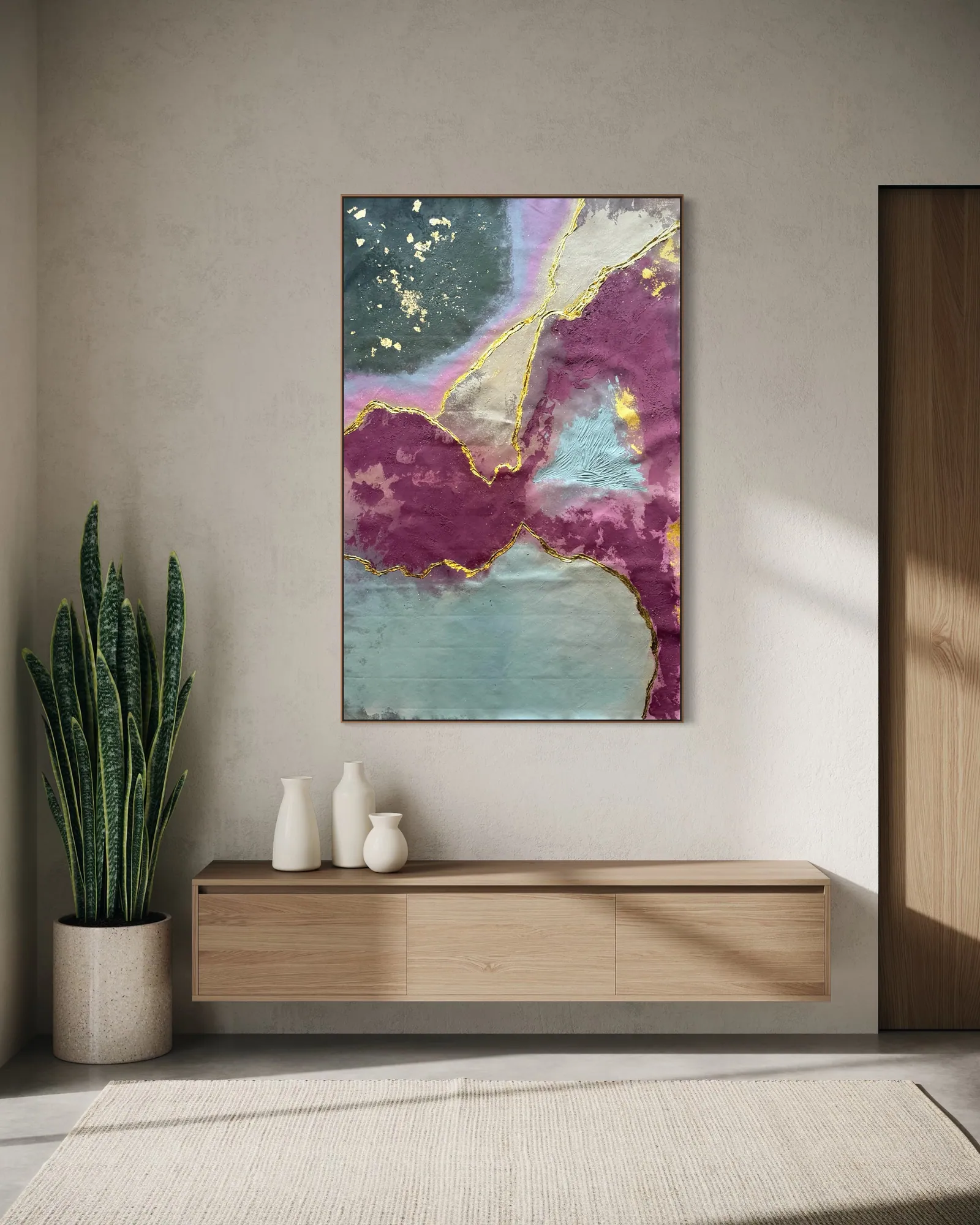
When I look at Quartz Seam (Terra & Ether, 2026, 98 x 152 cm, mixed media with acrylic and imitation gold leaf on canvas), the surface is where the work happens: pigment laid thick enough to carry its own relief, with gold lines marking where one field meets the next. I trained as an architect, and a painting's edge, the place where the surface stops, is something I would rather show than describe.
Most of my works ship unframed and ready to hang, with finished sides, and a side-view photograph of a specific piece can be sent on request.
Frequently asked
What does gallery wrap mean?
Gallery wrap is a way of stretching a canvas so the fabric folds around the sides of the stretcher bars and is fastened to the back. Because the staples are on the back, the sides are clean and the work can hang without a frame. The sides may be painted a solid colour, continue the image from the front, or mirror it, depending on the artist or printer.
How deep are the stretcher bars on a gallery wrap?
Sources give different figures. Wikipedia describes a typical gallery-wrap frame as about 1.25 inches (about 3.2 cm) thick, while Montcarta lists gallery-wrap bars at 1.5 to 2.5 inches (about 3.8 to 6.4 cm) and standard bars at 0.75 to 1.5 inches. Because Wikipedia's gallery-wrap figure falls inside Montcarta's standard range, ask for the actual thickness of a specific canvas rather than relying on the label.
Can you hang a gallery-wrapped canvas without a frame?
Yes, that is the purpose of the method. The fasteners are at the back and the sides are finished, so the canvas presents as a complete object. A frame remains optional, for instance to match other framed work on the same wall. For frame choices, see the guide on how to choose a frame for a contemporary painting.
Is gallery wrap better than a flat, unwrapped edge?
It depends on the wall and the plan. Gallery wrap suits frameless, contemporary presentation. Montcarta describes standard bars as the ones made for decorative framing, so a canvas on shallow bars with raw or stapled sides is usually planned with a frame. Neither is a quality ranking: they are two routes to a finished wall.
What happens to the edges of a printed gallery wrap?
The image has to be prepared for the sides, and something is lost or repeated. Printumo describes mirrored edges, which reflect the outer strip of the image, a stretched option, where the outer band folds around the frame and the visible front loses roughly 4 to 10 percent depending on size, and a solid colour. Wikipedia notes that about two inches of an image can be hidden around thick bars.
Want to see the side of a specific canvas?
Ask for a side-view photograph or a surface close-up of the work you are considering, and we will send it over WhatsApp.
Published on · Updated on