How to discover emerging Latin American artists: a method, not a list
There is no reliable list, but there is a method. Start from institutional filters that show how an artist was chosen: project sectors at art fairs, prizes that work by nomination, and residencies. Then read what each filter does and does not certify, and check the artist's own documentation, price logic and answers.
Why a method serves you better than a list of names
"Latin American" is a regional label, not a single art scene. In its 2026 Miami Beach announcement, Art Basel says Latin America and the Caribbean are represented in depth, with galleries in Brazil, Mexico, Argentina, Colombia, Uruguay, Peru, Chile, Guatemala, Cuba and The Bahamas, and Brazil once again the show's third-largest national contingent. Ten places, with different languages, institutions and markets, cannot be reduced to one ranking, and a list of living artists carries somebody else's judgement while ageing within a season. This page therefore names no living artist on purpose. It gives you a way to read the places where emerging work is selected, and then to test the artist yourself. The two institutions described in detail, a prize and a residency, are both Brazilian; they stand for a type of filter, not for the whole region, and an equivalent you find elsewhere can be read with the same three questions.
The sources below were read on 10 October 2026. Each describes a different kind of selection: a gallery choosing to present an artist, a committee nominating one, and an institution hosting one for a residency.
Three filters, and how each one chooses
1. Project sectors at art fairs. Art Basel's 2026 Miami Beach edition describes its Nova sector as 20 galleries with presentations centred on new work by up to three artists, and its Positions sector as 12 solo projects by emerging artists. The same announcement says more than 30 galleries take part for the first time, most of them through the project-based sectors (Nova, Positions and Survey, the last one historical), and that these line-ups change with each edition. What this tells you: a gallery chose to present this artist in a sector the fair describes as project-based. That is mostly a dealer's choice, and it is useful as a lead, not as a verdict.
2. Prizes that work by nomination. Brazil's PIPA Prize accepts no applications. Under its 2026 regulation, participation is free and happens only through nomination by a member of its nominating committee, which has 20 to 30 professionals who each name up to three artists whose first institutional exhibition was no more than 15 years ago. The prize council then chooses four winners from the participating artists, and a separate online public vote runs alongside. What this tells you: a group of art professionals considered the artist worth following, inside a stated career window. It also gives you a working institutional definition of "early" in one country: a trajectory begun within the last 15 years. For the general question of what the word means, see what is an emerging artist.
3. Residencies. Pivô, an autonomous contemporary art platform in São Paulo, describes Pivô Pesquisa as its artistic residency programme, active since 2013 in the Copan building, with more than 300 Brazilian and foreign artists in its first ten years. The programme page says residencies run for three or five months, that the open call is launched annually and that participants receive a research stipend. It also describes Campo Aberto, the event that opens the studios and gathers the outcomes of each resident's individual research, and says that some of the educational activities in each cycle are open to the public. Formats move: for a special edition in the second half of 2025, Pivô said the São Paulo programme would run exclusively through institutional collaborations. What this tells you: an institution invited an artist into a period of research, and the programme describes a way for its residents to share that research.
What a filter certifies, and what it leaves to you
Each filter answers one question, and none answers all of them:
- A fair sector shows that a gallery chose to present the artist. It does not show whether the work is documented or how the price was set.
- A nominated prize shows that a professional nominated the artist and a council accepted the nomination under written rules. The regulation's stated aim is artists with a recent trajectory and a promising participation in the circuit; it is not a statement about what any work will be worth.
- A residency shows institutional interest in a period of research. Pivô's own description says it has welcomed hundreds of artists at different moments in their trajectories, so a residency alone does not mean an early-career artist.
None of the pages read for this guide addresses price, paperwork or resale. That part is yours, and it is where the real risk of buying early work sits; it is covered in the real risk of buying work by an emerging artist.
Then test the artist directly
Once a filter has pointed you at a name, the questions are the same wherever the artist lives, and a few minutes of correspondence usually answers them:
- Is the work identified? Title, year, medium and dimensions on the page, tied to a record such as an archive number.
- Is there a body of work? Several pieces across more than one moment, not one striking image.
- Is the price stated, with a logic? In writing, tied to size, series or material, and the same for every enquirer.
- Is the sale documented? A signed certificate and a fiscal invoice or official receipt.
- Does the artist answer specifically? A direct question about technique or availability should get a direct answer.
Check also that the filter you are relying on is current, since sector line-ups, nominee lists and residency formats change from one edition to the next. For the signals inside the work itself, see how to find emerging artists before they are represented, and for the places where unrepresented artists show, where to buy art from emerging artists.
From the studio
From the studio
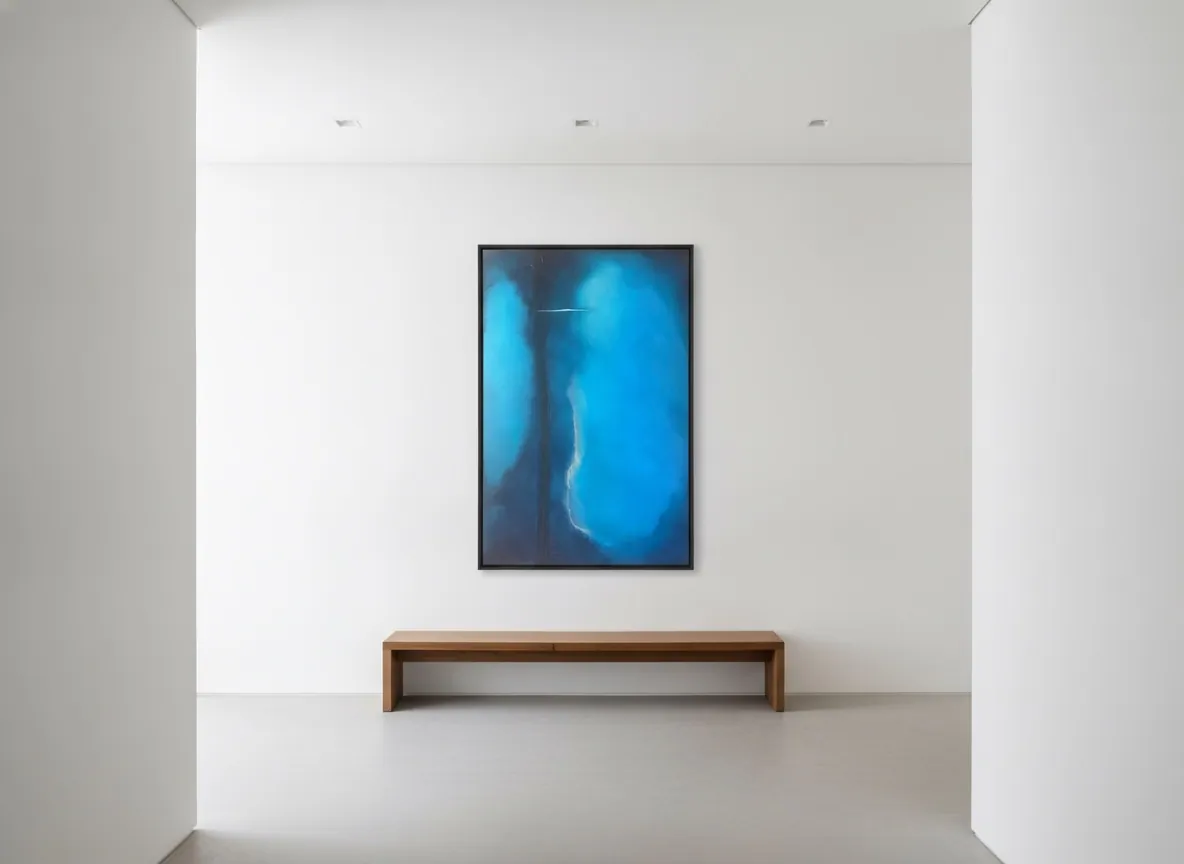
I do not use any of these filters as a credential, and this page does not ask you to treat my work as if I did. What I can offer is the checklist above applied to one painting. Veil of Light is 70 × 110 cm, mixed media on canvas with sculpted texture and acrylic, painted in 2026, from the Luminous Rebirth series, Archive ID AP-LMR-2026-004. It is built around a single dark vertical column and a textured ridge, and that ridge is the part a thumbnail flattens.
My body of work, painted between 2025 and 2026, is organised in five series, and each painting is catalogued under an Archive ID and photographed in detail before it leaves the studio. If you are weighing work from any early-career artist, mine or someone else's, I would ask for the same things: detail photographs, the written record of medium and size, and a direct answer. For buyers who cannot visit, detail photographs and video of a specific work are available on request.
Frequently asked
What counts as an emerging artist?
There is no single authority. One institutional wording comes from Brazil's PIPA Prize, whose 2026 regulation targets artists whose first institutional exhibition was no more than 15 years ago and whose trajectory is recent. Other institutions may set different windows, and the label describes a stage of a career more than quality. Use it as a starting description, then judge the work, its documentation and how the artist answers your questions.
Where do emerging Latin American artists show first?
There is no single first stage. The sources used for this page point to three recurring places: gallery presentations in the project sectors of art fairs, prizes where professionals nominate artists, and residencies, some of which describe events where residents share their research. A given artist may appear in none of them and still be worth looking at, so treat them as leads that you then verify yourself.
What should I check before buying from an emerging artist?
Check that the work is identified by title, year, medium and dimensions, that there is a body of work behind it, that the price is stated in writing with a logic, and that the sale comes with a signed certificate and a fiscal invoice or official receipt. Ask a specific question about technique or availability and see whether the answer is specific. A fair, prize or residency listing does not replace any of this.
Is buying emerging art risky?
Yes, in a specific way: an early-career artist may have little public price history, and nothing guarantees that a work can be resold, or at what price. That risk is about evidence and liquidity, not about the quality of the work. Buy a piece because you want to live with it, with full documentation in hand, and do not treat any future value as an expectation.
How do I contact an artist directly?
Start from the artist's own site or profile, or from the gallery, prize or residency page that introduced them, and write a specific message: the work you are asking about, the information you need, and whether you are buying locally or from abroad. Ask the same documentation and price questions you would ask anyone. At Perfeito Studio, direct contact with the artist takes place over WhatsApp.
Want to look closely at one work before deciding anything?
Ask for detail photographs and video of a specific painting, and for the documentation that comes with it.
Sources
- Art Basel (press announcement, September 2026; date not shown on the page, 29/09/2026 per press coverage) — 2026-10-10
- Prêmio PIPA / Instituto PIPA (page last updated April 2026) — 2026-10-10
- Prêmio PIPA / Instituto PIPA, Regulamento 2026 — 2026-10-10
- Pivô — 2026-10-10
- Pivô — 2026-10-10
Published on