The world's major art auction houses
The best-known art auction houses are Sotheby's, Christie's, Phillips and Bonhams, along with a Beijing house, China Guardian. They differ less in rank than in type: global generalists, a 20th and 21st century specialist, a broad fine-art and antiques house, and a regional house built around Chinese art.
Four ways to sort auction houses, instead of one ranking
Searching for the "top" auction houses usually returns a list of names. A more useful way to read the market is by type, because the type tells a buyer what kind of work a house handles and how its sales are organised. This page makes no attempt to rank the houses; each does different work, and several of them overlap.
Four types cover most of the houses people ask about: global generalists that sell across many categories, specialists that focus on a period or field, broad fine-art and antiques houses with a long regional footprint, and regional houses built around the collecting culture of one part of the world. For how a sale itself runs, see how art auctions work.
Global generalists: Sotheby's and Christie's
Sotheby's describes itself as established in 1744 and sells through auctions as well as private sales, e-commerce and retail channels. Its own site cites 70 categories, from Contemporary Art and Old Masters to jewellery, watches, wine, design, collectible cars and real estate, supported by specialists in 40 countries.
Christie's was founded in London in 1766 by James Christie, with its first sale dated by the house to 5 December 1766, and is today owned by Groupe Artémis, the holding company of François Pinault, which acquired it in 1998. Like Sotheby's, it holds art and luxury auctions and also arranges private sales.
The shared trait is breadth. Both handle everything from Old Master paintings to jewellery in one organisation, which is why the two are so often named together. Any difference in house style, sale calendar or fee structure is best checked on each house's own current pages, since fees change.
A period specialist: Phillips
Phillips says Harry Phillips founded the house in 1796 in Westminster, London, and describes itself as a leading global platform for buying and selling 20th and 21st century works. Its departments include Modern and Contemporary Art, Design, Photographs, Editions, Watches and Jewels.
The point of the type is focus. A house concentrated on the twentieth and twenty-first centuries will usually be most relevant to a buyer interested in living or recently active artists, editions or design, rather than antiquities or Old Masters.
Broad fine-art and antiques houses: Bonhams
Bonhams was founded in London in 1793 by antique print dealer Thomas Dodd and book specialist Walter Bonham. It is described as a fine art and antiques auction house running more than 450 sales a year across more than 60 collecting areas, among them Asian art, pictures, cars, watches and jewellery, with salerooms in cities including London, New York, Los Angeles, Paris, Hong Kong and Sydney.
This type is wide in subject matter and spread across several countries, so a buyer may meet the same house in very different sales: a car sale one week, a picture sale the next.
Regional houses: A regional house: China Guardian in Beijing
Not every major house is built on the European model. China Guardian was founded in Beijing in May 1993, is headquartered there and has offices in Shanghai, Guangzhou, Hong Kong, Taiwan, Japan and North America. Chinese calligraphy and ink painting make up about 60% of its sales, alongside porcelain, furniture, sculpture, rare books and jewellery.
It stands for a wider point: a house's strength often follows the collecting tradition of the place where it grew. A buyer of Chinese works on paper and a buyer of contemporary abstraction may well be looking at different houses.
What the type does not tell you
None of this says which house is right for a particular purchase, and none of it says what a work will be worth later. An auction house is an intermediary: it catalogues, markets and sells on behalf of consignors. What a buyer pays depends on the sale, the lot and the fees in force on the day, so read the current conditions of sale on the house's own site before bidding. If you are still deciding between auction, gallery and direct purchase, how collectors buy art now compares the channels.
From the studio
From the studio
I trained as an architect, and I tend to read a market the way I read a floor plan: by what each part is for. Auction houses are a good example. They exist to move works that already have a history, and a catalogue entry is built around provenance, estimate and condition.
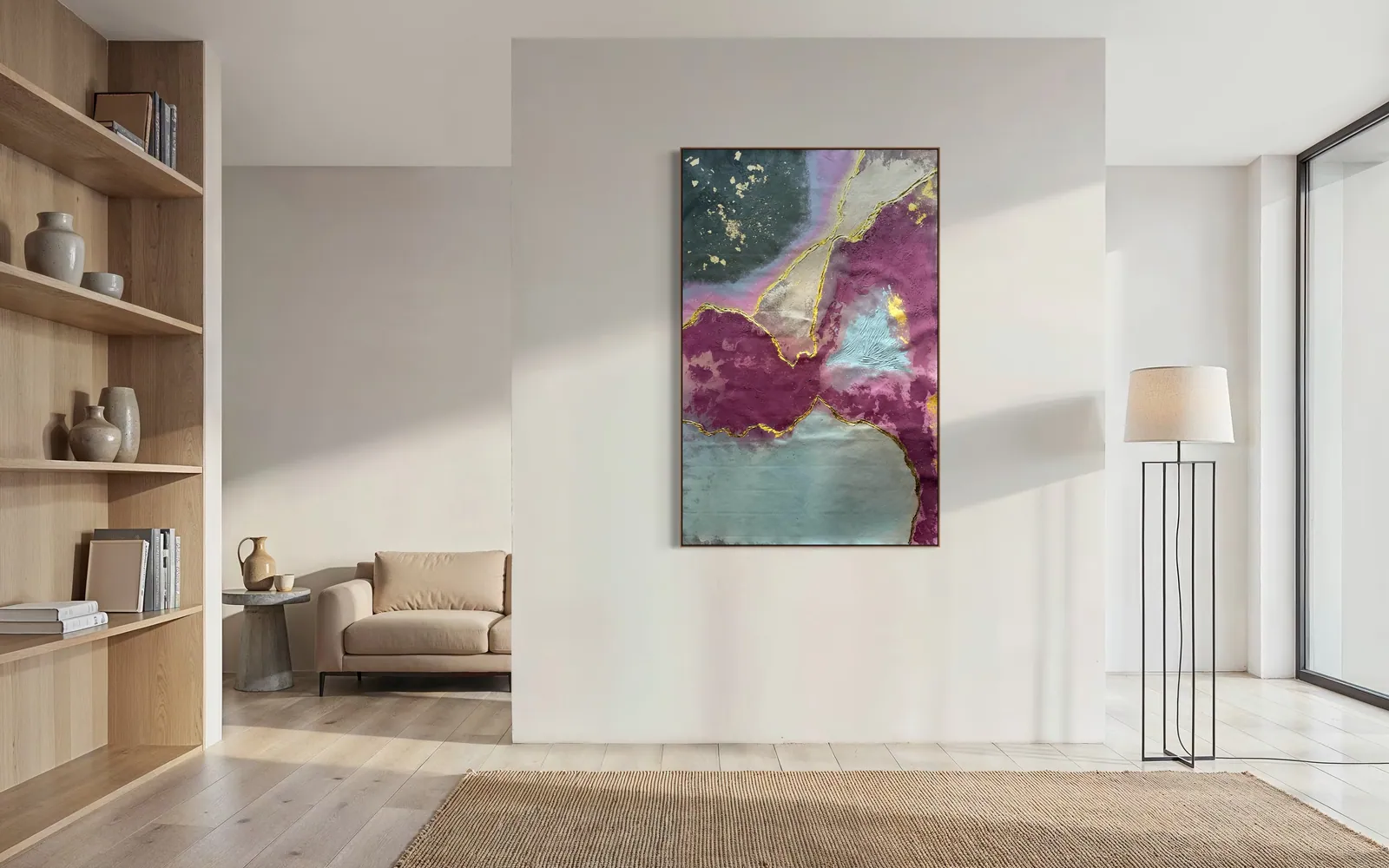
A work leaving this studio does it differently. Quartz Seam (Terra & Ether, 2026, 98 x 152 cm, Archive ID AP-TAE-2026-007) is built in thick pigment bounded by lines of imitation gold leaf, and it is listed at a single published price of R$ 6,700 with its documentation prepared at the start. I do not offer this as better than an auction; it is a different route, for a buyer who wants to speak to the artist directly and see the work before deciding. Parts of the collection can be viewed in Brasília by appointment.
Frequently asked
Which are the world's major art auction houses?
The names most often cited are Sotheby's, Christie's, Phillips and Bonhams, together with China Guardian in Beijing. They differ by type. Sotheby's and Christie's handle many categories worldwide, Phillips focuses on 20th and 21st century works, Bonhams spans fine art and antiques across more than 60 collecting areas, and China Guardian is strongest in Chinese art. This page does not rank them.
What is the difference between Sotheby's and Christie's?
Both are global generalists that hold auctions and arrange private sales across many categories, from paintings to jewellery. Sotheby's dates its establishment to 1744 and cites 70 categories; Christie's dates its first sale to 1766 and is owned by Groupe Artémis. For fees, sale calendars and specific departments, check each house's current pages directly, because those details change and differ lot by lot.
Are there major auction houses based outside Europe and the US?
Yes. China Guardian was founded in Beijing in 1993 and is headquartered there, with offices in Shanghai, Guangzhou, Hong Kong, Taiwan, Japan and North America. Chinese calligraphy and ink painting account for about 60% of its sales. Regional houses exist elsewhere too, and a house's strength often follows the collecting tradition of the place where it grew.
Do all major auction houses charge the same buyer's premium?
No. Each house sets its own buyer's premium and revises it from time to time. Because they are revised, the reliable source is the conditions of sale on the house's own site for the specific sale you are interested in. This page does not quote rates, and our guide to how auctions work explains what a buyer's premium is.
Can anyone bid at these auction houses, or is it members-only?
Each house publishes its own registration requirements for a sale, and they can differ between live and online-only sales. Confirm them on the house's site before the sale date. Some private sales are arranged differently, outside the open saleroom.
Prefer to speak to the artist directly?
One published price per work, documentation prepared from the start, and international shipping quoted on request.
Published on · Updated on