Brazilian art history in one timeline: from the baroque to concrete art
Brazilian art history runs in six steps: the colonial baroque of the eighteenth century, the French Artistic Mission of 1816 and the academy it fed, the Modern Art Week of 1922, Anthropophagy in 1928, concrete (1952) and neo-concrete (1959) art, and the 1967 shift toward environments and objects.
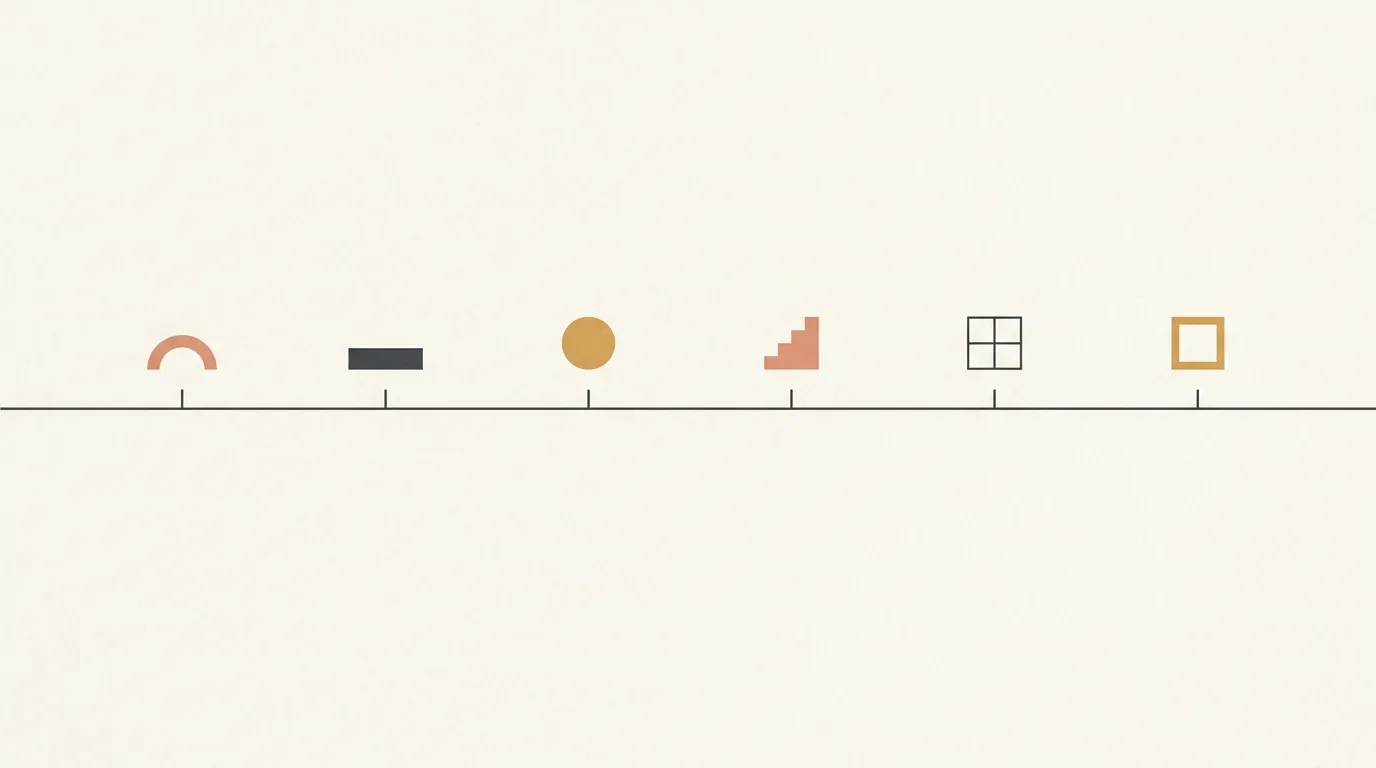
The timeline at a glance
Dates below come from the cited sources. Each step is expanded in the sections that follow.
- Eighteenth century: the colonial baroque flourishes, with major centres in Bahia, Pernambuco and Minas Gerais.
- 1816: the French Artistic Mission reaches Rio de Janeiro, and a royal decree of 12 August creates the school that becomes the Imperial Academy of Fine Arts, fully operating in 1826.
- February 1922: the Modern Art Week takes place at the Theatro Municipal in São Paulo.
- 1928: Tarsila do Amaral paints Abaporu and Oswald de Andrade writes the Anthropophagic Manifesto.
- 1951 to 1959: the first São Paulo Bienal (1951), the Ruptura exhibition (9 December 1952) and the Neo-Concrete Manifesto (1959).
- 1967: Hélio Oiticica shows the environment Tropicália in the exhibition Nova Objetividade Brasileira at the Museu de Arte Moderna in Rio.
This is a map, not a ranking. Nothing here says one period or artist matters more than another; it only puts the turning points in order.
Colonial baroque and the academy, from the 1700s to 1826
Wikipedia's overview of Brazilian art places the colonial baroque in the seventeenth and eighteenth centuries, with major centres in Bahia, Pernambuco and Minas Gerais. In Minas Gerais the sculptor and architect Aleijadinho worked in towns such as Ouro Preto, Sabará, São João del-Rei and Congonhas. Scholars caution that his biography is thinly documented and that most works attributed to him rest on stylistic comparison rather than documents, so attributions in this period are often a matter of judgement.
The second step is institutional. The French Artistic Mission, led by Joachim Lebreton, arrived in Rio de Janeiro in 1816 with painters and architects including Jean-Baptiste Debret, Nicolas-Antoine Taunay and Grandjean de Montigny. The Museu Nacional de Belas Artes presents it as the group that introduced neoclassicism and changed how art was produced and taught in Brazil. A royal decree of 12 August 1816 created the Escola Real de Ciências, Artes e Ofícios; in 1826 a building designed by Grandjean de Montigny was completed and the school began operating fully as the Academia Imperial de Belas Artes, which Wikipedia dates to its inauguration on 5 November 1826.
Modernism: the Week of 1922 and Anthropophagy in 1928
The Modern Art Week was held at the Theatro Municipal in São Paulo from 10 to 17 February 1922, according to Wikipedia and the city of São Paulo, and it is widely treated as the starting point of Brazilian modernism. It brought together visual artists such as Anita Malfatti and Di Cavalcanti with writers and composers, and it was met with open hostility from part of the audience. For a closer reading, see what the Modern Art Week of 1922 was.
Six years later the argument turned from adopting European modernism to digesting it. Tarsila do Amaral painted Abaporu in 1928, and Oswald de Andrade drew on it when he wrote the Anthropophagic Manifesto the same year; Google Arts & Culture, in a story presented with MALBA, calls the manifesto an essential document of Brazilian modernism. The central image is symbolic: foreign influence is consumed and transformed rather than copied. See what Anthropophagy was.
Concrete and neo-concrete art, 1951 to 1959
The first São Paulo Bienal opened in 1951, organised by the Museu de Arte Moderna de São Paulo. Its international sculpture prize went to the Swiss artist Max Bill for Tripartite Unity (1948 to 1949), a work often read as a sign of the growing weight of concrete art in São Paulo. On 9 December 1952 the group Ruptura, seven artists led in theory by Waldemar Cordeiro, opened its first exhibition at the same museum with a manifesto that argued for geometric, non-figurative art.
In Rio de Janeiro a different position formed. The first Neo-Concrete exhibition was held at the Museu de Arte Moderna do Rio de Janeiro in 1959, and the Neo-Concrete Manifesto was published in the Jornal do Brasil's Sunday supplement on 23 March 1959. Tate describes the group as a splinter from the concrete movement that called for greater sensuality, colour and poetic feeling, with Lygia Clark, Lygia Pape and Ferreira Gullar among those named. For the contrast between the two, see what neo-concrete art was.
1967: the object leaves the frame
In 1967 the exhibition Nova Objetividade Brasileira at the Museu de Arte Moderna in Rio de Janeiro included the environmental installation Tropicália by Hélio Oiticica. The Museo Reina Sofía, which holds related works by Hélio Oiticica, records that he presented it in that show, and places the work at the height of the military dictatorship's repression. Brazilian modern art can be explored further in the Journal's guide to where to start.
From the studio
From the studio
Alyne Perfeito is a Brazilian visual artist and trained architect based in Brasília, and our current body of work was painted between 2025 and 2026. This timeline is background reading, not a lineage; the studio makes no claim of belonging to any of the movements above. What we can describe is procedure.
Origin of Light (60 x 80 cm, mixed media with acrylic and imitation gold leaf on canvas, 2025, Heart of Chaos series) belongs to a body of work built in layers of texture, pigment and, in some pieces, imitation gold leaf. The full set of works, with materials and dimensions for each, is in the gallery.
Frequently asked
What is the history of Brazilian art?
Brazilian art history is usually told in stages: the colonial baroque of the eighteenth century, especially in Minas Gerais; the French Artistic Mission of 1816 and the academy that followed; modernism, from the Modern Art Week of 1922 and Anthropophagy in 1928; concrete and neo-concrete art in the 1950s; and the experimental objects and environments of the 1960s. Indigenous and pre-colonial art is a separate, much longer history that this timeline does not cover.
When did Brazilian modernism begin?
Brazilian modernism is conventionally dated to the Modern Art Week, held at the Theatro Municipal in São Paulo in February 1922. It ran from 10 to 17 February. The movement then took a distinct turn in 1928 with Oswald de Andrade's Anthropophagic Manifesto and Tarsila do Amaral's Abaporu.
What came before Brazilian modernism?
Two things stand out. The colonial baroque flourished in the seventeenth and eighteenth centuries, with major centres in Bahia, Pernambuco and Minas Gerais, where Ouro Preto is among the best-known towns. In the nineteenth century the Imperial Academy of Fine Arts in Rio de Janeiro, tied to the French Artistic Mission of 1816, taught academic and neoclassical practice.
How did concrete art arrive in Brazil?
Scholars point to the first São Paulo Bienal in 1951, where the Swiss artist Max Bill won the international sculpture prize for Tripartite Unity, as a decisive impulse. In 1952 the group Ruptura, led in theory by Waldemar Cordeiro, held its first exhibition at the Museu de Arte Moderna de São Paulo, on 9 December, and published a manifesto for geometric, non-figurative art.
What are the main periods of Brazilian art?
A common outline is colonial baroque, the academic period that begins with the 1816 French Mission, modernism from 1922, concrete and neo-concrete art in the 1950s, and the experimental period around 1967 and the years of military rule. Periods overlap and historians draw the lines differently, so treat any single list, including this one, as a way in rather than a fixed rule.
Ask the studio directly
Alyne answers WhatsApp enquiries with materials, dimensions and shipping details for any work in the gallery.
Sources
- Wikipedia — 2026-10-18
- Wikipedia (timeline of Brazilian art, citing Enciclopédia Itaú Cultural) — 2026-10-18
- Museu Nacional de Belas Artes via Google Arts & Culture — 2026-10-18
- Arquivo Nacional (MAPA) — 2026-10-18
- Wikipedia — 2026-10-18
- Wikipedia — 2026-10-18
- Prefeitura de São Paulo, Secretaria Municipal de Cultura — 2026-10-18
- MALBA via Google Arts & Culture — 2026-10-18
- Wikipedia — 2026-10-18
- Perspective (OpenEdition Journals) — 2026-10-18
- Modos, Universidade Estadual de Campinas — 2026-10-18
- Wikipedia — 2026-10-18
- Tate — 2026-10-18
- Toda Matéria — 2026-10-18
- Museo Nacional Centro de Arte Reina Sofía — 2026-10-18
- Perfeito Studio (src/data/obras.json, studio-facts.json) — 2026-10-18
Published on · Updated on