What was the Modern Art Week of 1922 in São Paulo?
The Modern Art Week (Semana de Arte Moderna) was a festival of exhibitions, lectures, concerts and poetry readings held at the Theatro Municipal in São Paulo in February 1922, with its main evenings on 13, 15 and 17 February. It is widely treated as a landmark of Brazilian modernism, though historians caution against calling it the single origin.
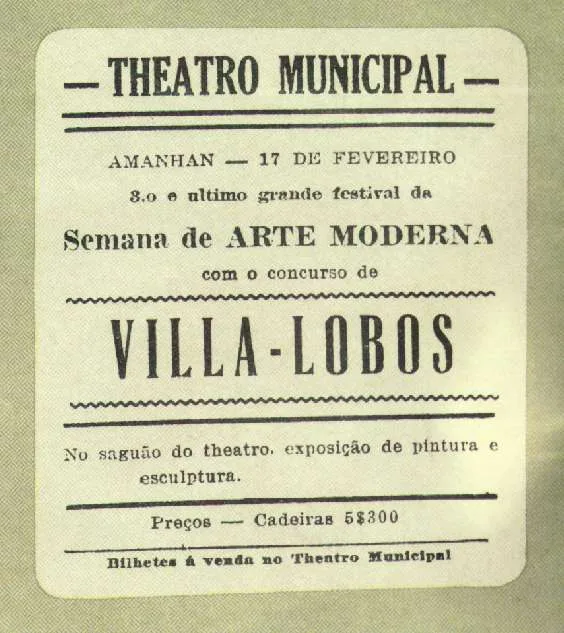
What happened in February 1922
The Week was staged at the Theatro Municipal, a traditional venue for artistic performances in São Paulo, so the new art was shown inside an established institution. A note in the Correio Paulistano of 29 January 1922 announced a week of art between 11 and 18 February, with writers, musicians, artists and architects from São Paulo and Rio de Janeiro. The lectures and concerts took place on three evenings, 13, 15 and 17 February. In the lobby, artists and architects showed their work.
The date was not accidental. 1922 was the centenary of Brazilian independence, and the organizers used the commemorations as an opening to argue for artistic renewal. The scholar Elza Ajzenberg describes the aim as renewing a stagnant cultural climate in São Paulo and in the country, and rethinking Brazil in a way that loosened its aesthetic ties to Europe. Who proposed the idea is itself disputed: the press note credited the writer Graça Aranha, while some researchers consider the painter Di Cavalcanti more likely, and Di Cavalcanti claimed it in his own memoir.
The patronage came from the São Paulo elite. The sponsoring committee included Paulo Prado, Alfredo Pujol, René Thiollier and José Carlos Macedo Soares. Graça Aranha, an established writer, acted as a kind of guarantor for the younger participants, and he opened the programme on 13 February with a lecture titled A emoção estética na arte moderna (The aesthetic emotion in modern art).
Who took part, and who did not
The exhibition catalogue, conceived by Di Cavalcanti, lists the architects Antonio Moya and Georg Przyrembel; the sculptors Victor Brecheret and Wilhelm Haerberg; and the painters and draughtsmen Anita Malfatti, Di Cavalcanti, John Graz, Martins Ribeiro, Zina Aita, Yan de Almeida Prado, Ferrignac and Vicente do Rego Monteiro. Among the writers were Mário de Andrade, Oswald de Andrade, Menotti Del Picchia, Ronald de Carvalho, Guilherme de Almeida, Ribeiro Couto and Sérgio Milliet. The musicians included Heitor Villa-Lobos, the pianist Guiomar Novaes, Ernani Braga and Frutuoso Viana.
The best-known absence is Tarsila do Amaral. She was studying in Paris at the time and was not part of the Week. She is nonetheless often linked to it, because she later joined Anita Malfatti, Mário de Andrade, Oswald de Andrade and Menotti Del Picchia in the so-called Group of Five; the Guggenheim Bilbao chronology dates the founding of that group, with Malfatti, to June 1922. Oswald de Andrade, by contrast, did take part in the Week itself. For Tarsila, see who Tarsila do Amaral was.
Why it caused a scandal
The Week took place, in Ajzenberg's phrase, amid applause and boos. In Ajzenberg's reading, the newspapers of the time counted more enemies than friends, though other historians say the press outside São Paulo barely noticed the event. The works hung in the lobby moved most visitors somewhere between amusement and indignation, and the main targets were the paintings of Anita Malfatti and the sculptures of Victor Brecheret. One of Malfatti's works shown there was O homem amarelo (The Yellow Man, 1915/16), today in the Mário de Andrade collection of the Instituto de Estudos Brasileiros at the University of São Paulo.
Malfatti had been a lightning rod before. Her 1917-18 solo exhibition in São Paulo had already stirred controversy, and the debates around it, in Ajzenberg's account, are where the ideas behind the Week began to take shape.
The second evening also produced one of the best-known episodes: Manuel Bandeira's poem Os sapos, a satire of Parnassian poetry, was read by Ronald de Carvalho and met with boos and jeers. It is worth adding that the modernism on show looks modest today. Ajzenberg notes that even the titles in the catalogue, such as Impressão Divisionista or Cubismo, show how loosely the exhibitors used the labels of European movements.
Was it really the start of Brazilian modernism?
The standard account says yes. The official historiography treats the Week as the starting point of modernism in Brazil, and Ajzenberg calls it a watershed (divisor de águas), a collective call rather than an isolated gesture of rebellion. In Mário de Andrade's later assessment, it won three things: the permanent right to aesthetic research, the updating of Brazilian artistic intelligence, and the consolidation of a national creative consciousness.
The qualification is that renewal was already under way. Ajzenberg notes that the idea of renewal had appeared before in isolated forms and was not yet consolidated as an organized movement, and in 2022 Deutsche Welle reported historians who argue that the Week's status as a founding moment was built up afterwards, partly by later academics, and that music and literature in Rio de Janeiro were already modern in 1922. Even within the Week, the organizing committee was more traditional than the artists it showcased. Fair summary: the Week was a public, collective manifestation that gave modernism a date and a place, not the only origin.
What followed is easier to document. The magazine Klaxon appeared in São Paulo from May 1922 to January 1923. Oswald de Andrade's Pau-Brasil manifesto followed in 1924 and his Anthropophagic Manifesto in 1928, the line of thought that Tarsila's Abaporu helped to name. For a wider map of the period, see Brazilian modern art: where to start and famous Brazilian painters.
From the studio
From the studio
I trained as an architect, and what I take from the Week is less a style than a stance: the claim to a permanent right to research, to work out a language through the act of making. I do not claim any lineage to the people of 1922, and I do not place my work beside theirs. What I can describe is procedure.
In Golden Passage (2025, Black & Gold series, mixed media, texture paste and imitation gold leaf on canvas, 60 x 80 cm) I build a dark field in layers of sculpted texture, and only then place small fragments of imitation gold leaf. Research, for me, happens on the surface: a layer is added, scraped back and judged before the next one. Every acquisition is direct from the artist, with a certificate of authenticity and a dossier, and the available paintings are on the gallery page.
Frequently asked
What was the Semana de Arte Moderna?
The Semana de Arte Moderna, or Modern Art Week, was a festival of exhibitions, lectures, concerts and poetry readings held at the Theatro Municipal in São Paulo in February 1922. Its main evenings were on 13, 15 and 17 February, and an exhibition of painting, sculpture and architecture ran in the theatre lobby. It coincided with the centenary of Brazilian independence and is generally regarded as a landmark of Brazilian modernism.
Who took part in the 1922 Modern Art Week?
Participants included the painters Anita Malfatti, Di Cavalcanti, Zina Aita and Vicente do Rego Monteiro, the sculptor Victor Brecheret, and the writers Mário de Andrade, Oswald de Andrade, Menotti Del Picchia and Ronald de Carvalho. Graça Aranha gave the opening lecture. Musicians included Heitor Villa-Lobos and the pianist Guiomar Novaes. Tarsila do Amaral was not there: she was studying in Paris.
Why was it controversial?
Much of the audience and the press reacted with hostility, and the Week took place amid both applause and boos. Visitors to the lobby exhibition felt amusement or indignation, and the works of Anita Malfatti and Victor Brecheret were the main targets. On the second evening a poem by Manuel Bandeira that satirized Parnassian poetry was jeered. Much of the audience moved between amusement and indignation, and Ajzenberg notes that the press counted more enemies than friends.
Did the Week really start Brazilian modernism?
It is the conventional starting point, and scholars describe it as a watershed. But the idea of renewal had appeared earlier in isolated forms, including Anita Malfatti's 1917 exhibition, and some historians argue that its status as a founding moment was built up afterwards. A cautious reading is that the Week gave modernism a public, collective moment in São Paulo, without being its only origin.
Which artworks are linked to it?
Anita Malfatti's O homem amarelo (The Yellow Man, 1915/16) is documented as one of the works she showed there, and it is now held by the Instituto de Estudos Brasileiros at the University of São Paulo. Victor Brecheret's sculptures and the paintings of Di Cavalcanti, Zina Aita and Vicente do Rego Monteiro were also in the lobby exhibition. Tarsila's Abaporu, of 1928, belongs to a later phase.
Where was the Modern Art Week held?
It was held at the Theatro Municipal de São Paulo, a traditional venue for artistic performances, so the new art was shown inside an established institution of the city. The evening lectures and concerts took place in the theatre itself, while the exhibition of painting, sculpture and architecture was installed in the lobby.
Interested in abstract work made in Brasília?
Write to the studio for details, detail photographs or a viewing by appointment. Every acquisition is direct from the artist.
Sources
- Elza Ajzenberg, Revista Cultura e Extensão USP, vol. 7 (University of São Paulo) — 2026-10-14
- Elza Ajzenberg, Revista Cultura e Extensão USP, vol. 7 (University of São Paulo) — 2026-10-14
- Wikipedia — 2026-10-14
- Fundação Abrinq (FADC) — 2026-10-14
- Guggenheim Museum Bilbao — 2026-10-14
- Wikipedia — 2026-10-14
- Toda Matéria — 2026-10-14
- Wikimedia Commons (credit: Prefeitura de São Paulo) — 2026-10-14
- Perfeito Studio (obras.json) — 2026-10-14
- Deutsche Welle (Edison Veiga, 11 Feb 2022) — 2026-10-14
Published on · Updated on