Parangolé by Hélio Oiticica, explained
A Parangolé is a work by Hélio Oiticica, begun in 1964, made of cloth, capes, banners and tents designed to be worn or carried. It is completed only by a body in motion, often dancing samba, which is why Oiticica called the wearer a participant rather than a viewer.
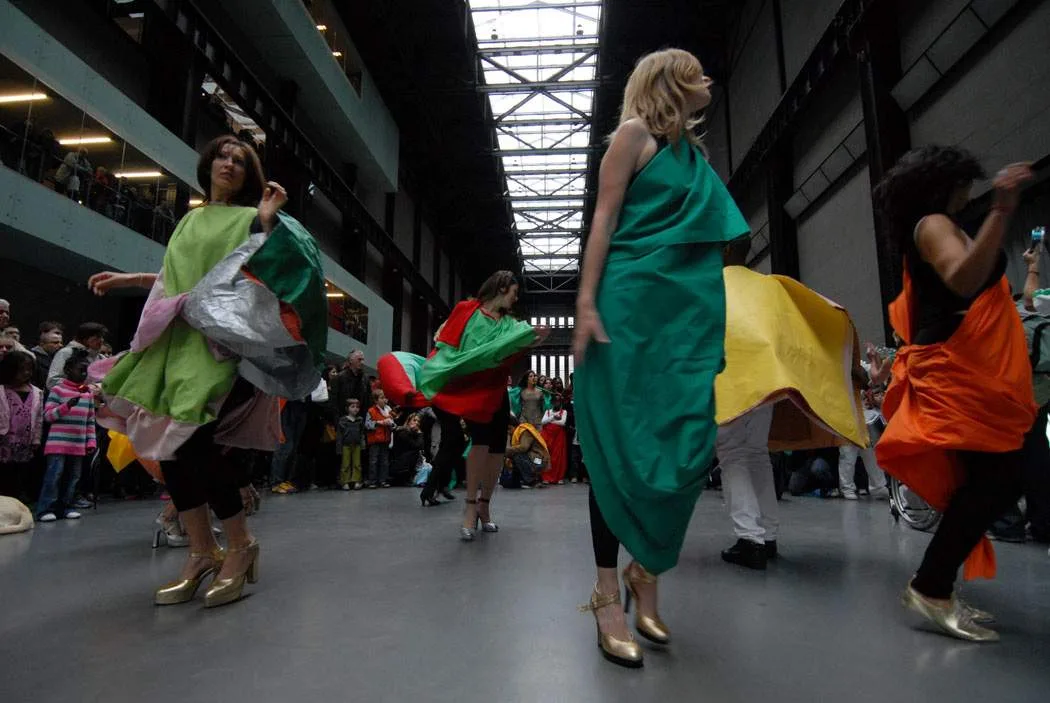
What a Parangolé is
The Parangolé is a series Oiticica began in 1964. The Hélio Oiticica project's own chronology says he conceived the first one that year, after seeing a makeshift structure in Rio's North Zone, built by a beggar from wooden slats and ropes, with the word parangolé written on a piece of burlap. The first three pieces were a tent, a banner and a flag, and P4 Cape 1 was the first meant to be worn on the body.
Tate describes the form as capes, flags, banners and tents made from layers of painted fabric, plastics, mats, screens, ropes and similar materials, worn or carried while dancing to samba. Dates vary slightly by source: Tate's essay dates the series 1964 to 1968, while the Museu de Arte Moderna do Rio de Janeiro (MAM Rio) and Tate's performance case study date it 1964 to 1979.
The word was not Oiticica's invention. MoMA's online essay, citing the scholar Irene V. Small, calls it carioca slang that emerged from Rio's favelas.
Mangueira, samba and the first public showing
In 1964 the sculptor Jackson Ribeiro introduced Oiticica to the Estação Primeira de Mangueira samba school. According to the Projeto HO chronology he became an enthusiastic samba dancer there and built friendships in the community. MAM Rio calls this a turning point in his life and work.
The Parangolés were first shown publicly on 12 August 1965 at Opinião 65, at MAM Rio. MAM's page says the artist and sambistas and musicians from Mangueira wore the capes and arrived at the museum in a festive procession. The Projeto HO chronology records that he was forbidden to show the capes worn by the Mangueira dancers inside the museum; he left in protest and continued the parade in the museum gardens.
Why the cloth needs a body
Tate's case study says the Parangolés have an indeterminate status: they come alive through the movement of the people wearing them. Its account of the 2007 restaging at Tate Modern adds that Oiticica wanted spectators to become participators, and that workshops had visitors build a cloak from lengths of fabric before learning simple samba steps.
MoMA's essay is more precise about the vocabulary. It describes the Parangolé as not only a costume, a construction or a shelter, but the performer's experience of wearing it, and notes that a viewer becomes a participant, and is seen from outside as a participant-work. Tate's 2007 magazine piece places the series within what Oiticica called vivência, an interaction with living life.
This is why a Parangolé is hard to file as painting, sculpture or performance. Tate links the series to Oiticica's earlier idea of habitable paintings, colour carried out of the frame and into the environment.
Capes that survive, and how to approach them
Tate notes that the materials were deliberately cheap and ephemeral, and some capes in museum collections are reconstructions: MoMA's essay credits P16 Parangolé Cape 12 "From Adversity We Live" as dated 1965 and reconstructed in 1992. The Projeto HO site publishes his chronology and documentation online.
For Oiticica's wider path, from the Neo-Concrete group to the Bólides and Tropicália, see Who was Hélio Oiticica?, which covers the biography this page deliberately does not repeat. For the movement he came from, see What was neo-concrete art?, and for a wider map of the period, Brazilian abstract artists to know.
From the studio
From the studio
A Parangolé is the opposite kind of object from the paintings I make, and that is why it is useful to think with. Mine hang on a wall and are read from a fixed distance; his only exist when someone moves. What I take from it is a point about attention: colour behaves differently when the viewer's position changes.
As a trained architect I think about how a person approaches a work in a room, from the door, from the sofa, up close. In Celestial Drift (Luminous Rebirth, 2025, acrylic on canvas, 70 x 100 cm, Archive ID AP-LMR-2025-001) the diagonal currents of blue, ivory and indigo are laid in fluid layers with pale yellow openings breaking through them; it is the kind of surface I would want a viewer to approach from the door and then from up close. It is a way of building movement into a still surface, nothing more ambitious than that.
Frequently asked
What is a Parangolé?
A Parangolé is a work by the Brazilian artist Hélio Oiticica, begun in 1964, made of cloth capes, banners, flags and tents meant to be worn or carried. Tate describes layered painted fabric, plastics, mats, screens and ropes, activated by the movement of the person wearing them, often while dancing samba. Sources date the series 1964 to 1968 or 1964 to 1979.
Why did Oiticica make cloaks to be worn?
Tate says Oiticica used the Parangolés to bring colour into the environment and to stress the fluidity of life over fixed systems, growing from his idea of habitable paintings. Wearing the work turns the viewer into a participant. MoMA's essay describes the work as inseparable from the performer's experience of wearing it, which is why it resists the wall and the plinth.
What is the link to samba and Mangueira?
In 1964 the sculptor Jackson Ribeiro introduced Oiticica to the Mangueira samba school in Rio, where he became a dancer. Dancers from Mangueira wore the capes at the first public showing, at Opinião 65 in August 1965. Denied entry to the Museu de Arte Moderna with the capes, the group continued the parade outside, according to MAM Rio and the Projeto HO chronology.
Where can I see Parangolés?
Some capes shown in museums are reconstructions, such as the 1992 reconstruction of P16 credited in a MoMA essay. Tate Modern staged a participatory restaging in 2007 around its Oiticica retrospective. The Projeto HO site publishes chronology and documentation online. Displays change, so confirm with the institution before travelling for a specific piece.
Is a Parangolé a painting or a performance?
It is usually described as both and neither. Tate links the series to Oiticica's idea of habitable paintings, while its performance case study says the objects have an indeterminate status and come alive only through the people wearing them. MoMA's essay speaks of a participant-work. The cloth is a painted object, but the work is completed by movement.
See Celestial Drift, from the Luminous Rebirth series
One original, one signature. Write to the atelier for detail photos, how it reads at scale, and acquisition details.
Sources
- Projeto Hélio Oiticica — 2026-10-16
- Museu de Arte Moderna do Rio de Janeiro (MAM Rio) — 2026-10-16
- Tate Etc., issue 10, summer 2007 — 2026-10-16
- Tate, Performance at Tate case study — 2026-10-16
- post, The Museum of Modern Art — 2026-10-16
- Tate — 2026-10-16
- Perfeito Studio catalogue — 2026-10-16
Published on