Journal · Technique & materials
Gold leaf on canvas: how it is laid and sealed, and how long imitation leaf lasts
Leaf is laid onto an adhesive size and, when it is imitation metal leaf, sealed to delay tarnishing. On canvas the risk is movement and humidity. No source we read gives a safe lifespan for imitation leaf: one conservation firm says even sealed leaf often dulls within a few years. The studio's leaf is sealed with a spray sealant.

How leaf is laid on a surface, in general
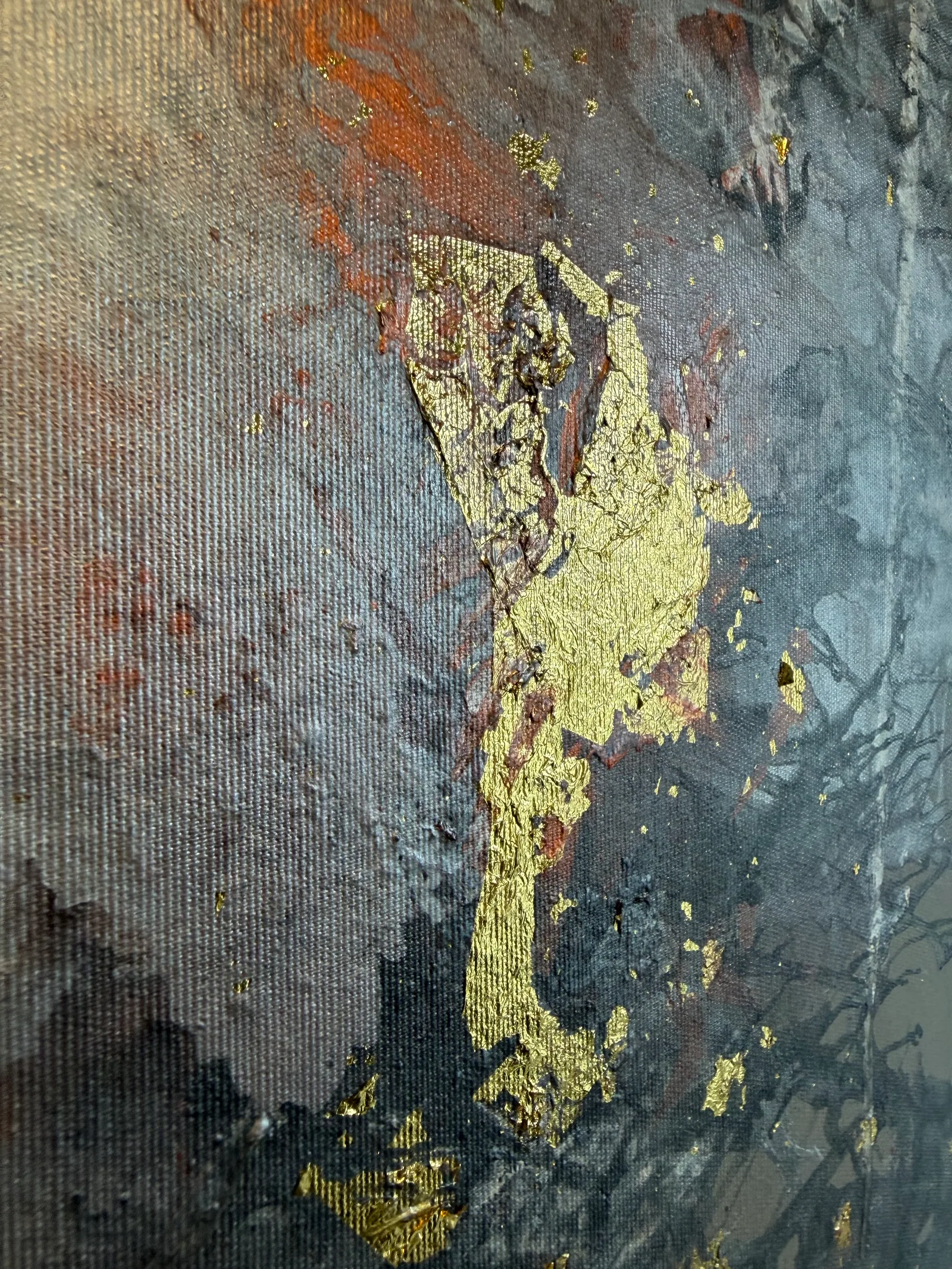
Golden Passage (60 × 80 cm, Black & Gold, 2025) is a black field of sculpted texture paste across which small fragments of imitation gold leaf (metallic leaf) are set in clusters. In the surface photograph below the fragments run from specks to larger flakes, with torn, irregular edges, scattered over the black rather than laid as a continuous sheet.
The studio has not published its own sequence, adhesive or products, so this section describes how leaf is laid in general and is not the artist's recipe. SeppLeaf, a supplier of gilding materials, lists the sequence for imitation (Dutch) leaf as: prepare the surface, apply the correct size, wait for the right tack, lay the leaf onto the tacky size with overlapping edges and patched gaps, brush off the excess once the leaf is set, and seal only when needed. Size is the adhesive, and tack is the stage at which it is sticky enough to hold the sheet.
Canvas has its own history in gilding. Wikipedia's article on gilding, citing the Oxford Companion to the Decorative Arts, says that gilders working on canvas often coated the surface with gesso first, and sometimes used egg white, gum or Armenian bole as the size. It adds that egg white and gum become brittle over time, causing the leaf to crack and detach, so honey was sometimes added to make them more flexible. What sits under the leaf, and how flexible it stays, is the question that matters on a canvas. For the definition of leaf and the difference between real and imitation, see our guide What is gold leaf in contemporary painting?

Works cited in this text


Sealing: what it is for, and what it cannot promise
Imitation leaf is not gold. John Canning & Co., a conservation and restoration firm, describes it as some combination of copper, zinc and brass, with no gold at all, and says it will have to be treated with protective coatings to help delay tarnishing. SeppLeaf says metal leaf often needs sealing because tarnish or discoloration is a risk, and that Dutch leaf can tarnish especially with moisture, fingerprints or the wrong sealer. Its advice is to choose a compatible sealer and test it first where colour shift or gloss matters.
At Perfeito Studio the metallic leaf on these works is sealed with a spray sealant; the studio does not name the product. Sealing is a measure, not a guarantee. The same firm writes that imitation leaf is subject to oxidation and tarnish and, even if sealed with a protective top coat, will often not last more than a few years before it acquires a green, dull haze. That is the only lifespan figure we found for sealed imitation leaf. It comes from a firm that gilds buildings; the same article says imitation leaf is often used indoors, and suits out-of-reach areas that are less likely to be touched or worn.
The studio cannot test that figure against its own work: the works date from 2025 and 2026, and a first documented body of work has no ageing record. What it can say is what is documented: the leaf is imitation, it is sealed, and every work is photographed in detail before it leaves.
A flexible support: canvas, humidity and flaking
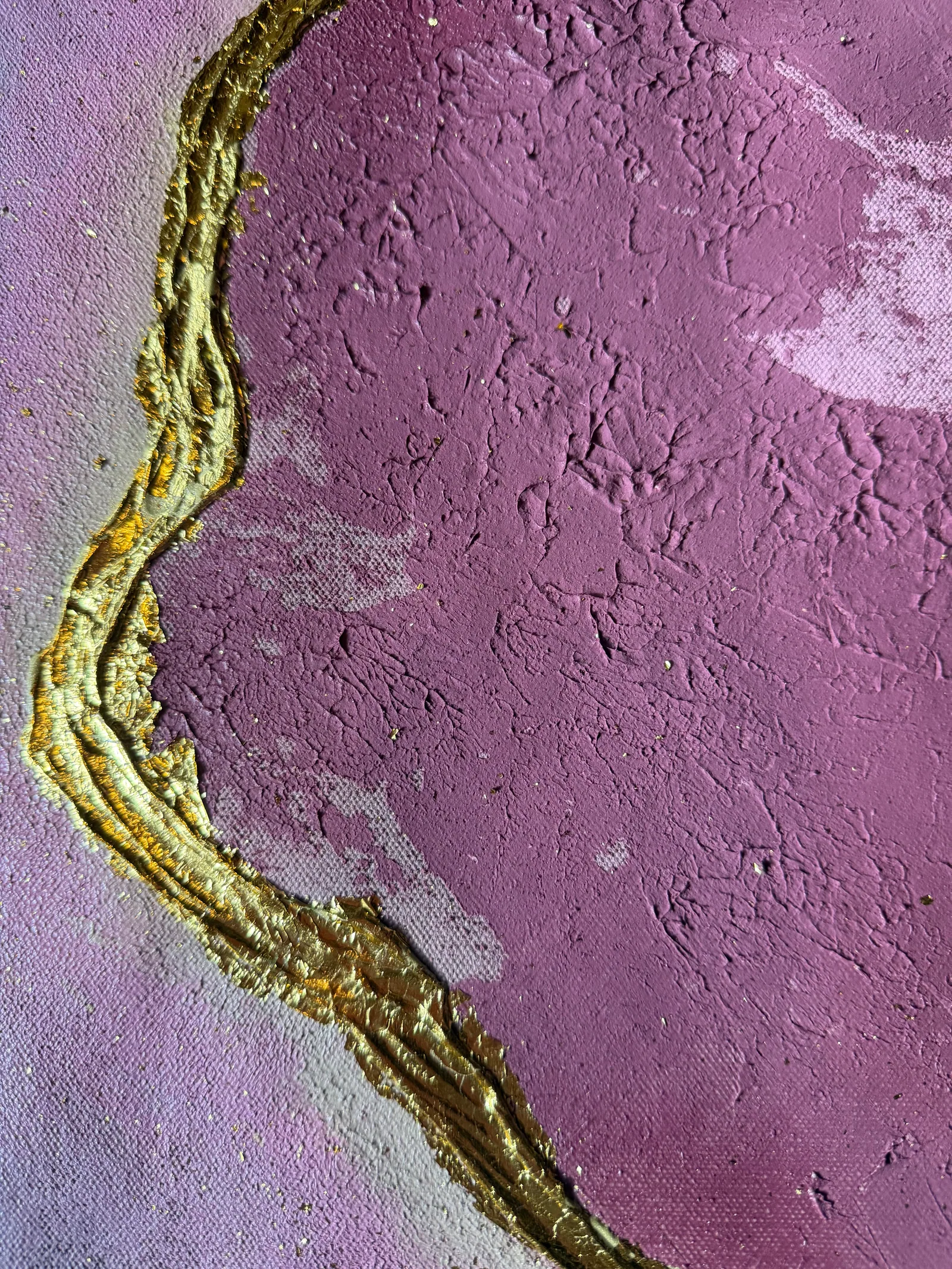
The conservation bodies we read describe the mechanism, mostly for paint and for gilded frames. Museums Galleries Scotland says that when humidity fluctuates, many materials in a painting expand and contract, and paint can crack or flake as a result; it recommends relative humidity between 50 and 60 per cent. For gilded frames it adds that gilding can flake when humidity is unstable, but handling, cleaning and dusting are more likely to damage it. The Museum of Fine Arts, Boston, writing about a gilded wood frame, says the constant slight movement of the support makes the binders in the gilding layers lose their elasticity, which leads to cracking, lifting and flaking of the gesso.
None of these sources tests metallic leaf on a modern acrylic canvas, so we do not claim that flaking will or will not occur. What they establish is where to look: the layers under the leaf, and the movement of whatever they are bonded to. The technique line for Golden Passage and Celestial Plan lists texture paste and imitation gold leaf together on canvas; the order of the layers is not published. Before acquiring any work with leaf, ask for close photographs of the surface, ideally in raking light, and look at the edges of each fragment.
Cleaning, and how long it lasts
Cleaning. The Canadian Conservation Institute says never to use dry or moist dust cloths, stiff bristle brushes or feather dusters on the surface of a painting: threads can catch on raised paint, and moisture may cause loss of paint. Museums Galleries Scotland goes further and advises never cleaning the surface of a painting, even to remove dust, and, for gilded frames, avoiding cloths because dust contains abrasive particles. Neither note covers metallic leaf on canvas, so for a work with leaf the safe reading is the same: do not wipe it, prevent dust, and consult a paintings conservator for anything more. Care guidance comes with every acquisition.
Lifespan. The studio states no number of years, and the sources give none for sealed imitation leaf beyond the warning above. They do agree on conditions that reduce risk: relative humidity between 50 and 60 per cent, light at or below 200 lux with ultraviolet excluded, hanging on an internal wall away from draughts, and not above a heat source (Museums Galleries Scotland); and keeping fingers off the surface, since fingerprints are a named cause of tarnish (SeppLeaf). Our guide to where to hang a gold leaf painting covers light, and the guide to dusting a textured painting covers the surface.
For whoever is acquiring: the works, the documents, light and shipping
- The works with metallic leaf. Celestial Plan, 50 × 70 cm, 2025: R$ 2,700. Origin of Light, 60 × 80 cm, 2025: R$ 3,300. Golden Passage, 60 × 80 cm, 2025: R$ 3,500. Vegetal Dawn, 80 × 120 cm, 2026: R$ 4,900. Quartz Seam, 98 × 152 cm, 2026: R$ 6,700. Dimensions are width by height; prices are set by the studio in Brazilian reais, and any conversion to your currency is approximate.
- What comes with the work. Every acquisition is direct from the artist and includes the original, unique painting; a signed Certificate of Authenticity carrying the full technical record and the Archive ID, a fiscal invoice or official receipt, an Artwork Acquisition Agreement covering ownership, copyright and image use, an artist dossier, conservation and care guidance, and professional packaging.
- Scale. Set the width and height against the wall and the furniture beneath it before choosing between a 50 cm and a 98 cm width.
- Light and room. Use the conditions above as the checklist: steady humidity, moderate light, an internal wall, no heat source below.
- Seeing it. Part of the collection can be seen in Brasília by appointment, arranged over WhatsApp. For buyers elsewhere, detail photographs and video of a specific work are available on request.
- Shipping. Freight is quoted per destination and paid by the buyer, as are any import duties or taxes in the destination country. Professional packaging is included and transit insurance is available. Domestic delivery takes up to 15 business days; international shipping is quoted on request. See the shipping page.
From the studio
From the studio
I trained as an architect, so I read a surface the way I read a junction in a drawing, and I look first at where one material meets another. In Golden Passage the leaf is scattered fragments on black texture paste; in Quartz Seam it follows seams in pigment laid thick enough to carry its own relief. Those are different junctions, and I would look at each in close photographs before I looked at its price.
I will not tell you how long imitation leaf lasts, because nobody holds that record for these works: they were painted in 2025 and 2026. What I can give is what is documented. The leaf is imitation, it is sealed with a spray sealant, the certificate carries the technical record and the Archive ID, and the surface is photographed in detail before the work leaves the studio.
Frequently asked
How is gold leaf applied to a canvas?
In general: the surface is prepared, an adhesive size is applied and left until it is tacky, the leaf is laid on with overlapping edges and patched gaps, and the loose excess is brushed off once it has set (SeppLeaf). Gilders on canvas have also coated the surface with gesso first. The studio has not published its own adhesive or sequence, so this is the general method, not the artist's recipe. The leaf on these works is imitation (metallic leaf), not real gold.
Does gold leaf on canvas need to be sealed?
Imitation (metallic) leaf, as used on these works, generally does: a supplier and a conservation firm say it can tarnish and needs a protective coat to delay that. Real gold leaf is described as resistant to tarnishing. The metallic leaf on the studio's works is sealed with a spray sealant. Sealing is a delay, not a guarantee: one firm says even sealed imitation leaf often acquires a dull haze within a few years.
Can gold leaf flake off a painting?
It can. Museums Galleries Scotland links flaking of paint and of gilding on frames to unstable humidity, and adds that handling, cleaning and dusting are more likely to damage gilding. No source we read tests metallic leaf on acrylic canvas, so we cannot give a rate. Keep humidity steady, avoid touching the surface, and ask for close photographs of the leaf before acquiring a work.
How do you clean a painting with gold leaf?
Do not wipe it. The Canadian Conservation Institute says never to use dry or moist dust cloths, stiff bristle brushes or feather dusters on a painting, because threads catch on raised paint and moisture may cause loss. Museums Galleries Scotland advises never cleaning the surface, even for dust. Neither note covers metallic leaf on canvas, so for anything beyond dust, consult a paintings conservator. Care guidance comes with every acquisition.
Does canvas movement damage gold leaf?
Movement is the mechanism conservators name. Museums Galleries Scotland says fluctuating humidity makes painting materials expand and contract, so paint can crack or flake; the Museum of Fine Arts, Boston says constant slight movement of a wood frame makes the binders of gilding layers lose elasticity. On canvas, Wikipedia notes that historical gilders found egg-white and gum sizes turned brittle and added honey for flexibility. The studio has no published test of its own works.
How long does imitation gold leaf last on a painting?
No source gives a safe figure. One conservation firm says imitation leaf, even sealed, will often not last more than a few years before it acquires a green, dull haze; that comes from architectural gilding, and the same article says imitation leaf is often used indoors. The studio's works date from 2025 and 2026 and have no ageing record, so it documents the leaf, the sealing and the surface and states no number of years.
Considering a work with metallic leaf?
Tell us the wall and the light it gets, and we will send close photographs of the leaf on the works that fit, with a shipping quote for your address.
Sources
- SeppLeaf — 2026-10-24
- SeppLeaf — 2026-10-24
- SeppLeaf — 2026-10-24
- John Canning & Co. (conservation and restoration firm), blog dated 9 July 2021 — 2026-10-24
- Wikipedia (citing the Oxford Companion to the Decorative Arts) — 2026-10-24
- Museums Galleries Scotland — 2026-10-24
- Canadian Conservation Institute (Government of Canada), CCI Notes — 2026-10-24
- Museum of Fine Arts, Boston — 2026-10-24
- Perfeito Studio — 2026-10-24
- Perfeito Studio — 2026-10-24
- Perfeito Studio — 2026-10-24
- Perfeito Studio — 2026-10-24
- Perfeito Studio — 2026-10-24
- Perfeito Studio — 2026-10-24
- Perfeito Studio — 2026-10-24
Published on