Who was Di Cavalcanti?
Di Cavalcanti (1897-1976) was a Rio de Janeiro painter, illustrator and muralist, one of the exponents of Brazilian painting, in Itaú Cultural's words. Itaú Cultural credits him with the idea of the 1922 Modern Art Week and with its catalogue and poster. He is known for samba and Black women as subjects, work that MASP's curators now read critically.
Early career and the 1922 Modern Art Week
Emiliano Augusto Cavalcanti de Albuquerque e Melo was born in Rio de Janeiro on 6 September 1897 and died there on 26 October 1976. He signed his paintings Di Cavalcanti. The Itaú Cultural encyclopedia records that he began working as an illustrator in Rio in 1914, published his first caricature in the magazine Fon-Fon, and moved to São Paulo in 1917, where he studied law, held a first solo show of caricatures and drew covers for the magazine O Pirralho.
The same source says the idea of staging the 1922 Semana de Arte Moderna came from him, and that he created its catalogue and poster and exhibited some works there. The week itself is covered separately in our guide to the Modern Art Week of 1922; the point here is that Di Cavalcanti was an organiser as well as a participant, which is a different position from, for example, that of Tarsila do Amaral.
Paris, Samba and a national subject
In 1923 Di Cavalcanti travelled to Paris and attended the Académie Ranson. Itaú Cultural names Picasso, Braque, Léger and Matisse among the painters he met there, and describes the result as a reconciliation of European avant-garde influence with a language of his own, built on nationalist themes and social concern. He returned to Brazil in 1925 and joined the Brazilian Communist Party in 1928.
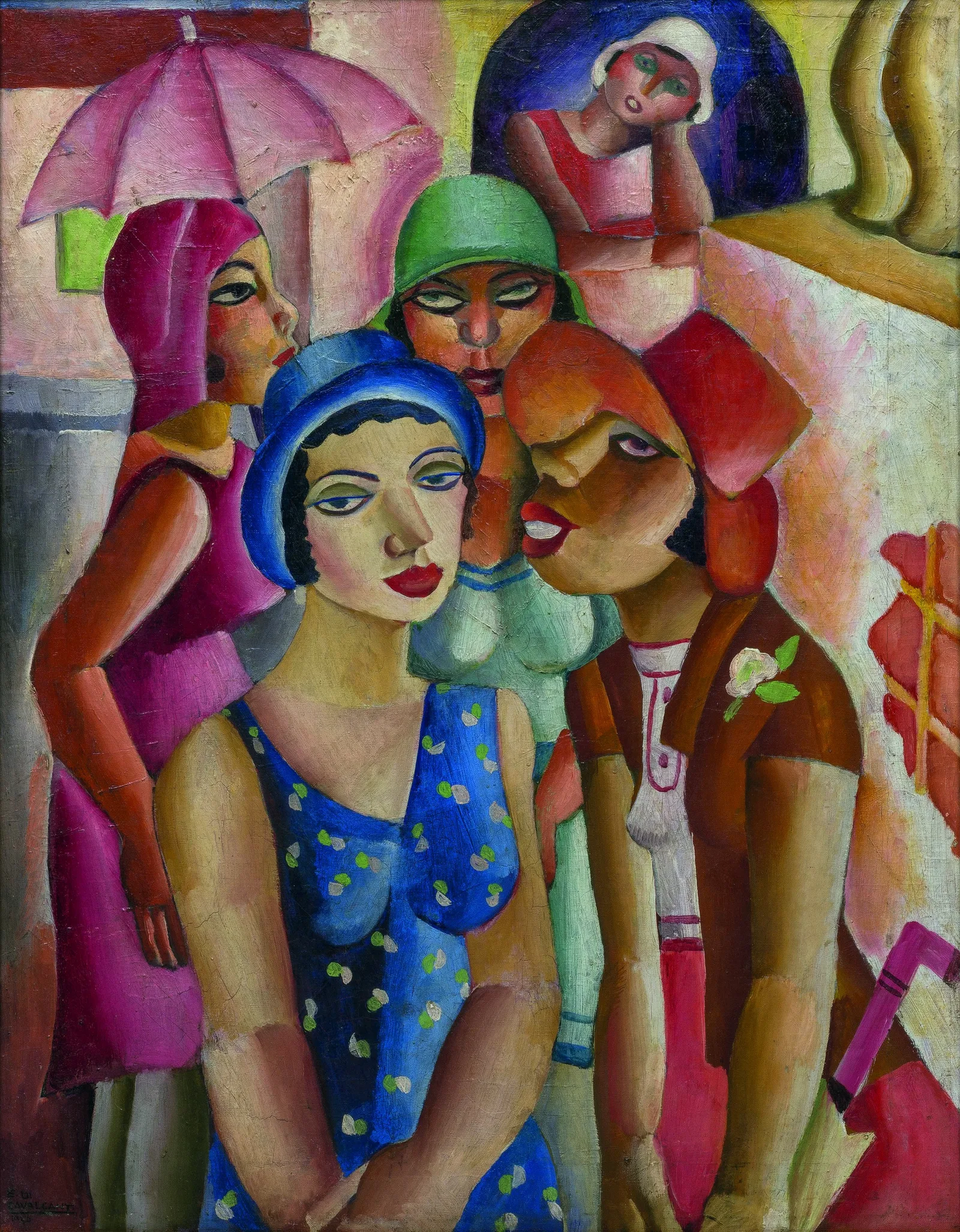
The encyclopedia treats Samba (1925) as his masterpiece. It shows a half-naked Black woman, a figure that recurs throughout his work, together with samba as an emblem of popular culture, and it notes the Picasso-like monumental volume of the figures and the treatment of hands and feet. Samba was destroyed in a fire at the Copacabana apartment of the collector Jean Boghici, reported on 14 August 2012. Cinco moças de Guaratinguetá (1930), the painting shown above, is described by Itaú Cultural as an example of his warmer palette, simplified curved forms and many tones of red.
The mulata paintings and how museums read them now
Di Cavalcanti was often called the painter of the mulatas. MASP's curatorial text on his Mulata (c. 1947, oil on canvas, 24 x 54 cm) says he helped shape a visual image of Black women in Brazilian painting, typically with defined busts, low necklines and seductive gazes. The same text argues that, although he multiplied depictions of women, especially Black women, he tended to portray them as passive and sexualised.
MASP also points out that the word mulata derives from mula, a hybrid animal, and that it is applied far more often to women than to men. In the museum's reading, both the imagery and the title helped construct a place for Black women in modern Brazilian society: lighter than darker-skinned Black women, and reduced to their sexual attributes. That is the museum's critical position, quoted here as a position and not as a verdict of ours.
Murals, politics and the argument against abstraction
Itaú Cultural lists several large public works: a panel at the Hotel Jaraguá in São Paulo (1954), a glass-mosaic panel for the Edifício Triângulo designed by Oscar Niemeyer, inaugurated in 1955, and Candangos (1960), an oil on canvas for the Chamber of Deputies in Brasília. The Chamber of Deputies records Candangos as measuring 283 x 881 cm and made for the Palácio do Congresso Nacional, now in its Salão Verde.
The encyclopedia also records that in 1948 he gave a lecture at the Museu de Arte Moderna de São Paulo, published as "Realismo e Abstracionismo", taking a position for a Brazilian figurative art and against abstraction, which was then beginning to spread in the country. It describes him as an ardent defender of figurative art, which is useful context for anyone reading Brazilian abstraction against its own history.
Where his paintings are held
MASP in São Paulo holds Cinco moças de Guaratinguetá (accession MASP.00316, donated by Frederico Barata in 1947) and Mulata (accession C.01219). The Centre Pompidou in Paris holds Danse populaire brésilienne, oil on canvas, 114 x 146 cm, dated [1937] and acquired by the French State in 1939 (inventory JP 899 P). Candangos remains in the Chamber of Deputies collection in Brasília. Samba, as noted above, no longer exists.
From the studio
From the studio
I do not paint the figure. In Solar Rain (Luminous Rebirth, 2026, acrylic on canvas, 70 x 110 cm) I lay a saturated yellow field almost uninterrupted across the canvas and let red and copper marks descend and pool toward the edge. That is a difference of method, nothing more.
Frequently asked
Who was Di Cavalcanti?
Di Cavalcanti, born Emiliano Augusto Cavalcanti de Albuquerque e Melo in Rio de Janeiro on 6 September 1897, was a Brazilian painter, illustrator, caricaturist, muralist and set designer who died in Rio on 26 October 1976. The Itaú Cultural encyclopedia calls him one of the exponents of Brazilian painting and notes that he portrayed popular figures in a constant search for a national art.
What themes did he paint?
Itaú Cultural describes a nationalist, socially concerned subject matter: popular figures, samba, and the recurring figure of the Black woman. MASP adds that he was often called the painter of the mulatas. His murals took on subjects such as the press, coffee workers and, in 1960, the painting Candangos for the Chamber of Deputies in Brasília.
Was he part of the 1922 Modern Art Week?
Yes, and in a leading role. The Itaú Cultural encyclopedia states that the idea of holding the Semana de Arte Moderna came from Di Cavalcanti, that he created its catalogue and poster, and that he exhibited some of his own works there.
Why are his figures controversial today?
MASP's curatorial text on his painting Mulata argues that he tended to depict Black women as passive and sexualised, and that the imagery and the word mulata, derived from mula, a hybrid animal, helped place Black women in a whitened and sexualised position in modern Brazilian society. This is the museum's critical reading, and it sits alongside his standing as a major modernist.
Where are his paintings?
MASP in São Paulo holds Cinco moças de Guaratinguetá and Mulata. The Centre Pompidou in Paris holds Danse populaire brésilienne, acquired by the French State in 1939. The large oil Candangos (1960) is in the Chamber of Deputies collection in Brasília. His best-known painting, Samba (1925), was destroyed in a fire in Rio de Janeiro in 2012.
See Solar Rain, from the Luminous Rebirth series
One original painting, with a signed Certificate of Authenticity. Write to the studio for detail photographs, dimensions on your wall, and acquisition details.
Sources
- Enciclopédia Itaú Cultural — 2026-10-15
- MASP - Museu de Arte de São Paulo Assis Chateaubriand — 2026-10-15
- MASP - Museu de Arte de São Paulo Assis Chateaubriand — 2026-10-15
- Centre Pompidou, Paris — 2026-10-15
- Câmara dos Deputados, Centro Cultural — 2026-10-15
- Vermelho (news report) — 2026-10-15
Published on