Abstract art above a TV or media wall: does it work, and when does it not?
Abstract art above a TV works when the screen is treated as furniture: leave at least 6 inches (15 cm) above it, the minimum one designer quoted by Homes and Gardens suggests; keep the painting near two-thirds the width of the unit; choose a calm piece. It works less well on a high-mounted screen or pressed against hot equipment.
Does art above a TV work, or is it a compromise?
It works, on one condition: the painting has to help the screen recede, not compete with it. Homes and Gardens frames the problem plainly. In many living rooms the TV has replaced the fireplace as the focal point, and art is among the easiest ways to make that black rectangle sit back into the room when the set is off [1].
The designers it quotes agree on the brief and differ on the details. Art curator and interior designer Alex Bass recommends work that is not too visually stimulating, in fairly minimalist frames. Content editor Zara Stacey suggests framing a wall-mounted screen with pieces on either side, as a triptych, and prefers an odd number of works to a single piece above the set, with a dark-toned console so the black screen looks intentional [1]. Jacky Chou, of the architecture magazine Archute, allows either one large piece or several smaller ones on the wall, as long as the art does not distract from the screen [1].
So the sources split on one piece versus several. What they share is restraint, and that is the useful part: the question is less "can I?" than "what will the painting have to ignore?"
How high, and how far above the screen
Start from the screen, not the wall. Consumer Reports advises hanging a wall-mounted TV so that the bottom of the screen is no higher than eye level when you are seated and the top is no higher than eye level when you are standing, and using a tilting or articulating mount if it has to go higher [2]. That keeps the top of the set at or below standing eye level, and anything above it starts higher still.
The gap is the next number. Chou suggests leaving at least 6 inches (about 15 cm) between the TV and the art so the two do not look crowded [1]. The same designer advises hanging art at eye level or slightly lower when you are sitting on the sofa [1], which is hard to square with a painting that starts above the screen. General hanging guides for art above furniture give 6 to 10 inches [5] and 6 to 12 inches [6]. For a TV, read 6 inches as the floor rather than the target.
Stack those figures and the arithmetic is unforgiving. Museums commonly hang art with its center at 57 to 60 inches (about 145 to 152 cm) from the floor, a height within the range of average eye level [7]. A painting that begins 6 inches above a TV mounted within that guidance can easily have its center above that line (our arithmetic, not a published figure), and Tribeca Printworks cautions that you should never have to tilt your head completely back to look at a piece [6]. Because the center sits half the work's height above its bottom edge, a horizontal or square format keeps the center lower than a tall vertical of the same width.
If the numbers do not close, the other option is to leave the wall above the set empty and move the painting beside the screen, as Stacey's triptych does [1], or to the wall next to it. For the standard heights in general, see how high to hang a painting.
Size: measure against the media unit, not the screen
One designer's rule of thumb, reported by Homes and Gardens, is that art above furniture should span about two-thirds the width of the piece below it [5], and Tribeca Printworks gives the same proportion for the overall display regardless of furnishing type [6]. On a TV wall, the furniture is the media unit or console: the wider, fixed block the wall has to balance. Sizing from the screen alone tends to give a result that looks small against that block.
Worked out against the dimensions of works currently listed, the two-thirds figure gives:
- A unit about 75 cm (30 in) wide: two-thirds is 50 cm, the width of Echo of Silence (50 × 70 cm, R$ 2.400).
- A unit about 150 cm (59 in) wide: two-thirds is 100 cm, the width of Patina Field (100 × 100 cm, acrylic on canvas, R$ 5.200).
- A unit about 225 cm (89 in) wide: two-thirds is 150 cm, the width of Amber Strata (150 × 100 cm, R$ 6.700), the one horizontal format among the listed works.
For the same proportion on a console without a screen, see art above a console or sideboard. These are arithmetic on a published rule, not a prescription. Check the height as well as the width: add the work's height to the gap and to the top of the screen, and see whether the total still clears the ceiling and any light fixtures.
Heat, ventilation and the canvas
A TV is built with ventilation openings to keep it from overheating, and a media unit often holds more equipment. Samsung's safety guide for its televisions says the ventilation slots and openings protect the set from overheating and must never be blocked or covered, and that the set should not be placed near or over a radiator or heat resistor [3]. A painting should not sit in that airflow or lean against the equipment.
The Canadian Conservation Institute makes the matching point from the painting's side. It warns that rapid environmental changes occur in locations directly affected by airflow from heating and cooling ducts or radiators, and it calls the space above a fireplace a place of honour that is not the best choice, because the environment there can become hot and very dry [4]. Neither source tests a TV wall, so read them as a reason to keep a clear gap and an open vent, not as a measured limit.
Two practical consequences follow. First, keep the canvas off the top of the unit and away from vents. Second, if you add a picture light, the same institute advises not focusing spotlights or picture lamps over a painting, since that raises the temperature around it [8]. It also reminds owners to choose hanging hardware suited to the weight of the painting and frame [8].
Which kind of abstract work suits a TV wall
The brief from the sources is a piece that is not too stimulating and does not distract from the screen [1]. In the catalogue, that points to works that hold still. Echo of Silence (Matter & Silence, 2025, sculpted texture on canvas, 50 × 70 cm) is monochrome, built from concentric reliefs and organic folds. Patina Field (Terra & Ether, 2026, 100 × 100 cm) is described on its page as settling a room rather than animating it. For a wide unit, Silent Interval (Matter & Silence, 2026, 120 × 160 cm, R$ 7.900) is described as composed for interiors that value calm and breathing room, though at 160 cm tall it needs the vertical clearance checked first.
The opposite brief, a high-energy composition, is better kept for a wall without a screen, where nothing else in the room is already lit and moving. Every work at Perfeito Studio is a unique original, bought directly from the artist; the studio does not sell prints. To compare other rooms, see a large abstract painting for a living room and art for a home cinema, where the screen is the room's one light source.
From the studio
From the studio: a relief and a screen make poor rivals
As an architect by training, I read a media wall as two rectangles set against each other: a screen that is lit from inside, and a canvas that has only the light the room gives it. Echo of Silence (Matter & Silence, 2025, sculpted texture on canvas, 50 × 70 cm, AP-MAS-2025-002) is the work in the catalogue I would worry about most here, because its subject is the surface itself: concentric reliefs and organic folds that are meant to be read slowly and up close, in the room's own light. A screen is built to be looked at first, and I would not ask a quiet relief to compete with it.
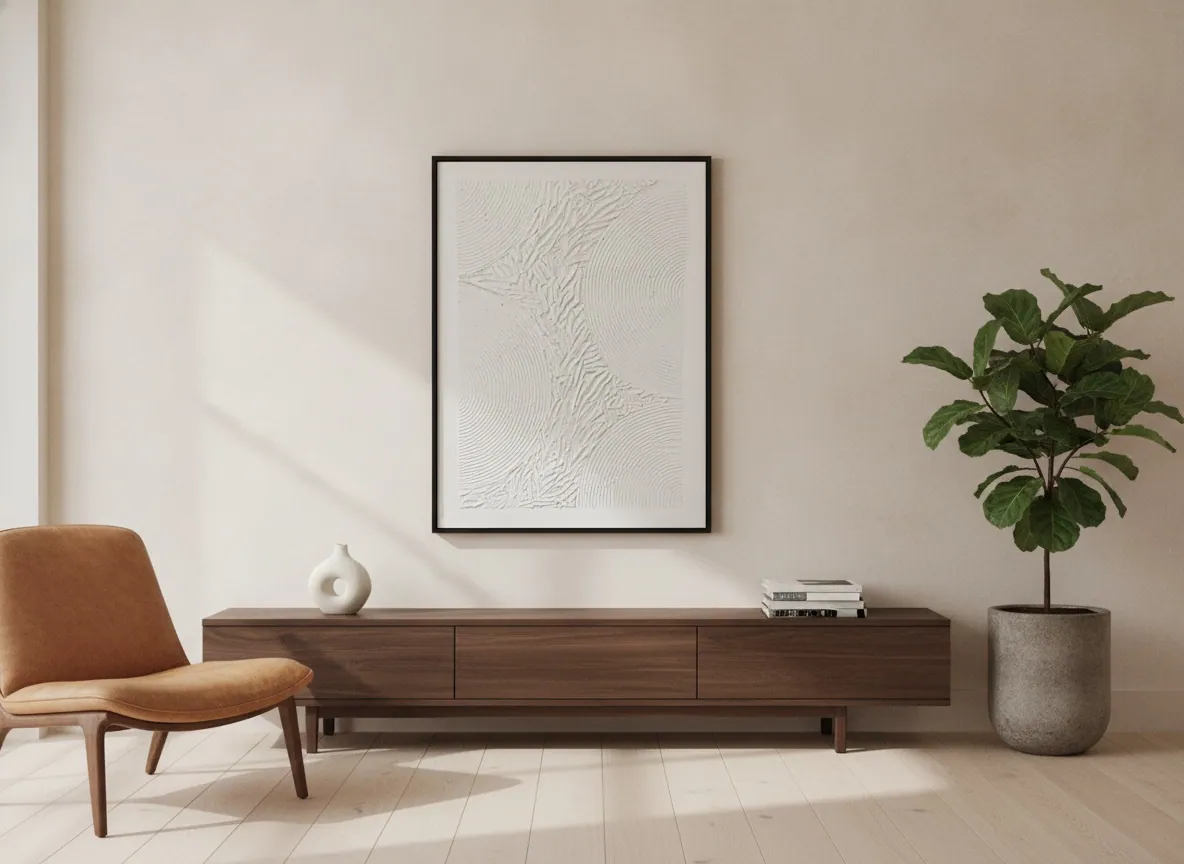
The room visualization at the top of this page shows the work above a low unit with nothing else on the wall, and it shows no television and is not drawn to scale; I would not pretend otherwise. At 50 × 70 cm it is also a small painting: against the two-thirds guide it fits a unit about 75 cm wide. Over a wide media unit I would look at a larger work, or place this one on the wall beside the screen.
Frequently asked
Is it a good idea to hang a painting above a TV?
Yes, if the painting is meant to quiet the screen rather than compete with it. Homes and Gardens describes art above the TV as one of the easiest ways to make the dark rectangle recede, and the designers it quotes ask for restrained work. The conditions are practical: a gap of at least 6 inches (15 cm), vents left clear, and a painting calm enough not to fight the picture. A high-mounted screen makes it harder.
What height and size look balanced over a television?
Leave at least 6 inches (about 15 cm) between the top of the TV and the bottom of the frame, and size the painting to about two-thirds of the width of the media unit rather than the screen. A 150 cm unit points to a work near 100 cm wide; a 225 cm unit, near 150 cm. These are published rules of thumb, not fixed measurements, so tape a paper template to the wall before you drill.
What is the difference between buying an original and a print for this?
Perfeito Studio offers original paintings only: each work is unique, signed and catalogued under its own Archive ID. On a TV wall that matters for texture. Echo of Silence, for example, is sculpted texture on canvas, with concentric reliefs and organic folds that are physical form rather than a picture of texture. The studio does not sell reproductions.
How does Perfeito Studio ship an original painting?
The studio ships within Brazil and internationally. Shipping is quoted per destination, by postcode inside Brazil, and is paid by the buyer, as are any import duties or taxes in the destination country. Professional packaging is included and transit insurance is available. Domestic delivery takes up to 15 business days depending on destination; international shipping is quoted on request. Collection in person after purchase is also possible.
What comes with an original from Perfeito Studio?
Every acquisition is direct from the artist and includes the original painting; a Certificate of Authenticity signed by hand, with the technical record, the Archive ID and a QR code linking to the work's official page; a fiscal invoice or official receipt; an Artwork Acquisition Agreement; an artist dossier; conservation and care guidance; and professional packaging.
Is it safe to hang a canvas close to a TV?
Keep the canvas off the equipment and out of its airflow. Samsung's safety guide says a TV's ventilation openings must never be blocked and that it should not sit near or over a radiator or heat resistor. The Canadian Conservation Institute warns about rapid environmental change near airflow from ducts and radiators. Neither tested a TV wall, so treat a gap of at least 6 inches as a margin, not a guarantee.
Planning a painting for your TV wall?
Send a photo of the wall, the width of the media unit and the height of the screen, and we will tell you which works fit and which do not.
Sources
- Homes and Gardens (Millie Hurst, 5 Sep 2023) — 2026-10-09
- Consumer Reports — 2026-10-09
- Samsung (Basic Product Guide, Safety Guide, Ireland) — 2026-10-09
- Canadian Conservation Institute, Government of Canada (Basic care - Paintings) — 2026-10-09
- Homes and Gardens (Emily Moorman, 12 Nov 2023, quoting designer Jordan Samson) — 2026-10-09
- Tribeca Printworks — 2026-10-09
- Fine Art Shippers — 2026-10-09
- Canadian Conservation Institute, Government of Canada (Caring for paintings) — 2026-10-09
Published on · Updated on