Abstract art for a small bedroom: one wall, one painting, no clutter
In a small bedroom, choose one wall and one painting. Over a bed, one published guide asks for 50 to 75 percent of the headboard's width: about 76 to 114 cm on a queen. A 50 × 70 cm canvas is narrower than that band, so it suits a side wall, a dresser or a pair.
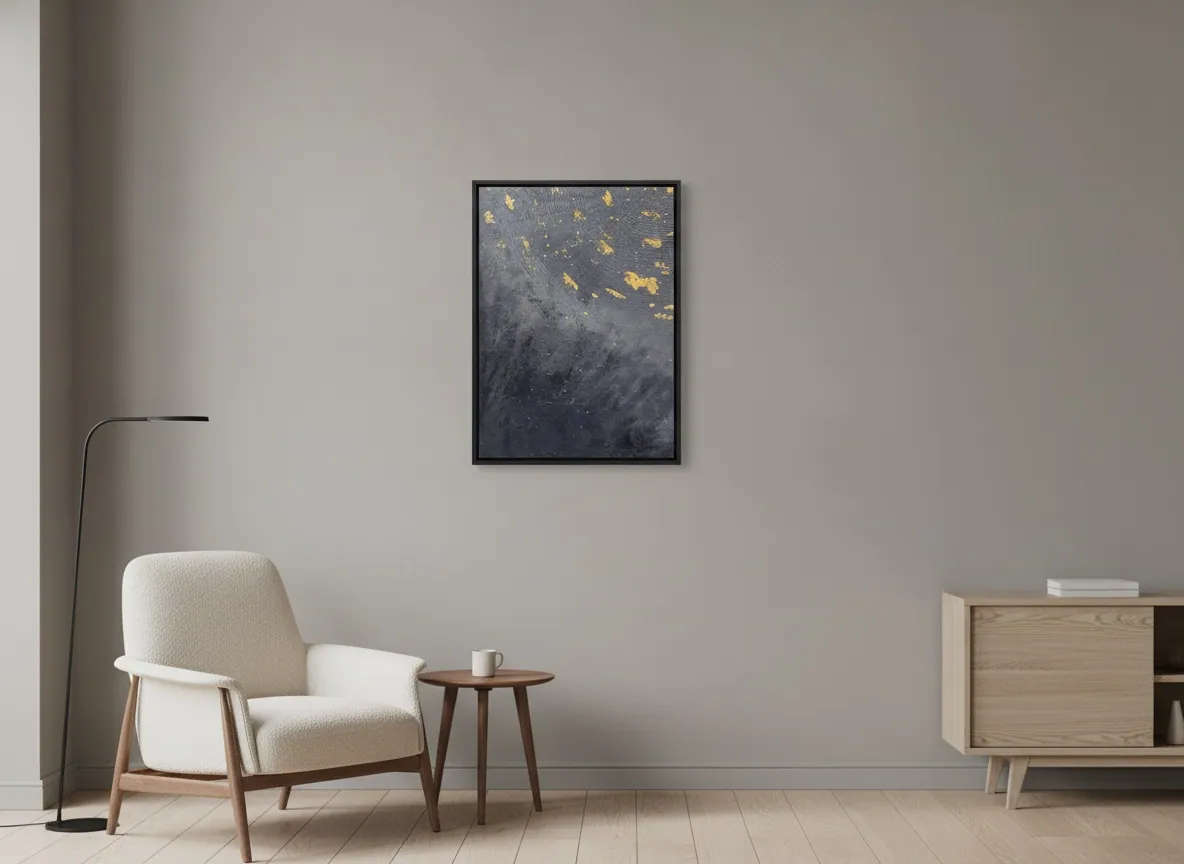
Start from the headboard, not from the room
A small bedroom usually has one wall that is clearly the bed wall, and that wall sets the size of the painting. A standard US queen mattress measures 60 × 80 inches, about 152 × 203 cm, and a full measures 54 × 75 inches, about 137 × 191 cm. One designer guide gives the rule for any bed size: art should be 50 to 75 percent of the width of the bed or headboard.
- Queen (about 152 cm): a painting roughly 76 to 114 cm wide.
- Full (about 137 cm): roughly 69 to 103 cm wide.
Those figures are simple arithmetic on the published percentages, not a rule the studio invented. Measure your own headboard and nightstands before trusting any table, including this one.
Where a 50 × 70 cm work fits, and where it does not
Against the band above, a 50 × 70 cm canvas is about a third of a queen headboard (50 of 152 cm). Alone over a bed it will look small. That is not a flaw of the work; it is a different job. Three places where a compact canvas does well:
- The wall you face from the pillow. Seen from a few metres away, a single canvas keeps the wall quiet.
- Above a dresser or a narrow console. The width of the furniture, not the bed, sets the proportion.
- As a pair over the bed. Two 50 cm canvases side by side span about 100 cm plus the gap between them, which lands inside the 76 to 114 cm band for a queen. This is arithmetic, not a published rule.
If you want one work over the bed, the next steps up in the studio's catalogue are the 60 × 80 cm format, such as Golden Passage (Black & Gold, 2025, R$ 3,500), and Celestial Drift at 70 × 100 cm (Luminous Rebirth, 2025, R$ 3,700). On a queen they come to about 39 and 46 percent of the width, so both are still below that guide's 50 percent minimum. Reaching the band itself means a work about 80 cm wide or more, which is a large canvas for a small room; in that case a pair or a side wall is usually the more comfortable answer.
Height: low eye level, little ceiling to spare
Two numbers from published guides matter in a compact room. First, hang the painting 6 to 8 inches (15 to 20 cm) above the headboard and keep its top at least 6 inches (15 cm) below the ceiling. Guides differ on that gap, so treat 15 to 30 cm as the range to judge by eye. Second, for a wall without a bed under it, such as a dresser or a side wall, the usual centre height is 57 to 62 inches (145 to 157 cm) from the floor; one framing guide notes that in bedrooms people are typically seated or lying down, so it suggests starting at the lower end of that range. Over the bed itself, the gap above the headboard sets the height instead.
On a low ceiling, work out the tallest canvas first: ceiling height, minus headboard height, minus the gap, minus the clearance. Our guide to art above the bed works that budget step by step, and the general rule is in how high to hang a painting.
One painting, no clutter: what to keep off the wall
A small room reads as full quickly, so the useful discipline is subtraction. Leave a margin of bare wall on each side of the canvas, keep shelves and sconces away from its edges, and let the painting be the only object with a visible surface on that wall. In the studio's experience a textured work benefits from a little more bare wall than a flat one, because its relief is part of what is seen; for light on texture, see how to light a textured painting.
Choosing the room matters too. The same canvas that works here is discussed for another case in art for a home office, and a larger bed is covered in abstract art for a master bedroom.
Dark or light: the colour question in a small room
Colour does not change the dimensions of a wall, so the size rules above hold for a pale work and a dark one alike. What changes is contrast: a dark canvas on a pale wall reads as a clear, contained shape, while a pale canvas on a pale wall reads as texture and shadow. For a small room, the practical test is to hold a dark sheet cut to the canvas size against the wall for a day and see whether you want to keep looking at it.
Echo of Silence (50 × 70 cm, Matter & Silence, 2025, R$ 2,400) is white and sculpted; Celestial Plan (50 × 70 cm, Black & Gold, 2025, R$ 2,700) is black with imitation gold leaf. Both are the same size, and they behave very differently on a wall.
From the studio
From the studio
As an architect by training, I look at a small wall as a measurement before it is a mood. Celestial Plan is 50 × 70 cm: a black surface with fine concentric textures and scattered fragments of imitation gold leaf. At that size the gold reads as points of light rather than as a field, and the whole canvas can be taken in at one glance from the foot of a bed.
Echo of Silence, at the same 50 × 70 cm, is the quiet counterpart: white, sculpted, built to be looked at closely. If I were choosing for a compact room, I would first decide whether the wall should recede or hold the eye, and only then pick between them.
Frequently asked
What size art fits a small bedroom?
Start from the bed wall. One published guide asks for 50 to 75 percent of the headboard's width, which is about 76 to 114 cm on a queen bed (152 cm wide) and 69 to 103 cm on a full (137 cm wide). A 50 × 70 cm canvas is narrower than that, so it suits a side wall, a dresser or a pair over the bed. Measure your own headboard first, since furniture varies.
Is a dark painting too heavy for a small room?
Colour does not change a wall's dimensions, so the size rules are the same for dark and pale works. A dark canvas on a pale wall reads as a clear, contained shape; on a dark wall the edges merge with the background, so the texture does more of the work. A practical test is to cut a sheet of dark paper to the canvas size, tape it up for a day, and see whether you still want to look at it. If you do, the room can hold it.
What is the difference between buying an original and a print for this?
An original is a single unique object, with its surface, relief and signature; a reproduction is a copy of an image that exists elsewhere. The studio sells original, unique paintings by Alyne Perfeito, with no editions or reproductions, each with a signed Certificate of Authenticity. For a longer comparison, see the guide on original painting versus a decorative print from a store.
How does Perfeito Studio ship an original painting?
The studio ships within Brazil and internationally. Shipping is quoted per destination, by postcode inside Brazil, and is paid by the buyer, together with any import duties or taxes in the destination country. Professional packaging is included and transit insurance is available. Domestic delivery takes up to 15 business days depending on destination; international shipping is quoted on request.
What comes with an original from Perfeito Studio?
Every acquisition is direct from the artist and includes the original painting, a signed Certificate of Authenticity with the technical record and the internal Archive ID, a fiscal invoice or official receipt, an Artwork Acquisition Agreement, an artist dossier, conservation and care guidance, and professional packaging. The certificate carries a QR code that links to the work's official page, so provenance can be checked at any time.
Not sure which size fits your bed wall?
Send the width of the wall, the bed and a photo of the room, and we will talk through scale before you decide.
Sources
- Welsh Design Studio — 2026-10-09
- Tribeca Printworks — 2026-10-09
- DreamCloud — 2026-10-09
Published on · Updated on