Abstract art for a study or home library: shelves, books and one wall for a painting
Abstract art suits a room of books when the painting gets one clear stretch of wall that the shelves do not cover. The spines supply pattern; the painting supplies one open field. Hang it away from direct sun, in a room with steady humidity, and where you can see it from the desk or the chair.
Let the shelves do the busy part
A wall of books is already a dense composition: hundreds of narrow vertical bands, each with its own colour and lettering. A painting that tries to add more of the same, with many small marks and several focal points, competes with the shelves for the same attention. The more workable division of labour is to let the shelves carry the detail and ask the painting for something different: a large resting area for the eye, built on a clear structure, such as one dominant gesture or a field of colour with a few events in it.
This is a design judgement, not a rule with a measurement behind it, and it holds whatever the spines look like. An abstract work also has the advantage of not illustrating anything: it does not repeat a subject the books are already describing.
Where the painting goes when shelves cover most of the walls
Start from the wall, not the painting. Measure the stretch of wall that the shelves do not use, and leave visible margin on both sides of the canvas; a painting that fills a clear stretch edge to edge reads as squeezed in. Four positions usually exist in a study or library:
- The free wall. Often the wall with the door or the window. It is the simplest case and takes the largest work.
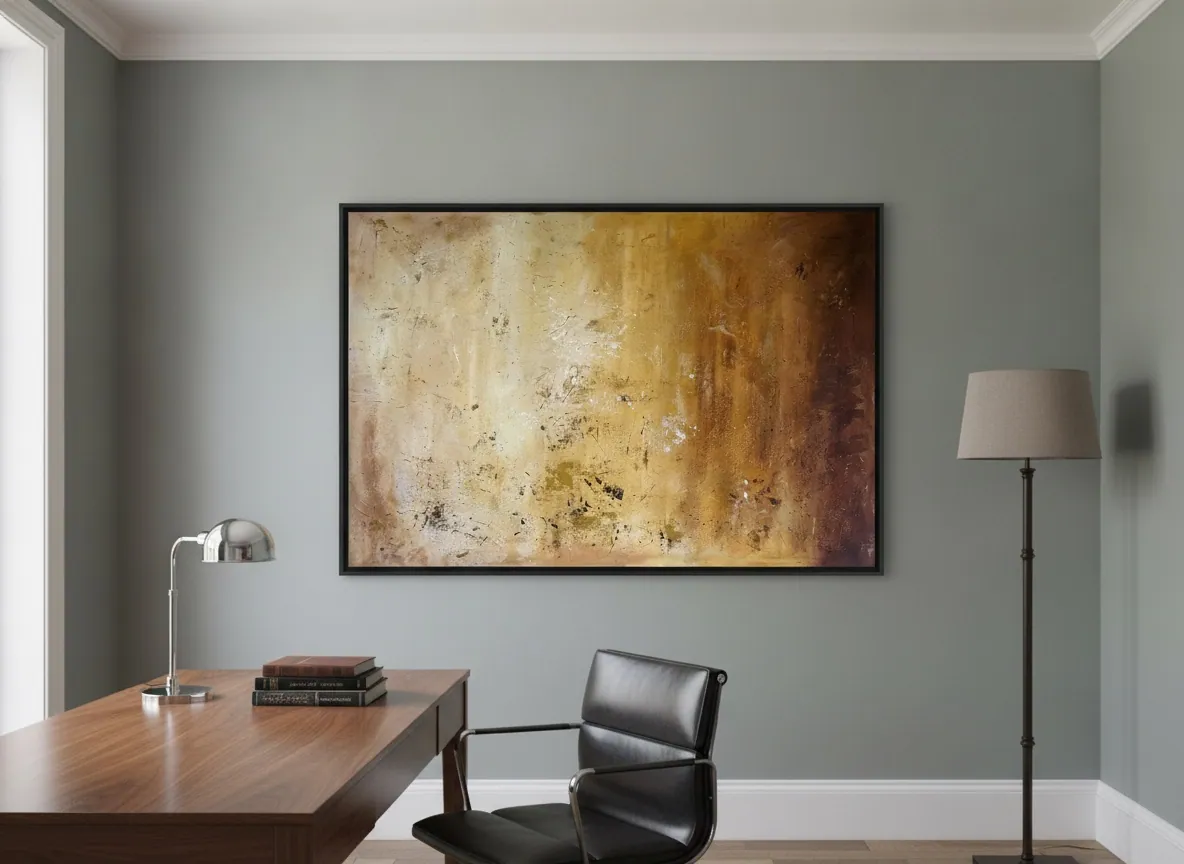
- Above the desk or a low cabinet. A horizontal canvas suits the long line of a desk or credenza. The mockup above shows a horizontal canvas on the wall behind a desk; the room has no bookcases, so read it as the desk-wall case only.
- The panel between two bookcases. A narrow, tall section of wall, often with a work in portrait format.
- Above a run of low shelves. The top of the shelf becomes the ledge, and the painting hangs on the wall above it.
Avoid hanging a painting in front of the shelves themselves: it blocks the books you came into the room for. For the height of the centre, see the hanging height guide, and remember that in a study you are often seated, so check the sightline from the chair before marking the wall.
Light, humidity and dust: what books and canvas both ask for
Books and paintings share the same main risks, and conservation guidance is explicit about them. The Canadian Conservation Institute advises against storing or displaying books under spotlights, in full sunlight or in artificial light, which it links to discolouration, desiccation and photochemical degradation. For paintings, the same institute notes that many pigments and dyes fade or discolour in visible light, and that the effect of light is cumulative and irreversible. A sunny wall is therefore a poor place for the painting and for the books beside it.
Humidity points the same way. The Institute gives a stable relative humidity of 40 to 60% as the safest range for paintings on canvas or wood, and, for leather bindings, a stable 45 to 55% at 18 to 22 °C, with dry central heating able to drive a room below 30% and humidity above 75% with poor air circulation encouraging mould. These figures come from two separate notes written for different materials, but the ranges overlap, so a steady, moderate room is a reasonable target for both.
Dust is the routine job. The Institute's book-care note recommends inspecting for dust and dusting shelving at least every twelve months. The painting needs its own, gentler care, and the conservation and care guidance that accompanies each original from the studio covers it.
Three originals read against this brief
Amber Strata (Terra & Ether, 2026, mixed media with acrylic on canvas, 150 × 100 cm, R$ 6,700) is the horizontal work, a warm field built in lateral passages. It is the natural candidate for the wall above a desk or a low cabinet.
Silent Interval (Matter & Silence, 2026, mixed media with acrylic on canvas, 120 × 160 cm, R$ 7,900) is a tall bone-white field crossed by one dark gesture, with a block of blue near the lower edge. It needs a wall section with real height. It also has a reading-corner reading, covered in the guide on abstract art for a reading corner.
Amethyst Ground (Terra & Ether, 2026, mixed media with acrylic on canvas, 100 × 100 cm, R$ 5,200) is square, warm terracotta below and cool violet above, with a pale band between them. Its 100 cm width asks for a panel of wall clearly wider than that, with margin on each side. Each of the three is an original, unique painting. The gallery lists the rest of the catalogue by size. If the study doubles as a workplace, see also art for a home office.
From the studio
From the studio
Amber Strata is the painting I think of for this room. It is a horizontal canvas, 150 × 100 cm, and the horizontality is the point of it: the surface is worked in lateral passages, like a cross-section of sediment, and the eye travels sideways across it. A row of books on a shelf is also a stratum in its own way, read left to right, and the two lines run in the same direction.
As an architect by training, I see a study as a set of directions before it is a set of objects. In a study the shelves set the verticals and the desk sets one horizontal. A horizontal painting above the desk completes that frame without adding a third competing system, which is the balance I would aim for on a wall like this.
Frequently asked
Can abstract art work in a room full of books?
Yes. Shelves of spines already supply dense detail, so an abstract painting with a clear structure gives the eye a place to rest instead of competing, and it does not repeat a subject the books already describe. The practical condition is a clear stretch of wall that the shelves do not cover, with visible margin on each side of the canvas. Colour and scale then decide the rest, and they are matters of judgement rather than fixed rules.
Where does a painting go when shelves cover three walls?
Use the fourth wall, or the part of a shelved wall that is free: above a desk or a low cabinet, on the panel between two bookcases, or on the wall above a run of low shelves. Do not hang the painting in front of the shelves, since it blocks the books. Measure the clear stretch first, choose a canvas narrower than it with margin on each side, and check the sightline from the chair.
What is the difference between buying an original and a print for this?
An original is the object the artist made: unique, signed, with its own surface and relief on the wall. A print reproduces an image. The Perfeito Studio catalogue consists of original works, each unique and catalogued under an Archive ID, so there is no print edition to choose instead. In a study, where you sit near the wall for hours, the physical surface of an original, especially a textured one, is what you notice at close range.
How does Perfeito Studio ship an original painting?
The studio ships within Brazil and internationally. Shipping is quoted per destination, by postcode within Brazil, and is paid by the buyer, as are any import duties or taxes in the destination country. Professional packaging is included and transit insurance is available. Domestic delivery takes up to 15 business days depending on destination; international shipping is quoted on request, and collection in person after purchase is also possible.
What comes with an original from Perfeito Studio?
Every acquisition is direct from the artist and includes the original painting, a signed Certificate of Authenticity with the technical record and the internal Archive ID, a fiscal invoice or official receipt, an Artwork Acquisition Agreement, an artist dossier, conservation and care guidance, and professional packaging. The certificate carries a QR code linking to the work's official page, so provenance can be checked at any time.
Planning a wall for a study or library?
Send a photo of the room and the width of the clear wall, and we will talk through which original fits the space.
Sources
- Canadian Conservation Institute (CCI Notes 11/7, Basic Care of Books) — 2026-10-10
- Canadian Conservation Institute (CCI Notes 10/4, Environmental Guidelines for Paintings) — 2026-10-10
- Perfeito Studio (catalogue source) — 2026-10-10
- Perfeito Studio — 2026-10-10
Published on