How to choose art for a narrow hallway
To choose art for a narrow hallway, pick one vertical work that is shallow in depth and sized to the wall rather than the corridor. People pass close and at an angle, so a single strong piece centered near 57 inches (about 145 cm) reads better than several small ones and keeps the walkway clear.
Start with how the hallway is actually seen
A hallway is a place you move through, not a room you sit in. Nobody steps back ten feet to take in a painting there: the work is met in passing, close up and often from the side. That changes the brief. In a living room the question is how the piece balances the furniture; in a corridor it is how the piece behaves at walking speed and at a sharp angle.
Three practical consequences follow. First, a work with one clear gesture or colour field survives an oblique view better than a dense composition of small incidents. Second, a work with real surface texture rewards the second look as someone walks past. Third, the wall is the scarce resource, not the art budget: the frame, depth and hardware should take as little of the corridor as possible.
Choose a vertical format and size it to the wall
A narrow hallway usually has long, tall wall surfaces and very little depth. A vertical canvas echoes that geometry: it follows the height of the space instead of fighting the length of it. Measure the clear wall between doors, switches and trim, and size the piece to that stretch, leaving a visible margin on each side so it does not look squeezed.
One larger work generally does more than a row of small ones. A row of small frames along a corridor tends to read as a repeating border, and each piece is crossed in a second. If the wall is long, hang one anchor piece at the natural pause, such as the end of the hall, beside a doorway or opposite a window, and leave the rest of the wall quiet. The sizes the studio currently lists run from 50 x 70 cm up to 120 x 200 cm, so the question is rarely whether a suitable size exists but how much wall the piece should be allowed to use.
Keep the depth shallow
In a narrow passage, every centimetre a piece projects is a centimetre taken from the walkway. The US Access Board's guidance on protruding objects limits wall-mounted objects whose leading edges sit between 27 and 80 inches above the floor to a projection of 4 inches (about 10 cm) into a circulation path. That standard is written for buildings covered by US accessibility rules rather than for a home hallway, but it is a useful, official yardstick for what counts as shallow: choose a flat canvas hung flush to the wall, avoid deep box frames, and keep picture lights and shelves out of the corridor line.
The same logic is the reason to prefer a work that sits close to the wall over one with a deep float frame. In a tight space, how far a piece sticks out matters as much as how large it appears.
Hang it at the standard height, then adjust for the space
The usual starting point is to centre the artwork at about 57 inches (roughly 145 cm) from the floor, a height described as the eye-level standard used in most galleries and museums. The same guidance notes that in an entryway or a space with a high ceiling you can hang a little higher than 57 inches to avoid leaving too much empty wall above. In a hallway, test that against your ceiling height and the door frames beside the piece, then mark the centre before you drill. For a longer walk-through, see our guide to how high to hang a painting.
Light and colour: keep it simple
Hallways often have no window and a single ceiling fixture. Pick a work that holds up under the light you actually have, and look at it at night as well as by day before you decide. A calm, wide tonal range tends to read well in low light, while very dark compositions can lose their structure. This is a practical observation rather than a rule; the surest check is to view the piece, or detailed photographs of it, in a space with similar light.
From the studio
A note from the studio
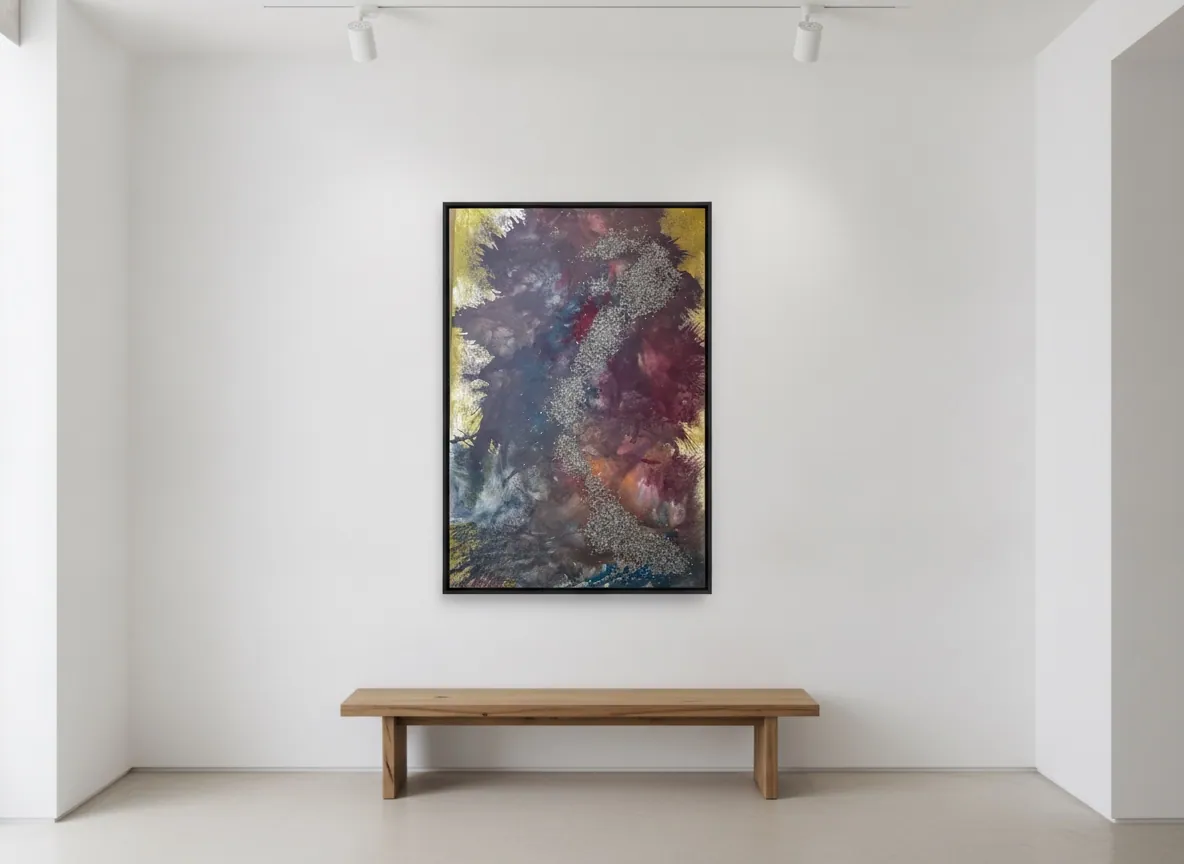
I am also trained as an architect, so I tend to read a wall by its proportions first: how much clear surface there is, where the eye lands when you come around a corner, how much the piece asks of the space. A canvas such as Elemental Veins, from the Terra & Ether series, measures 90 x 140 cm and is vertical, which makes it a natural fit for a tall, narrow stretch of wall: it follows the height of the surface and leaves the walkway free. The surface carries mixed media with acrylic and metallic fragments, so it keeps something to reward a person who passes it every day. When someone is deciding for a corridor, I would rather send detailed photographs and the exact measurements than guess from a single picture.
Frequently asked
What size art works in a narrow hallway?
Size the piece to the clear wall, not to the width of the corridor. Measure between doors, switches and trim, then leave a visible margin on each side. One vertical work of moderate to large size usually reads better than several small ones, which can feel like a repeating border as you walk past.
Vertical or horizontal in a hallway?
Vertical is usually the safer choice. Hallway walls are tall and shallow, and a vertical canvas follows that geometry. A horizontal piece is seen at a very sharp angle by anyone walking along the wall, so it tends to be read in fragments. A horizontal work can still suit a short wall at the end of a hall that is faced head on.
How far should art hang from the floor?
A common starting point is to centre the artwork at about 57 inches (roughly 145 cm) from the floor, the height described as the eye-level standard in most galleries and museums. In an entryway or a high-ceilinged passage you can go a little higher. Always measure to the centre of the piece, not the top edge.
Can a large painting work in a tight corridor?
Yes, if it is shallow and the wall is clear. A large work is only a problem when it projects into the walkway. As a reference, the US Access Board limits wall-mounted objects between 27 and 80 inches above the floor to 4 inches of projection in circulation paths in accessible buildings. A flat canvas hung flush stays well within that kind of limit.
How do I light art in a hallway?
Start with the light you already have and check the work at night as well as by day. Avoid fixtures that project into the corridor line, since depth is scarce. If you want to add light, a slim, wall-flush solution costs the walkway less than a deep picture light. Detailed photographs under similar light can help you judge before buying.
Send us the wall, we will help you choose
Share the clear wall width and height and a photo of the hallway, and we will tell you which works fit its proportions.
Sources
- U.S. Access Board — 2026-10-01
- Shutterfly — 2026-10-01
Published on