Minimalist interiors and abstract art: how much painting is enough
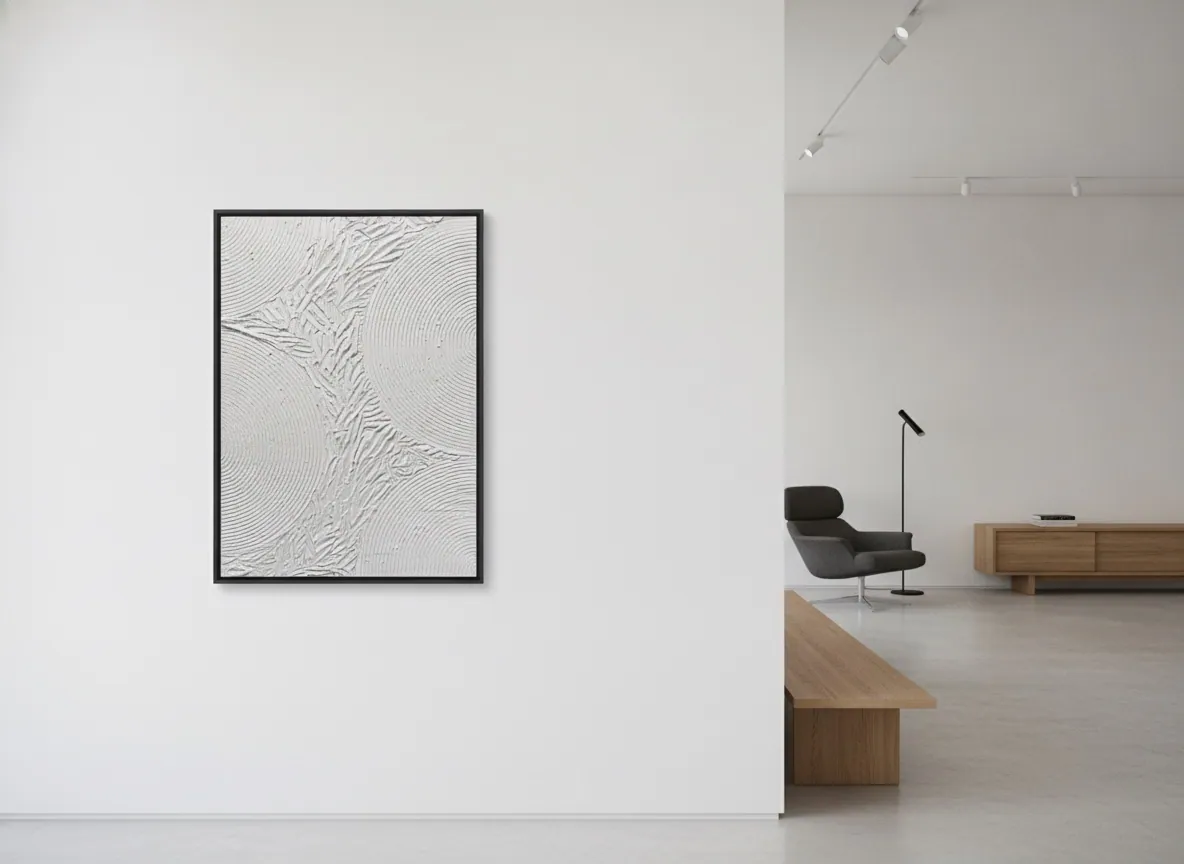
Often one painting per wall is enough, and the empty wall around it is part of the composition. This is a design judgement, not a rule: in a minimalist room, restraint of palette and a visible surface usually matter more than how many works are hung, so one considered original reads calmer than a grouped arrangement.
A minimalist interior is not Minimalism the art movement
The two share a word and a taste for reduction, but they are different things. Tate describes Minimalism as an art movement that developed in the USA in the 1960s: work typically made of simple geometric shapes based on the square and the rectangle, abstract to the point of making no attempt to represent external reality, and concerned with its own material and form. Artists Tate names with the movement include Donald Judd, Carl Andre, Dan Flavin, Frank Stella, Sol LeWitt and Agnes Martin.
A minimalist interior is a way of furnishing and hanging a room with little in it. A painting does not have to belong to the movement to suit such a room, and the works discussed here are not presented as Minimalist art. What they share with a quiet room is narrower and more practical: restraint of palette, and a surface worth looking at.
How much painting is enough: let the wall decide, not the count
There is no fixed number, so treat what follows as a working default rather than a rule. It starts from the wall rather than from the count.
- One work on a wall. The default for a room with little else. A single piece, with clear space on every side, is read as a decision. The empty wall is doing as much of the work as the painting.
- Two works. Reasonable when they share a tone or a surface and hang as a deliberate pair, with the gap between them set on purpose; the guide to spacing paintings on a wall covers that decision.
- Three or more. This stops being restraint and becomes a gallery wall, which is a legitimate choice but a different one, and it needs its own planning.
- Not every wall needs art. In a sparse room, one wall that carries a work and three that stay bare can read as calmer than four walls with one small piece each.
Where the work goes and at what height are separate questions: see how high to hang a painting and what size to hang above a sofa.
Restraint of palette is not the absence of colour
A minimalist room can hold colour. What it cannot hold comfortably is several colours competing at once. Three works from the studio show three ways of staying restrained:
- Echo of Silence (2025, Matter & Silence, sculpted texture on canvas, 50 × 70 cm) has no colour: a white field worked into concentric reliefs and folds.
- Patina Field (2026, Terra & Ether, acrylic on canvas, 100 × 100 cm) is tonal rather than colourless: the studio's description gives vertical panels of slate blue and iron brown beside a single ochre passage that carries the only warm light.
- Silent Interval (2026, Matter & Silence, mixed media with acrylic on canvas, 120 × 160 cm) is one dark gesture and one block of blue on a warm bone-white field: a single colour accent, at a scale for a main wall.
A multi-colour composition such as Prism Garden (2026, Luminous Rebirth, acrylic on canvas, 100 × 100 cm), with lime green, citrine, petroleum blue, orange and magenta, can also live in a plain room. It will be the one loud object in it, which is a fine decision as long as it is a decision.
When there is little else in the room, the surface carries the work
In a full room, a painting is one object among many. In a sparse one, it is often the only thing that asks to be looked at closely, so its surface matters more: whether the paint is thin or built up, matte or glossy, flat or in relief. A relief surface also depends on the light. The National Gallery in London defines raking light as light that strikes a painting from one side at an oblique angle, and notes that it reveals surface texture: raised paint facing the light is lit, while paint facing away casts shadow. So a textured work can read differently as the light on a wall changes. How to place light is covered in the guide to lighting a textured painting. For how relief and shadow work on a pale surface, see white textured abstract art.
Scale is the other half. A small work on a very large empty wall can look lost rather than restrained. Within the Matter & Silence series, the studio's works run from 50 × 70 cm (Echo of Silence) to 120 × 160 cm (Silent Interval), so the same quiet palette is available for a console wall or for the main wall of a room. For the wider logic of size, see the guide to a large abstract painting for a living room.
Original or reproduction in a room with little else
When a room has few objects, the surface of the one work on the wall is most of what there is to see. A reproduction is a flat image of a surface; an original is the surface. Echo of Silence is sculpted texture, with ridges that a printed image cannot carry. Perfeito Studio sells each work as a one-of-one original, with no editions and no reproductions. For the wider difference between the two, see original painting vs decorative print.
From the studio
Why Echo of Silence needs an empty wall
Trained as an architect, I think of a wall as a surface that light crosses, and of the empty part of it as material rather than leftover. Echo of Silence (50 × 70 cm, sculpted texture on canvas, Matter & Silence, 2025) shows why. It is a single white with no colour to offer, only relief in concentric ridges and folds, and the wall around it is what lets that relief be read. Crowd it with neighbours and the ridges compete with them; give it room and the surface is the whole event.
Silent Interval (120 × 160 cm, mixed media with acrylic on canvas, 2026) is the same idea at a larger scale: one dark gesture and one block of blue across a bone-white field, so the amount of quiet wall it asks for is correspondingly large.
Frequently asked
Can a minimalist home have colourful art?
Yes. Restraint concerns how much colour competes, not whether colour is present. A tonal work, or one with a single saturated passage on a pale ground, such as the block of blue on the bone-white field of Silent Interval, sits easily in a plain room. A multi-colour composition is possible too, but it will be the one loud object in the room, so it works best as a deliberate choice with everything around it kept quiet.
How many paintings should a minimalist room hold?
There is no fixed number, so this is a working default: one painting per wall, with clear space around it, and not every wall needs one. Two works can work when they share a tone or a surface and hang as a deliberate pair with the spacing chosen on purpose. Three or more begins to read as a gallery wall, which is a different arrangement with its own planning, not a smaller version of restraint.
What is the difference between buying an original and a print for this?
In a room with little else, the surface of the work is most of what is on view. An original is that surface: Echo of Silence, for example, is sculpted texture on canvas, with relief that a flat reproduction cannot carry. Perfeito Studio sells each work as a one-of-one original, with no editions and no reproductions, signed and catalogued under an Archive ID.
How does Perfeito Studio ship an original painting?
The studio ships anywhere, within Brazil and internationally. Shipping is quoted per destination and paid by the buyer, as are any import duties or taxes in the destination country. Professional packaging is included and transit insurance is available. Domestic delivery takes up to 15 business days depending on destination, and international shipping is quoted on request. Collection in person after purchase is also possible.
What comes with an original from Perfeito Studio?
Every acquisition is direct from the artist and includes the original painting, a signed Certificate of Authenticity with the technical record and the internal Archive ID, a fiscal invoice or official receipt, an Artwork Acquisition Agreement covering transfer of ownership, copyright and image use, an artist dossier, conservation and care guidance, and professional packaging. The certificate carries a QR code linking to the work's official page.
Planning a quiet, sparsely furnished room?
Send a photo of the wall and the direction of the light, and the studio will tell you which of its works suits it.
Sources
- Tate (Art Terms: Minimalism) — 2026-10-09
- The National Gallery, London — 2026-10-09
Published on