Famous Brazilian paintings: eight works held in museum collections
Famous Brazilian paintings include Abaporu, A Negra, Café, Retirantes and Três orixás. This list gathers eight works whose museum records are public, held at MALBA, MAC USP, MASP, the Pinacoteca, MNBA and Tate, so each date and collection can be checked. It is a reading guide, not a ranking.
How these eight were chosen
There is no official list of the most famous Brazilian paintings, and this page does not pretend to make one. The criterion is practical and checkable: each work below sits in a public museum collection that publishes a record for it, with at least a title, a date and the holding museum. Figures and dates follow the holder's own record.
The selection covers the 1920s modernists, the 1930s and 1940s, and two later painters whose work is geometric or abstract. For the painters behind these canvases, see Famous Brazilian painters: who to know and where their work is held; this page follows the paintings themselves.
The modernist canvases: Abaporu, A Negra and Café
Abaporu (1928), Tarsila do Amaral. Oil on canvas, 33.5 x 28.7 in (about 85 x 73 cm), in the collection of MALBA in Buenos Aires. Google Arts & Culture's record for the museum describes a humanoid figure with large feet beside a cactus and a sun, and notes that the title is Tupí-Guaraní for "man who eats man". MALBA's own press release calls it an emblem of Brazilian modernism, says it was donated by the museum's founder Eduardo F. Costantini, and records that it has been in the permanent collection since the museum opened in 2001. The painting inspired Oswald de Andrade's anthropophagic manifesto. More: Abaporu by Tarsila do Amaral, explained.
A Negra (1923), Tarsila do Amaral. Oil on canvas, 100 x 81.3 cm, in the Museu de Arte Contemporânea da USP (MAC USP), São Paulo, inventory 1963.3.391, a donation from the Museu de Arte Moderna de São Paulo.
Café (1935), Candido Portinari. Oil on canvas, 130 x 195.4 cm, held by the Museu Nacional de Belas Artes in Rio de Janeiro, according to the museum's record on Google Arts & Culture, which lists it under entry number 715 in its Brazilian painting collection.
Daily life and popular culture: Cinco moças, Retirantes and Três orixás
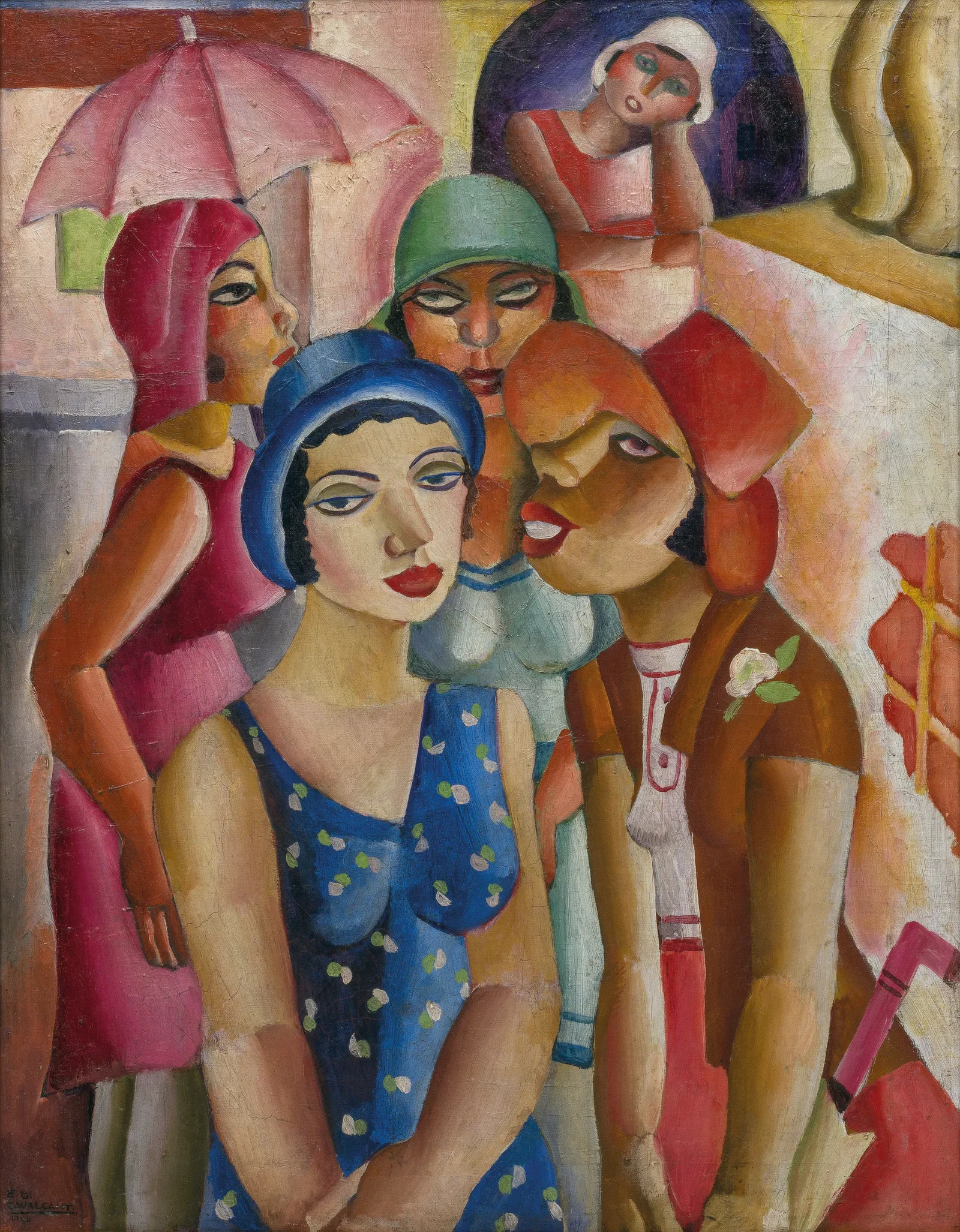
Cinco moças de Guaratinguetá (1930), Di Cavalcanti. Oil on canvas, 90.5 x 70 x 2.5 cm, MASP, inventory MASP.00316, gift of Frederico Barata in 1947. MASP's curatorial texts describe five figures in strongly coloured dress filling the whole canvas, and a 2017 text places it in a group of works made between 1926 and 1930 about urban and popular life.
Retirantes (1944), Candido Portinari. Oil on canvas, 190 x 180 x 2.5 cm, MASP, inventory MASP.00324, donated by Assis Chateaubriand in 1948. It has its own page here: Retirantes by Candido Portinari, explained.
Três orixás (1966), Djanira. Oil on canvas, 130.4 x 195.5 cm, Pinacoteca de São Paulo, purchased by the São Paulo State Government in 1969, per the credit line on Google Arts & Culture.
Geometry and abstraction: Volpi and Tomie Ohtake
Fachada com bandeiras (1959), Alfredo Volpi. Tempera on canvas, 115.5 x 72 x 1.5 cm, MASP, inventory MASP.01237, donated by Ernest Wolf in 1990. MASP's texts describe Volpi as self-taught, a wall painter and decorator before he became an artist, who took up tempera after a 1950 trip to Europe and painted his first bandeirinhas canvases in 1954, works the museum relates to popular festivals and to the abstract work of Brazilian concretists.
Untitled, from the series Blind Paintings (1962), Tomie Ohtake (1913-2015). Tate lists this work in its collection. The title places it in abstract painting.
Where each one is held
Buenos Aires: Abaporu (MALBA). São Paulo: A Negra (MAC USP), Cinco moças, Retirantes and Fachada com bandeiras (MASP), Três orixás (Pinacoteca de São Paulo). Rio de Janeiro: Café (Museu Nacional de Belas Artes). London: Ohtake's Blind Paintings work (Tate).
Museums rotate their displays and lend works, so a painting named here may not be on the wall on the day you visit. Check the holder's own site before planning a trip. For the wider picture, see Brazilian modern art: where to start.
From the studio
From the studio
I do not place my own work beside these paintings; they are history, and what I can offer is a note on procedure. Looking at them, I read the surface first: Di Cavalcanti's faceted planes, Volpi's tempera surfaces, the way an edge falls between two colours.
My own surfaces go the other way. In Golden Passage (Black & Gold, 2025, mixed media, texture paste and imitation gold leaf on canvas, 60 x 80 cm, Archive ID AP-BNG-2025-001), the paste is built up in relief and the gold is placed sparingly. As an architect I also tend to ask what a canvas does to the wall around it, and that question applies equally to a museum painting and a studio one.
Frequently asked
What are the most famous Brazilian paintings?
No institution publishes a single ranking, so any list is a selection. The eight works on this page, Abaporu, A Negra, Café, Cinco moças de Guaratinguetá, Retirantes, Três orixás, Fachada com bandeiras and Tomie Ohtake's Blind Paintings work, are chosen because public museum records document them. Abaporu is described by MALBA itself as an emblem of Brazilian modernism.
Where are they held?
Abaporu is at MALBA in Buenos Aires. A Negra is at MAC USP in São Paulo. Cinco moças de Guaratinguetá, Retirantes and Fachada com bandeiras are at MASP, and Três orixás is at the Pinacoteca de São Paulo. Café is at the Museu Nacional de Belas Artes in Rio de Janeiro, and Ohtake's Blind Paintings work is listed by Tate. Displays change, so confirm with each museum.
Which are by women?
Four of the eight are by women, by three artists: Abaporu and A Negra by Tarsila do Amaral, Três orixás by Djanira, and the Blind Paintings work by Tomie Ohtake. The other four are by Di Cavalcanti, Portinari (two) and Volpi. Anita Malfatti, another key modernist, is covered on her own page in this Journal.
Which are abstract?
Tomie Ohtake's Untitled (from the series Blind Paintings), 1962, is the work on this list closest to abstraction. Volpi's Fachada com bandeiras is figurative in origin, a facade with flags, but MASP relates his bandeirinhas to the abstract work of Brazilian concretists. Abaporu and A Negra are figurative paintings, even where the forms are simplified.
Which should a beginner see first?
There is no single right starting point. If you want the modernist story, begin with Abaporu and read about anthropophagy. If you want to see scale, Retirantes and Café are both large canvases by Portinari. If abstraction interests you, go from Volpi's Fachada com bandeiras to Tomie Ohtake. In each case, start with the museum's own record of the work.
Contemporary Brazilian painting, direct from the studio in Brasília
Each original comes with a signed certificate of authenticity and an Archive ID. Ask about a specific work and the studio will reply on WhatsApp.
Sources
- MALBA — 2026-10-16
- Google Arts & Culture / MALBA — 2026-10-16
- MAC USP — 2026-10-16
- Google Arts & Culture / MNBA — 2026-10-16
- MASP — 2026-10-16
- MASP — 2026-10-16
- Google Arts & Culture / Pinacoteca de São Paulo — 2026-10-16
- MASP — 2026-10-16
- Tate — 2026-10-16
Published on · Updated on