Retirantes by Candido Portinari, explained
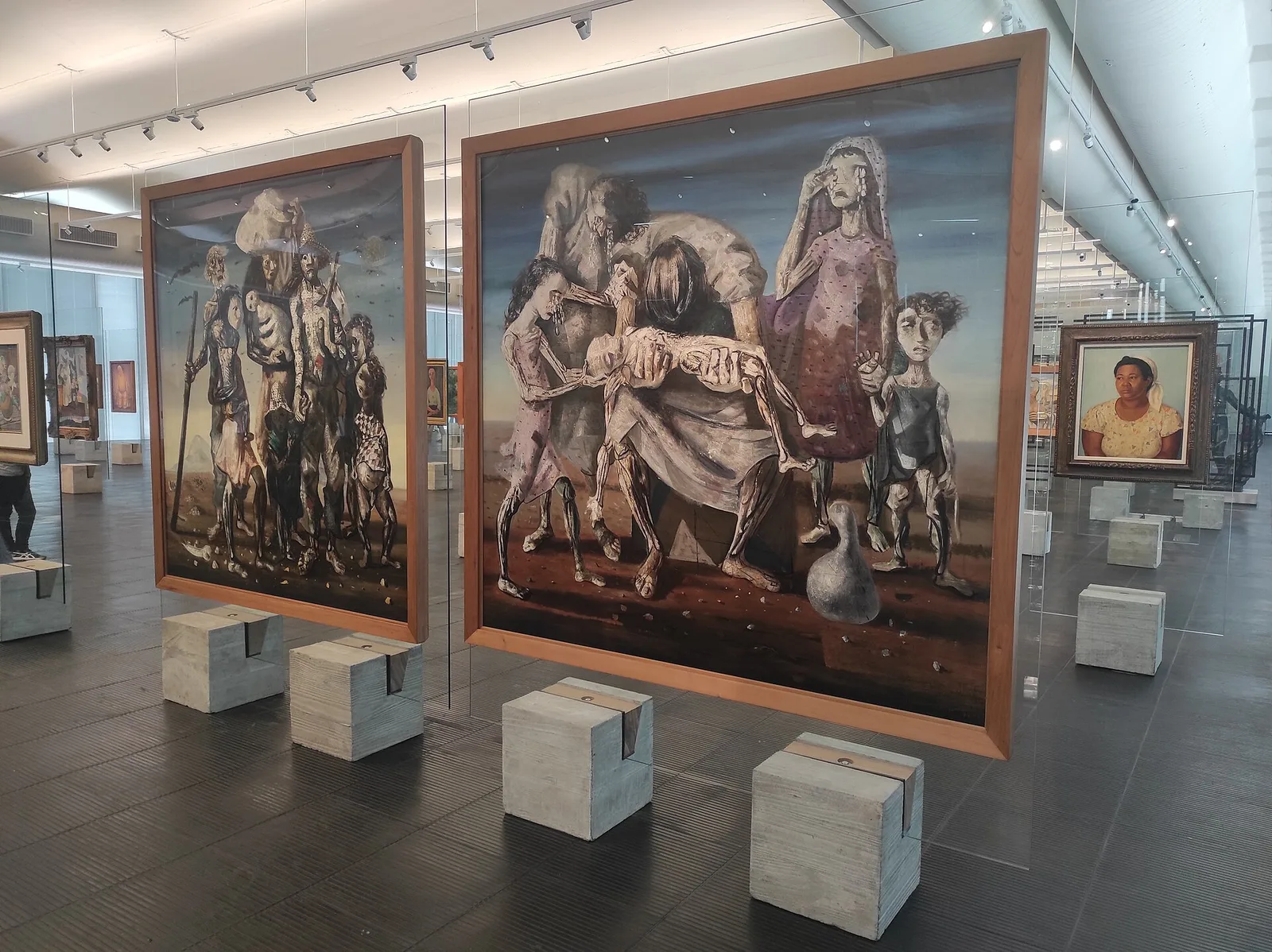
Retirantes (1944) is an oil on canvas by Candido Portinari, 190 x 180 cm, held at MASP in São Paulo. It belongs to a series of the same name on migrants of the drought in Brazil's northeast. A barefoot family walks crowded together, followed by vultures. MASP received it as a gift in 1948.
What the painting is
According to the MASP collection record, Retirantes is dated 1944, oil on canvas, measuring 190 x 180 x 2.5 cm (height by width, as museums list it). The museum acquired it as a gift from Assis Chateaubriand, its founder, in 1948, and it carries the inventory number MASP.00324.
The word retirante refers to a person who leaves the dry interior of the Brazilian northeast, driven by drought. MASP's curatorial text places the canvas in a series of the same name that, in its words, wrote the memory of the suffering of drought migrants into modern art.
What it depicts
The MASP text describes a family of migrants walking barefoot and bunched together, followed by vultures. The adults are weighed down by sacks and by babies, while the face and limbs of the child dressed in green seem to dissolve.
The curators describe a fusion of body and land: faces have the same shape and size as the Moon, and bones and the relief of the bodies resemble stones. The figures seem to lose their humanity and blend into a hard, violent nature, a reading the museum links to Graciliano Ramos's novel Vidas secas (1938).
The series and how it reached MASP
MASP states that the Retirantes series consisted of five paintings, shown in Paris in 1946. Pietro Maria Bardi, then director of MASP, saw them in the artist's studio in 1948 and persuaded Chateaubriand to acquire three for the collection. One version of Criança morta was acquired by the Musée d'Art Moderne de Paris, the museum says.
Where it sits in Portinari's work
MASP's text also names Portinari as the author of the War and Peace panels (1952–1956) at the United Nations headquarters in New York, and of the panels for the Ministry of Education and Public Health building in Rio de Janeiro (1936–1938). It says his work synthesises the contrasts of Brazilian culture: he portrayed the dominant elite and also the working class.
For a fuller biography, see Who was Candido Portinari?. For a wider orientation, famous Brazilian painters and where their work is held and Brazilian modern art: where to start set out the context. Confirm with MASP whether the work is on display before you plan a visit.
From the studio
From the studio
Portinari worked from the human figure and from a specific social subject. I paint without figures, and I will not set the two practices side by side. What I can describe is procedure: building a surface in layers, then deciding how much the colour is allowed to carry.
In Fire of Devotion, from the Heart of Chaos series, a saturated crimson field runs across the canvas, with flecks of gold and copper and diagonal white streaks. It is acrylic on canvas, 100 x 150 cm, made in 2026. The work is original and unique, and its page carries the full technical record and the price in BRL.
Frequently asked
What is Retirantes by Portinari?
Retirantes is a 1944 oil painting by the Brazilian artist Candido Portinari, 190 x 180 cm, in the collection of MASP in São Paulo. It belongs to a series of the same name about migrants fleeing drought in the northeast of Brazil. MASP received it as a gift from Assis Chateaubriand in 1948.
What does it depict?
According to MASP, it shows a family of migrants walking barefoot and crowded together, followed by vultures. Sacks and babies weigh on the adults, and the child dressed in green seems to dissolve. Faces resemble the Moon in shape and size, and bones resemble stones, so the people blend into the landscape.
Where is Retirantes kept?
It is held by the Museu de Arte de São Paulo (MASP), under inventory number MASP.00324. Displays change, so check with the museum before planning a visit to see it.
How does it relate to Portinari's social themes?
MASP says Portinari's work synthesises the contrasts of Brazilian culture: he painted the dominant elite and also the working class, in a style with echoes in modern Latin American art. MASP places Retirantes in a series that, in its words, inscribed the memory of drought migrants' suffering in modern art.
What other Portinari works should I see?
MASP names the War and Peace panels (1952–1956) at the United Nations in New York and the panels for the Ministry of Education and Public Health building in Rio de Janeiro (1936–1938). Our biography page also covers Café (1935) and where his works are held.
See Fire of Devotion, from the Heart of Chaos series
One original, one signature. Write to the studio for detail photos, dimensions on your wall and acquisition details.
Sources
- Museu de Arte de São Paulo (MASP) — 2026-10-15
- Wikimedia Commons (Pribruder) — 2026-10-15
- Perfeito Studio (obras.json) — 2026-10-15
Published on