What counts as Latin American art? Geography, language and the auction-house definition
Latin American art has no single definition. Geographically it means art from Mexico, Central America, the Caribbean and South America. By language, Brazil is included, while Spanish-only categories such as “Hispanic” leave it out. Auction houses and museums apply a third, institutional boundary, so the line moves with who is drawing it.
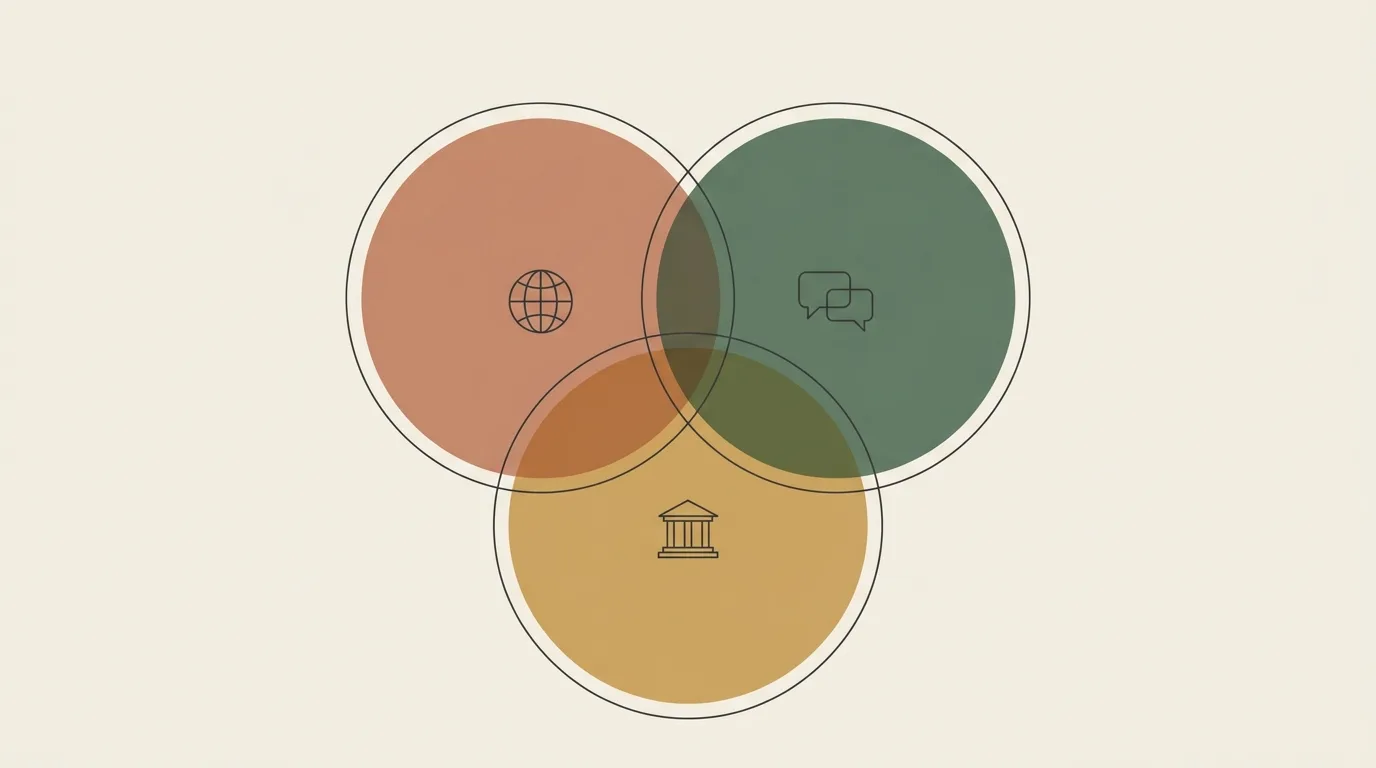
Definition one: geography
The broadest reading is territorial. Wikipedia's article on the subject describes Latin American art as the combined artistic expression of Mexico, Central America, the Caribbean and South America, and says it also takes in Latin Americans living in other regions. On this reading, Brazil is simply part of the map.
The geographic reading is the easiest to state and the hardest to apply cleanly, because the region itself has soft edges. Where the Caribbean begins and ends, and which islands count, depends on a second criterion: language.
Definition two: language and colonial history
“Latin America” is usually defined by language rather than by latitude. Wikipedia describes it as the cultural region of the Americas where Romance languages are predominantly spoken, primarily Spanish and Portuguese. Under the broader version of that definition, countries where French predominates, such as Haiti, are added as well. The same article notes that English- and Dutch-speaking nations such as Jamaica and Suriname are generally not considered Latin American because they speak Germanic languages.
This is why Brazil is in: it is a Portuguese-speaking country, and the article states that Latin America comprises Hispanic America along with Brazil. It is also why the Caribbean answer is “some of it”, and why the label sits differently from “Hispanic”. Wikipedia's article on that word says it refers to Spanish speakers overall and can include Spain, and that it is void of any self-identification in Brazil. In short, Latin American includes Brazil; Hispanic generally does not.
Definition three: the institutional category
The third boundary is drawn by the institutions that buy, sell and show the work. Sotheby's presents Latin American art as a collecting category of its own, describes it as one of the most dynamic and globally relevant collecting categories, and lists its regional team across New York, Mexico City, Rio de Janeiro, Buenos Aires and Caracas. The department page we reviewed does not state country or period criteria; it shows where the specialists sit, including Rio de Janeiro.
Museums make the same kind of choice in their own words. LACMA's 2013 press release on its reinstalled galleries describes a collection that ranges from ancient and Spanish colonial to modern and contemporary art, and notes that its department was established in 2006. These are working categories built for cataloguing and for sales. They are shaped by how collections were assembled and how the market organises itself, so they are practical rather than natural.
Why the label is contested
None of this means the label is settled. Wikipedia attributes the coining of “Latin America” to a Chilean politician in 1856, while noting that later historians found earlier uses. A glossary of the field published in Periódico Permanente by Fórum Permanente calls Latin America “a continent of moving boundaries” and, in technical terms a geographic subcontinent, treats it as “a cultural continent”. Its author also admits that the glossary's entry on Brazil “somehow hides the country”, a reminder that a regional label can flatten differences that matter inside it.
For a reader, the useful position is neither to defend the label nor to reject it. It is to know which of the three definitions a given gallery, auction page or museum is using.
What this means for a buyer
The label tells you where a work sits in a category used by auction houses and museums. It does not tell you about an artist's technique, period or quality, and it says nothing about price. Two works catalogued under the same heading can have little in common. A more useful set of questions is specific: who made the work, when, in what medium, with what documentation. For a method of looking at younger artists from the region, see how to discover emerging Latin American artists, and for how Brazilian work is held abroad, Brazilian art in museum collections outside Brazil.
From the studio
From the studio
At the studio, the label rarely changes how a work is made. We work from the surface: layers, texture, mineral pigment. Take Echo of Silence, from the Matter & Silence series, a 2025 work in sculpted texture on canvas, priced at R$ 2,400. Its concentric reliefs and folds are a matter of material and light more than of region.
A buyer weighing a Brazilian work against a larger category can ask a practical question: what does the work itself and its documentation show? Each painting is unique and is acquired directly from the artist, with a certificate and Archive ID. You can see the full set of original paintings in the gallery.
Frequently asked
Is Brazil part of Latin American art?
Yes, under the usual definitions. Latin America is commonly defined as the part of the Americas where Romance languages, mainly Spanish and Portuguese, are predominantly spoken, and Brazil is its Portuguese-speaking country. Sotheby's, for example, lists a specialist based in Rio de Janeiro. What Brazil is not, in general, is Hispanic, since that word refers to Spanish speakers.
Does Latin American art include Caribbean and diaspora artists?
Often, but it depends on who is drawing the line. A geographic definition names the Caribbean and also includes Latin Americans living in other regions. A language-based definition includes Spanish-, Portuguese- and, in its broader form, French-speaking Caribbean places, while English- and Dutch-speaking nations such as Jamaica and Suriname are generally left out. Always check which definition a gallery or sale is using.
Why do auction houses group these artists in one category?
Mostly for practical reasons of cataloguing and selling. A single department lets a house bring together specialists, collectors and sales calendars. Sotheby's, for instance, lists a regional team across several cities in the Americas. Such a category is a working tool, and the criteria are not always spelled out, so it should not be read as a statement about shared style.
Is 'Latin American art' a useful label for a buyer?
Partly. It helps you find where a work is discussed and sold, and it connects you to the specialists who know the field. It tells you little about an individual work's medium, period, quality or price. For a purchase, the specific facts matter more: artist, year, materials, condition, documentation and how the work was acquired.
How is it different from 'Hispanic art'?
Hispanic refers to Spanish speakers and can include Spain, while Latin American is defined by region and by Romance languages, which brings in Portuguese-speaking Brazil. Hispanic is reported to carry no self-identification in Brazil. The two terms overlap in Spanish-speaking Latin America but are not interchangeable.
Questions about a specific work?
Every painting is unique and comes with a signed certificate of authenticity. Write to the studio for detail photographs or to discuss a work.
Sources
- Wikipedia — 2026-10-17
- Wikipedia — 2026-10-17
- Wikipedia — 2026-10-17
- Sotheby's — 2026-10-17
- Los Angeles County Museum of Art — 2026-10-17
- Fórum Permanente, Periódico Permanente 9 — 2026-10-17
- Perfeito Studio (src/data/obras.json) — 2026-10-17
Published on