Abstract art for a kitchen: what survives steam, grease and daily use
An original abstract painting can work in a kitchen if the wall is chosen for stability, not for looks alone. Conservation guidance asks for a steady 40 to 60% relative humidity, warns above 70 to 75%, and advises against locations with large swings in temperature and humidity. Pick the wall furthest from the cooktop, sink and steam.
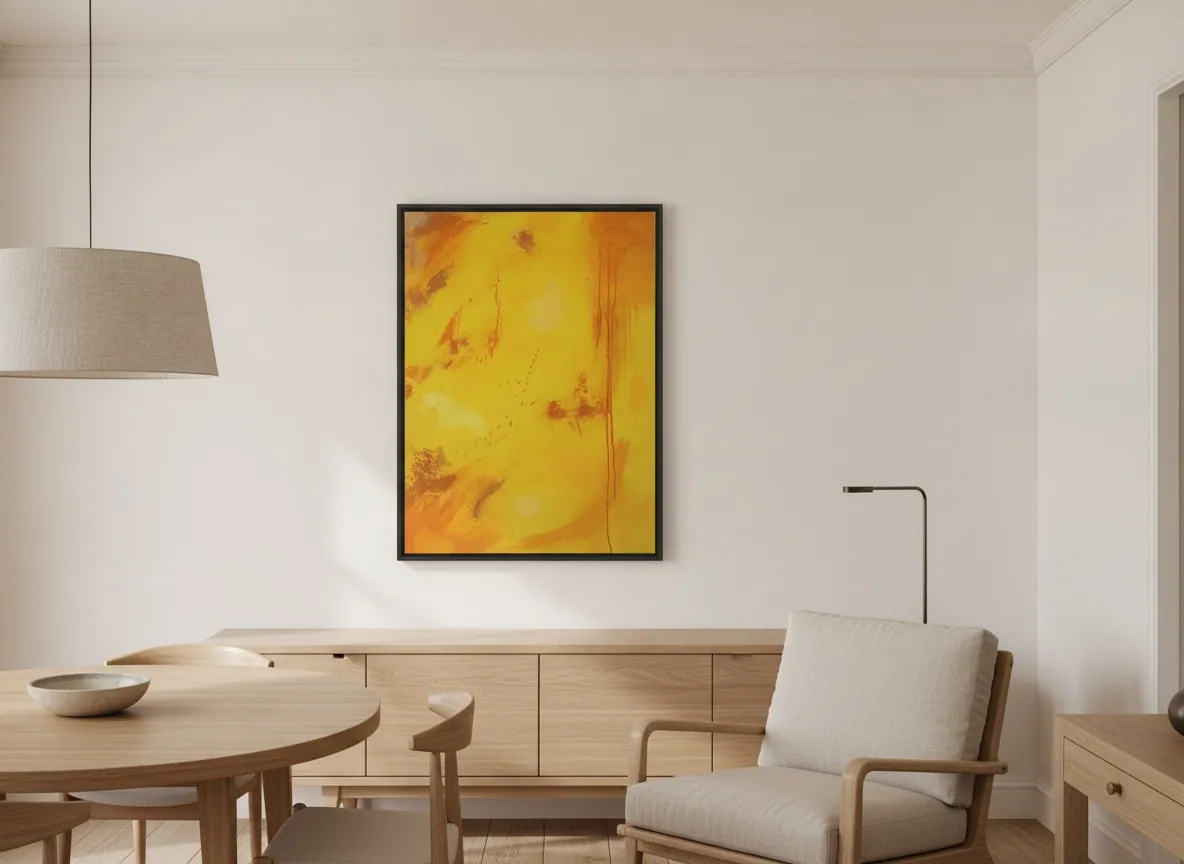
A kitchen is a climate, not a room type
The word covers a closed galley with a gas hob and an open kitchen that shares air with a dining table. What a painting meets is the same in both: moisture, heat and airborne particles, arriving in bursts every time something is boiled, fried or baked.
For large abstract kitchen art, that makes the first decision about the wall, not the picture. A work in an open plan, on the far side of a table from the cooktop, lives in a different room than one hung beside the extractor hood, even though both are called kitchen walls.
Steam and humidity: the numbers conservators use
The Canadian Conservation Institute (CCI) states that "the safest RH for paintings on canvas or wood is a stable level between 40 and 60%," with a recommended set point of 16 to 25°C. It adds that artworks are susceptible to fungal infestation when humidity exceeds 70 to 75% RH. The Western Australian Museum's collections care manual is narrower, giving 45 to 55% with maximum fluctuations of 5% in any 24-hour period.
Those sources do not publish a kitchen-specific figure, so this page does not give one. What they do establish is that the target is stability, not a particular number: large swings in humidity and temperature are what to avoid.
Heat and fireplaces: why the cooktop wall is the wrong wall
The Western Australian manual advises choosing "a location that is not prone to large variations in temperature and relative humidity," and warns against hanging a painting above a fireplace because of higher temperatures, lower relative humidity and possible smoke damage. A cooktop is not a fireplace, and no source we found measures a kitchen wall, so the following is our reading of the principle, not a measured rule: the wall behind and beside the cooking zone is the likeliest to see the largest swings, and the wall across the room is the safer candidate.
CCI also notes that paintings kept within the human comfort zone are not at risk from temperature-related problems. A wall where the cook is comfortable is therefore a reasonable test.
Grease, cleaning and airborne particles
CCI's guidance on pollutants says that "fine particles are particularly damaging, because they discolour or soil surfaces," and it singles out cooking, in a museum cafeteria, as one of the unusual particle sources. Its examples of contact pollutants include fatty acids from greasy objects. Cooking aerosol is not tested on the Perfeito Studio canvases, and we make no claim that any work is safe near a stove.
One practical point follows from the sources. The Western Australian manual cautions: "Do not use aerosols and spray cleaners near exposed paintings," because the solvent propellants can soften and damage paint surfaces. Whether that applies to a degreaser sprayed elsewhere in the same room is our inference, not something the manual states, so keep sprays well away from the work.
Choosing the wall and the work
Using the points above, a short checklist for an open kitchen:
- Choose the wall furthest from the cooktop, the sink and the dishwasher outlet.
- Avoid the wall behind the range hood, which sits closest to the heat and moisture of cooking (our reading of the principle above).
- Keep it clear of direct sun as well; light is a separate risk, covered in how to protect a painting from sunlight and fading.
- Size for the wall you have: a large vertical work on a clear dining-side wall reads better than a small one lost among cabinets. Hanging height follows the same rules as in any room.
Among the works in the catalogue, Solar Rain (acrylic on canvas, 70 × 110 cm) and Vegetal Dawn (acrylic on canvas, 80 × 120 cm) are vertical formats sized for a single clear wall. For humid rooms in general, see the guides on bathrooms and spas.
For a room that shares air with the dining area, see abstract art for an open-plan living space, or see all available works.
From the studio
From the atelier
I trained as an architect, and I read a kitchen the way I read a plan: where the heat is, where the air leaves, and which wall is quiet. Before asking whether a painting suits a kitchen, I would ask which wall of that kitchen is the quiet one.
Solar Rain, from the Luminous Rebirth series, is catalogued as acrylic on canvas, 70 × 110 cm, with a saturated yellow field crossed by red and copper streams. I do not present it, or any work in the catalogue, as made for a kitchen. Its technical record states the materials, and anyone weighing a specific wall is welcome to ask about that work before deciding.
Frequently asked
Can you hang an original painting in a kitchen?
It depends on the kitchen and the wall. Conservation guidance asks for a stable relative humidity of 40 to 60% for canvas and warns above 70 to 75%, and it advises against locations with large swings in temperature and humidity. A wall away from the cooktop and sink in a well-ventilated or open kitchen is closer to those conditions than the cooking wall. Perfeito Studio does not claim any of its works is safe near a stove.
What is the best wall for art in an open kitchen?
In our reading of the conservation sources, the best wall is the one furthest from the cooktop, sink and steam, often the dining or living side of an open plan. Avoid the wall behind the hood, and keep the work out of direct sun. The sources do not give a fixed distance, so we do not invent one.
What is the difference between buying an original and a print for this?
An original is a single, unique object, and Perfeito Studio sells originals only. Each comes with a signed Certificate of Authenticity and the technical record, so what it is made of is documented. That matters in a kitchen because the materials decide how the work should be cared for. For the specific materials of a work, ask the studio before choosing the wall.
How does Perfeito Studio ship an original painting?
The studio ships within Brazil and internationally. Shipping is quoted per destination and paid by the buyer, as are any import duties or taxes in the destination country. Professional packaging is included and transit insurance is available. Domestic delivery takes up to 15 business days depending on destination, and international shipping is quoted on request.
What comes with an original from Perfeito Studio?
Every acquisition is direct from the artist and includes the original painting, a signed Certificate of Authenticity with the technical record and Archive ID, a fiscal invoice or official receipt, an Artwork Acquisition Agreement, an artist dossier, conservation and care guidance, and professional packaging. The certificate carries a QR code linking to the work's official page.
Planning a work for a kitchen wall?
Tell the studio which wall you have in mind and ask about the materials and technical record of a specific painting.
Sources
Published on